

1974 – 2024 “SEMPER IDEM”
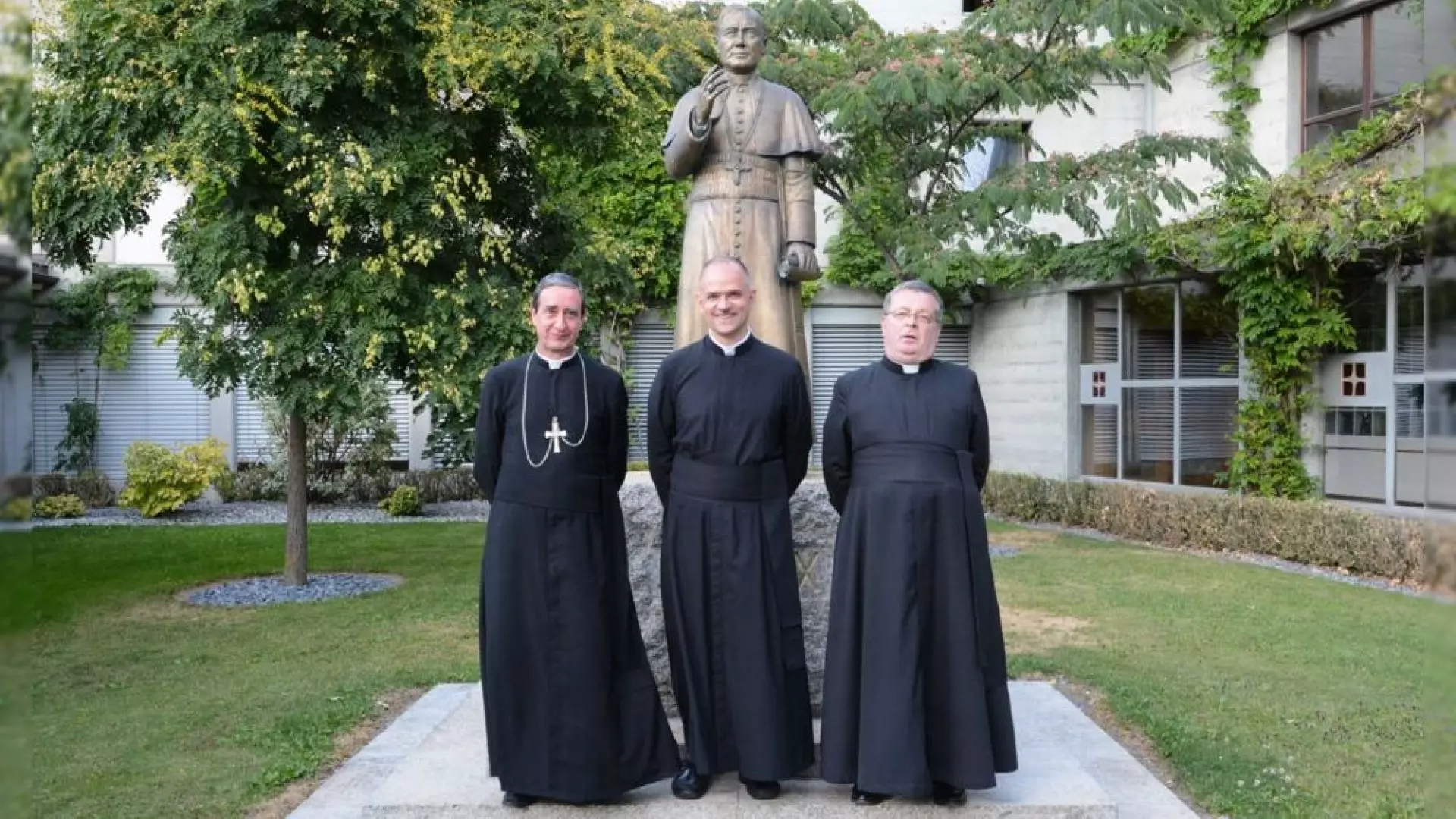
Message from the Superior General and his assistants on the occasion of the fiftieth anniversary of the Declaration of 21st November 1974.
Fifty years ago, His Grace, Archbishop Marcel Lefebvre, published a memorable declaration that was to become the charter of the Priestly Society of Saint Pius X. A true profession of faith with eternal resonance, this declaration expresses the essence of the Society, its raison d’être, its doctrinal and moral identity, and consequently its line of action. The Society cannot deviate one iota from its content and spirit which, fifty years later, remain perfectly appropriate to the present day.
This declaration contains two absolutely central ideas, which mutually complement and support each other. The first affirms the essentially doctrinal nature of the Society’s battle. The second expresses the purpose for which it is waged.
It is a doctrinal battle, against a clearly identified enemy: the reforms of the Council, presented as a poisoned entity, conceived in error and leading to error. It is its fundamental spirit that is called into question, and consequently everything that this spirit produced: “This Reformation, stemming from Liberalism and Modernism, is poisoned through and through; it derives from heresy and ends in heresy, even if all its acts are not formally heretical. It is therefore impossible for any conscientious and faithful Catholic to espouse this Reformation or to submit to it in any way whatsoever. The only attitude of faithfulness to the Church and Catholic doctrine, in view of our salvation, is a categorical refusal to accept this Reformation.”
The events of the last fifty years have only confirmed the pertinence of this analysis. Since the Reformation was corrupt in itself, and in its principles, it seems impossible to restore anything in the Catholic Church without first challenging the very principles of the Council, and rejecting all the errors contained therein. All those who have tried to maintain both Tradition and the Vatican II reforms, trying to marry them or to enrich them mutually, have inevitably failed. At the same time, contempt and hatred for Tradition and the Tridentine Mass have continued to grow, demonstrating in a concrete way that two incompatible doctrines correspond to two irreconcilable forms of worship, and two irreducible ways of conceiving the Catholic Church and her mission towards souls.
Begun at the Council, this Reformation is still underway and continues to produce its fruits. Today, through synodality, we are witnessing the complete reversal of the very structure of the Church. The transmission of the Divine Truths, received from the Incarnate Word, is being replaced by a system, of man’s elaboration, in which God Himself no longer has a place, and in which the spirit of man breathes and no longer the spirit of the Holy Ghost. This is a diabolical reversal of the Gospel itself.
Faced with this clearly denounced demolition of the Church, Archbishop Lefebvre encourages us to continue the doctrinal battle, and therefore to fight in a holy way for the reign of Our Lord Jesus Christ, who is the Way, the Truth and the Life. Today, as in the past, our mission is none other than the restoration of all things in Christ. Restoring all things – starting with the Catholic priesthood, in all its doctrinal purity, and in all its missionary charity. Restoring also the Holy Sacrifice of the Mass, which is the very heart of the Church’s life. Restoring true Catholic life, which is none other than the very life of Jesus Christ, marked by the spirit of the Cross, for the love and the glory of His Father. Restoring Catholic Truth, in giving it back its splendour and allowing it to illuminate the world. Restoring, finally, within the Church and within civil society, the recognition of the rights of Christ, King of all nations.
“Jesus Christ, yesterday, and today; and the same for ever. Be not led away with various and strange doctrines. For it is best that the heart be established with grace” (Heb. 13:8-9).
The second idea that dominates the 1974 declaration is the clear and determined intention to act with the sole aim of serving the Roman Catholic Church.
It is only in the Catholic Church as it has always been, and in her unchanging Tradition, that we have the guarantee of possessing the Truth, of being able to preach it, and of being able to serve her.
Above all, we are well aware that safeguarding Tradition, and taking all the necessary steps to preserve it and to transmit it, is a duty of charity that we fulfil for the benefit of all souls, and for the Catholic Church herself as a whole. From this perspective, our combat is profoundly disinterested. The Society is not primarily seeking its own survival. It is primarily seeking the good of the Universal Church and, for this reason, the Society is par excellence a work of the Church, which, with unique freedom and strength, responds adequately to the specific needs of an unprecedentedly tragic era.
This single goal is still ours today, just as it was fifty years ago. “That is why, without any spirit of rebellion, bitterness or resentment, we pursue our work of forming priests, with the timeless Magisterium as our guide. We are persuaded that we can render no greater service to the Holy Catholic Church, to the Sovereign Pontiff and to posterity.”
It is to the Catholic Church that Tradition belongs. It is in her and for her that we guard it in all its integrity, “until such time as the true light of Tradition dispelsthe darkness obscuring the sky of Eternal Rome”. We maintain this supernatural and unfaltering certainty that this same Tradition will triumph, and with it the whole Catholic Church – as well as the renewed certainty that the gates of hell will never prevail against her!
Menzingen, 21st November 2024
Davide Pagliarani, Superior General
† Alfonso de Galarreta, Christian Bouchacourt — 1st General Assistant 2nd General Assistant
Related article:1974 Declaration of Archbishop Lefebvre
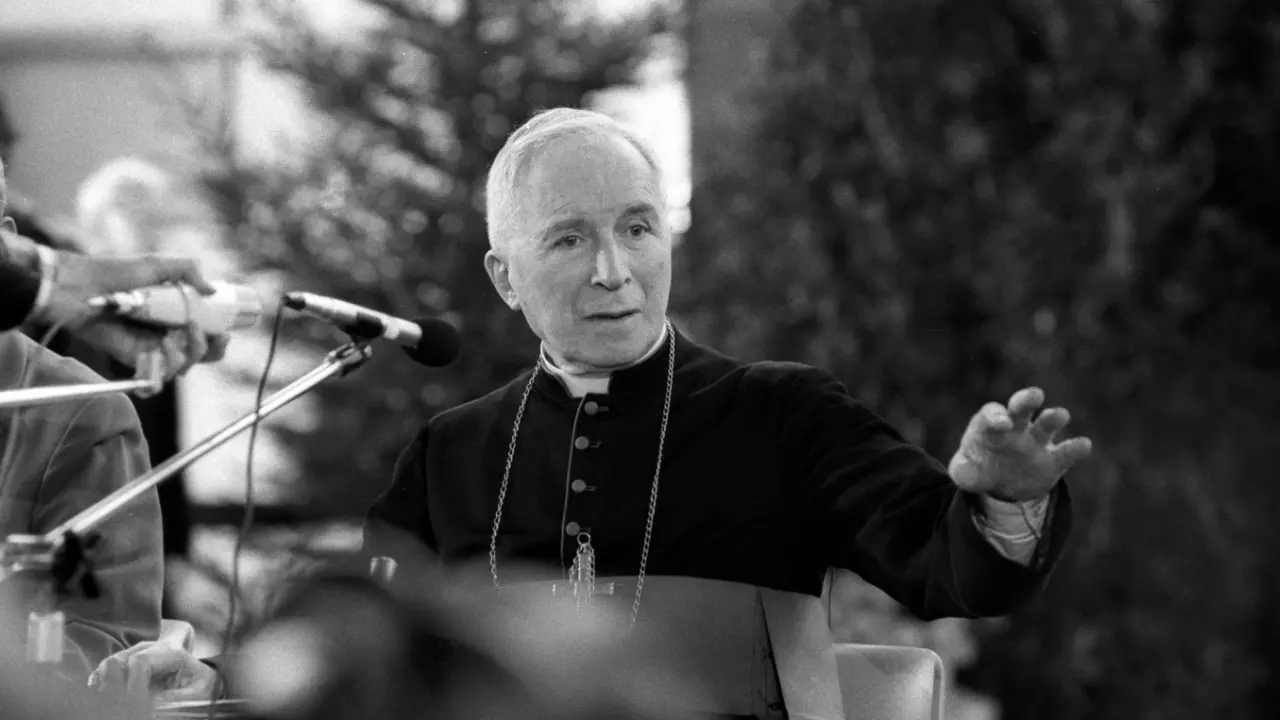
The famous "1974 Declaration" of Archbishop Lefebvre was an affirmation of the Catholic Faith in response to the Modernist crisis afflicting the post-conciliar Church.
On November 21, 1974 Archbishop Lefebvre, scandalized by the opinions expressed by the two Apostolic Visitors, drew up for his seminarians "in a spirit of indignation" this famous declaration as his stand against Modernism.
Ten days before, two Apostolic Visitors from Rome arrived at the St. Pius X Seminary in Econe. During their brief stay, they spoke to the seminarians and professors, maintaining scandalous opinions such as, the ordination of married men will soon be a normal thing, truth changes with the times, and the traditional conception of the Resurrection of Our Lord is open to discussion.
We hold fast, with all our heart and with all our soul, to Catholic Rome, Guardian of the Catholic Faith and of the traditions necessary to preserve this faith, to Eternal Rome, Mistress of wisdom and truth.
We refuse, on the other hand, and have always refused to follow the Rome of neo-Modernist and neo-Protestant tendencies which were clearly evident in the Second Vatican Council and, after the Council, in all the reforms which derived from it.
All these reforms, indeed, have contributed and are still contributing to the destruction of the Church, to the ruin of the priesthood, to the abolition of the Sacrifice of the Mass and of the sacraments, to the disappearance of religious life, to a naturalist and Teilhardian teaching in universities, seminaries and catechectics; a teaching derived from Liberalism and Protestantism, many times condemned by the solemn Magisterium of the Church.
No authority, not even the highest in the hierarchy, can force us to abandon or diminish our Catholic Faith, so clearly expressed and professed by the Church’s Magisterium for nineteen centuries.
“But though WE,” says St. Paul, “or an angel from heaven preach a gospel to you besides that which we have preached to you, let him be anathema” (Gal. 1:8).
Is it not this that the Holy Father is repeating to us today? And if we can discern a certain contradiction in his words and deeds, as well as in those of the dicasteries, well we choose what was always taught and we turn a deaf ear to the novelties destroying the Church.
It is impossible to modify profoundly the lex orandi without modifying the lex credendi. Corresponding with a new mass we have a new catechism, a new priesthood, new seminaries, a charismatic Pentecostal Church — all things opposed to orthodoxy and the perennial teaching of the Church.
This Reformation, stemming from Liberalism and Modernism, is poisoned through and through; it derives from heresy and ends in heresy, even if all its acts are not formally heretical. It is therefore impossible for any conscientious and faithful Catholic to espouse this Reformation or to submit to it in any way whatsoever.
The only attitude of faithfulness to the Church and Catholic doctrine, in view of our salvation, is a categorical refusal to accept this Reformation.
That is why, without any spirit of rebellion, bitterness or resentment, we pursue our work of forming priests, with the timeless Magisterium as our guide. We are persuaded that we can render no greater service to the Holy Catholic Church, to the Sovereign Pontiff and to posterity.
That is why we hold fast to all that has been believed and practiced in the faith, morals, liturgy, teaching of the catechism, formation of the priest and institution of the Church, by the Church of all time; to all these things as codified in those books which appeared before the Modernist influence of the Council. This we shall do until such time as the true light of Tradition dispelsthe darkness obscuring the sky of Eternal Rome.
By doing this, with the grace of God and the help of the Blessed Virgin Mary, and that of St. Joseph and St. Pius X, we are assured of remaining faithful to the Roman Catholic Church and to all the successors of Peter, and of being the fideles dispensatores mysteriorum Domini Nostri Jesu Christi in Spiritu Sancto. Amen.
+ Marcel Lefebvre
Albano, on the Feast of the Presentation of the Blessed Virgin Mary