

Pope Saint Pius X
(Giuseppe Melchiorre Sarto)

- 2 Jun 1835 — Born at Riese, diocese of Treviso, Venice, Austria (now Italy) as Giuseppe Melchiorre Sarto
- 27 Feb 1858 (age 22) — Ordained Deacon Deacon of Treviso, Italy
- 18 Sep 1858 (age 23) — Ordained Priest Priest of Treviso, Italy
- 10 Nov 1884 (age 49) — Appointed Bishop of Mantova, Italy
- 16 Nov 1884 (age 49) — Ordained Bishop Bishop of Mantova, Italy
- 12 Jun 1893 (age 58) — Elevated to Cardinal
- 15 Jun 1893 (age 58) — Appointed Patriarch of Venezia, Italy
- 15 Jun 1893 (age 58) — Appointed Cardinal-Priest of San Bernardo alle Terme
- 4 Aug 1903 (age 68) — Elected Pope (Roma, Italy)
- 9 Aug 1903 (age 68) — Installed Pope (Roma, Italy)
- 13 Mar 1904 (age 68) — Resigned Patriarch of Venezia, Italy
- 20 Aug 1914 (age 79) — Died at Vatican City from natural causes aggravated by worries over the beginning of World War I; buried under the altar of the chapel of the Presentation, Saint Peter’s basilica (Roma, Italy)
- 3 Sep 1950 — Venerated by Pope Pius XII
- 3 Jun 1951 — Beatified by Pope Pius XII
- 29 May 1954 — Canonized by Pope Pius XII
On May 29, 1954, more than 70 years ago, Pope Pius XII canonized Pope Pius X in front of an innumerable crowd. Everyone saw this canonization as extraordinary, since one would have to go back to 1712 – the year in which Clement XI entered Pius V into the canon of saints (the pope of the Rosary, of Lepanto, and of the Mass) – to see the figure of a sovereign pontiff honoured in such a way.
Through St. Pius X, who reigned from 1903 to 1914, Pius XII wanted to give an example to the entire Church of the sanctity of a pope, a “papal holiness” [1] able to guide the sheep in difficult times. In the beatification brief (June 3, 1951), Pius XII enumerated the principal traits worthy of attracting the attention and admiration of the crowds:
1) Concern for the holiness of the clergy, the key to renewing all things in Christ, according to his sublime motto [2]. Pius X wanted a clergy who were distinguished by their piety, their obedience, and their knowledge.
2) The renewal of ecclesiastical studies. Pius X exhorted Christian philosophers to defend the truth under the banner of St. Thomas Aquinas. He founded the Pontifical Biblical Institute in Rome, encouraging theological sciences, inspired exegesis, and carefully prepared preaching on the part of the clergy.
3) Concern for the eternal salvation of souls. While Pius X wanted a holy clergy, it was with the idea of the instruction of the faithful that he gave a catechism, made for adults as well as children. Regarding children, he will forever remain the pope of the Eucharist, favoring early communion, but also – and for all – frequent and even daily communion.
4) The defense of the Faith in its fullness and purity. The false teachings that represented all the errors were unmasked under the label of Modernism, and wisely repressed (Pascendi, September 8, 1907). In these circumstances, as in his fight against anticlerical laws and the secularist separation of Church and State, St. Pius X was, in the words of the Angelic Pastor, an “infallible teacher of the faith,” the “intrepid avenger of religion” and the “guardian of the freedom of the Church.”
5) Love of the liturgy. Initiator of an authentic liturgical movement, Pius X renewed sacred music, as well as the Breviary, the calendar of feast days in a way to orient “the Church resolutely towards a liturgical life that is thoroughly imbued with traditional piety, sacramental grace, and inspired beauty” [3].
These are the main features of the sanctity of Pius X and the holiness of a period of governance totally penetrated with the grandeurs and supernatural riches that are the treasure of the Church. Pius XII also evokes the reforming work accomplished in the Roman Curia, in schools and parishes, and the formidable work of bringing together into a single corpus the hitherto dispersed laws of the Church (the Code of Canon Law, promulgated in 1917). There is also the attention Pius X paid to evangelization in the missions and also his appeals for unity to the “separated Oriental Christians.”
Pius XII canonized this pontifical holiness for a very specific purpose: in order to “dispose minds to confront our own struggles and to ensure our victories and those of future generations” [4]. Proclaimed “saint and guide of the men of today,” “apostle of the interior life,” St. Pius X is given as an “providential example for the modern world in which worldly society, becomes always more of an type of enigma to itself, anxiously seeking a solution to restore a soul! Let it therefore take as a model the Church gathered around her altars” [5]. Because this pope “aroused everywhere an immense movement of return to the splendors of the liturgy and sacred music, and banished ugliness from the holy temple of God” [6].
He organized Catholic Action on a sound basis and promoted the social and professional activities of Catholics within a confessional framework. For people and all men of good will, so that they find access to Jesus Christ in the Church. This was his first concern, Pius XII explains, because God “is the origin and foundation of all order, of all justice, of all right in the world. Where God is, order, justice and law reign.” Hence the great project of the pontificate of Saint Pius X to organize the law of the Church. Hence again the primacy of faith and sound doctrine which was “the ultimate service of charity, rendered by a Saint, as Head of the Church, to all humanity” [7].
Finally, for the enemies of the Church, this canonization was performed so that they may know the intrepidity and the strength that only God can give to his Vicar on earth and, through him, to His children spread throughout the world. Emblematic was the courage with which Pius X rejected the laws separating Church and State; he “gave France, cruelly persecuted, new bishops, and resisted the attacks of the wicked” [8]. 70 years ago, this what Pius XII showed as an example to the world: the very papal holiness of a worthy and true successor of Peter. He had accepted the honor of the supreme pontificate “like a cross” – accepto in crucem. He carried it out like a saint.
- Expression of Fr. V.-A. Berto, in an article published in La Pensée Catholique, 1951, n°19, p. 27 and included in the collection For the Holy Roman Church, Editions du Cèdre, 1976, p. 95.
- “Omnia instaurare in Christo” [to restore all things in Christ]; phrase of St. Paul (Eph 1, 10) taken up as the motto of the pontificate in St. Pius X’s first encyclical, E supremi apostolatus, October 4, 1903.
- O. Rousseau, History of the liturgical movement, Paris, Cerf, 1945, p. 201.
- Address of June 3, 1951 (beatification) in Catholic Documentation n°1097, col. 713-720.
- Address of May 29, 1954 (canonization) Catholic Documentation No. 1175, col. 711-716.
- Fr. Victor-Alain Berto, “Holiness of Pius X,” in For the Holy Roman Church, op. cit., p. 98.
- Speech of May 29, 1954.
- Ibid..
ST. PIUS X —
APOSTOLIC CONSTITUTIONS, APOSTOLIC EXHORTATIONS, APOSTOLIC LETTERS,
ENCYCLICALS, LETTERS, MOTU PROPRIO, SPEECHES
The Catholic Encyclopedia
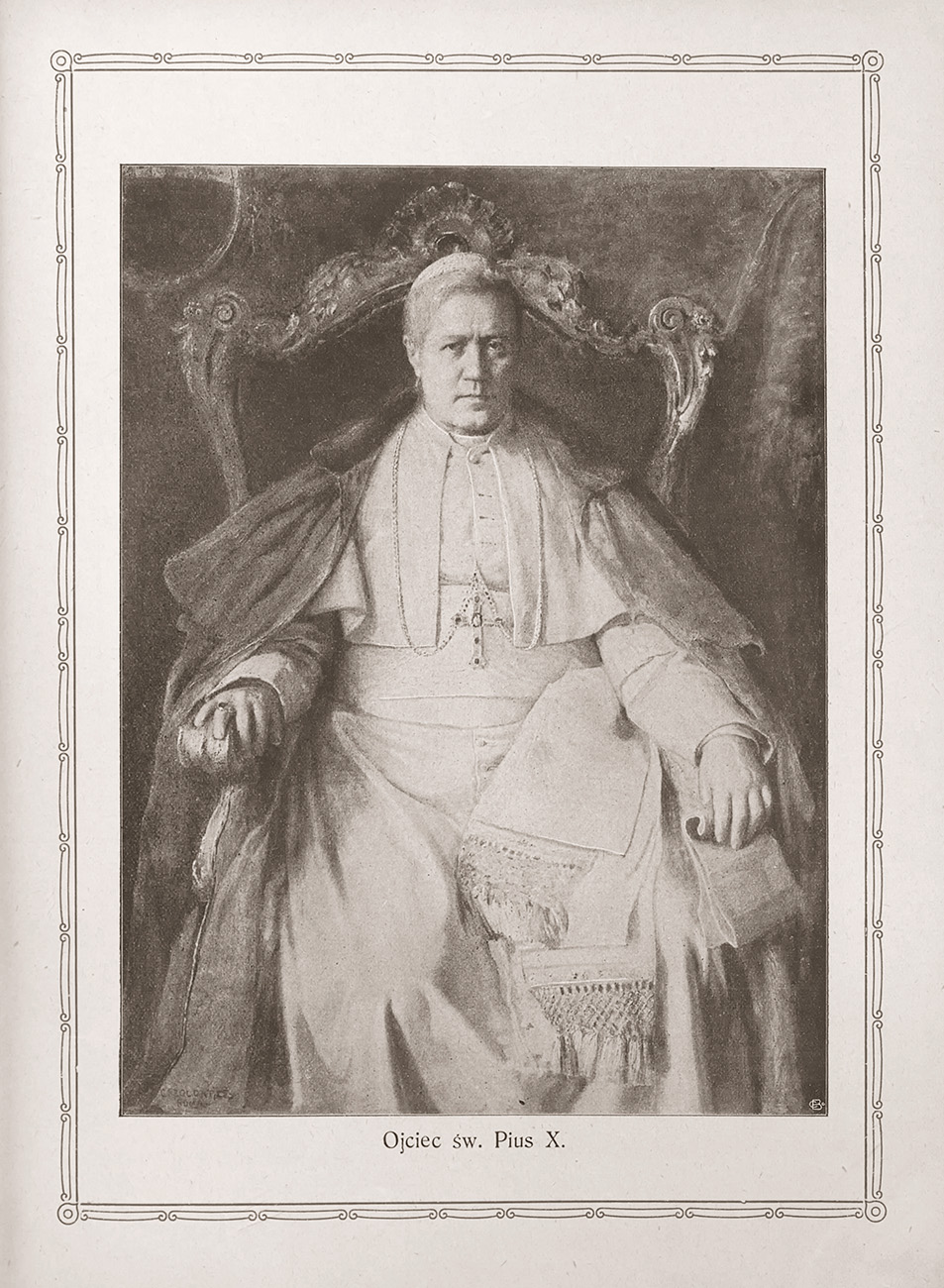
Born 2 June, 1835, at Riese, Province of Treviso, in Venice. His parents were Giovanni Battista Sarto and Margarita (née Sanson); the former, a postman, died in 1852, but Margarita lived to see her son a cardinal.
After finishing his elements, Giuseppe at first received private lessons in Latin from the arch-priest of his town, Don Tito Fusaroni, after which he studied for four years at the gymnasium of Castelfranco Veneto, walking to and fro every day.
In 1850 he received the tonsure from the Bishop of Treviso, and was given a scholarship of the Diocese of Treviso in the seminary of Padua, where he finished his classical, philosophical, and theological studies with distinction.
He was ordained in 1858, and for nine years was chaplain at Tombolo, having to assume most of the functions of parish priest, as the pastor was old and an invalid. He sought to perfect his knowledge of theology by assiduously studying Saint Thomas and canon law; at the same time he established a night school for adult students, and devoted himself of the ministry of preaching in other towns to which he was called.
In 1867 he was named arch-priest of Salzano, a large borough of the Diocese of Treviso, where he restored the church, and provided for the enlargement and maintenance of the hospital by his own means, consistently with his habitual generosity to the poor; he especially distinguished himself by his abnegation during the cholera. He showed great solicitude for the religious instruction of adults.
In 1875 he was made a canon of the cathedral of Treviso, and filled several offices, among them those of spiritual director and rector of the seminary, examiner of the clergy, and vicar-general; moreover, he made it possible for the students of the public schools to receive religious instruction.
In 1878, on the death of Bishop Zanelli, he was elected vicar-capitular.
On 10 November, 1884, he was named Bishop of Mantua, then a very troublesome see, and consecrated on 20 November. His chief care in his new position was for the formation of the clergy at the seminary, where, for several years, he himself taught dogmatic theology, and for another year moral theology. He wished the doctrine and method of St. Thomas to be followed, and to many of the poorer students he gave copies of the "Summa theologica"; at the same time he cultivated the Gregorian Chant in company with the seminarians. The temporal administration of his see imposed great sacrifices upon him.
In 1887 he held a diocesan synod. By his attendance at the confessional, he gave the example of pastoral zeal. The Catholic organization of Italy, then known as the "Opera dei Congressi", found in him a zealous propagandist from the time of his ministry at Salzano.
At the secret consistory of June, 1893, Leo XIII created him a cardinal under the title of San Bernardo alle Terme; and in the public consistory, three days later, he was preconized Patriarch of Venice, retaining meanwhile the title of Apostolic Administrator of Mantua. Cardinal Sarto was obliged to wait eighteen months before he was able to take possession of his new diocese, because the Italian government refused its exequatur, claiming the right of nomination as it had been exercised by the Emperor of Austria. This matter was discussed with bitterness in the newspapers and in pamphlets; the Government, by way of reprisal, refused its exequatur to the other bishops who were appointed in the meantime, so that the number of vacant sees grew to thirty. Finally, the minister Crispi having returned to power, and the Holy See having raised the mission of Eritrea to the rank of an Apostolic Prefecture in favour of the Italian Capuchins, the Government withdrew from its position. Its opposition had not been caused by any objection to Sarto personally.
At Venice the cardinal found a much better condition of things than he had found at Mantua. There, also, he paid great attention to the seminary, where he obtained the establishment of the faculty of canon law. In 1898 he held the diocesan synod. He promoted the use of the Gregorian Chant, and was a great patron of Lorenzo Perosi; he favoured social works, especially the rural parochial banks; he discerned and energetically opposed the dangers of certain doctrines and the conduct of certain Christian-Democrats. The international Eucharistic Congress of 1897, the centenary of St. Gerard Sagredo (1900), and the blessing of the corner-stone of the new belfry of St. Mark's, also of the commemorative chapel of Mt. Grappa (1901), were events that left a deep impression on him and his people.
Meanwhile, Leo XIII having died, the cardinals entered into conclave and after several ballots Giuseppe Sarto was elected on 4 August by a vote of 55 out of a possible 60 votes. His coronation took place on the following Sunday, 9 August, 1903. In his first Encyclical, wishing to develop his programme to some extent, he said that the motto of his pontificate would be "instaurare omnia in Christo" (Ephesians 1:10).
Accordingly, his greatest care always turned to the direct interests of the Church. Before all else his efforts were directed to the promotion of piety among the faithful, and he advised all (Decr. S. Congr. Concil., 20 Dec., 1905) to receive Holy Communion frequently and, if possible, daily, dispensing the sick from the obligation of fasting to the extent of enabling them to receive Holy Communion twice each month, and even oftener (Decr. S. Congr. Rit., 7 Dec., 1906).
Finally, by the Decree "Quam Singulari" (15 Aug., 1910), he recommended that the first Communion of children should not be deferred too long after they had reached the age of discretion. It was by his desire that the Eucharistic Congress of 1905 was held at Rome, while he enhanced the solemnity of subsequent Eucharistic congresses by sending to them cardinal legates.
The fiftieth anniversary of the proclamation of the dogma of the Immaculate Conception was an occasion of which he took advantage to enjoin devotion to Mary (Encyclical "Ad illum diem", 2 February, 1904); and the Marian Congress, together with the coronation of the image of the Immaculate Conception in the choir of St. Peter's, was a worthy culmination of the solemnity.
As a simple chaplain, a bishop, and a patriarch, Giuseppe Sarto was a promoter of sacred music; as pope, he published, 22 November, 1903, a Motu Proprio on sacred music in churches, and at the same time ordered the authentic Gregorian Chant to be used everywhere, while he caused the choir books to be printed with the Vatican font of type under the supervision of a special commission.
In the Encyclical "Acerbo nimis" (15 April, 1905) he treated of the necessity of catechismal instruction, not only for children, but also for adults, giving detailed rules, especially in relation to suitable schools for the religious instruction of students of the public schools, and even of the universities.He caused a new catechism to be published for the Diocese of Rome.
As bishop, his chief care had been for the formation of the clergy, and in harmony with this purpose, an Encyclical to the Italian episcopate (28 July, 1906) enjoined the greatest caution in the ordination of priests, calling the attention of the bishops to the fact that there was frequently manifested among the younger clergy a spirit of independence that was a menace to ecclesiastical discipline. In the interest of Italian seminaries, he order them to be visited by the bishops, and promulgated a new order of studies, which had been in use for several years at the Roman Seminary. On the other hand, as the dioceses of Central and of Southern Italy were so small that their respective seminaries could not prosper, Pius X established the regional seminary which is common to the sees of a given region; and, as a consequence, many small, deficient seminaries were closed.
For the more efficient guidance of souls, by a Decree of the Sacred Congregation of the Consistory (20 August, 1910), instructions were given concerning the removal of parish priests, as administrative acts, when such procedure was required by grave circumstances that might not constitute a canonical cause for the removal.
At the time of the jubilee in honour of his ordination as a priest, he addressed a letter full of affection and wise council to all the clergy. By a recent Decree (18 Nov., 1910), the clergy have been barred from the temporal administration of social organizations, which was often a cause of grave difficulties. The pope has at heart above all things the purity of the faith.
On various occasions, as in the Encyclical regarding the centenary of Saint Gregory the Great, Pius X had pointed out the dangers of certain new theological methods, which, based upon Agnosticism and upon Immanentism, necessarily divest the doctrine of the faith of its teachings of objective, absolute, and immutable truth, and all the more, when those methods are associated with subversive criticism of the Holy Scripture and of the origins of Christianity.
Wherefore, in 1907, he caused the publication of the Decree "Lamentabili" (called also the Syllabus of Pius X), in which sixty-five propositions are condemned. The greater number of these propositions concern the Holy Scripture, their inspiration, and the doctrine of Jesus and of the Apostles, while others relate to dogma, the sacraments, and the primacy of the Bishop of Rome.
Soon after that, on 8 Sept., 1907, there appeared the famous Encyclical "Pascendi", which expounds and condemns the system of Modernism. It points out the danger of Modernism in relation to philosophy, apologetics, exegesis, history, liturgy, and discipline, and shows the contradiction between that innovation and the ancient faith; and, finally, it establishes rules by which to combat efficiently the pernicious doctrines in question.
Among the means suggested mention should be made of the establishment of an official body of "censors" of books and the creation of a "Committee of Vigilance". Subsequently, by the Motu Proprio "Sacrorum Antistitum", Pius X called attention to the injunctions of the Encyclical and also to the provisions that had already been established under Leo XIII on preaching, and proscribed that all those who exercised the holy ministry or who taught in ecclesiastical institutions, as well as canons, the superiors of the regular clergy, and those serving in ecclesiastical bureaux should take an oath, binding themselves to reject the errors that are denounced in the Encyclical or in the Decree "Lamentabili".
Pius X reverted to this vital subject on other occasions, especially in those Encyclicals that were written in commemoration of St. Anselm (21 April, 1909) and of St. Charles Borromeo (23 June, 1910), in the latter of which Reformist Modernism was especially condemned.
As the study of the Bible is both the most important and the most dangerous study in theology, Pius X wished to found at Rome a centre for these studies, to give assurance at once of unquestioned orthodoxy and scientific worth; and so, with the assistance of the whole Catholic world, there was established at Rome the Biblical Institute, under the direction of the Jesuits.
A need that had been felt for a long time was that of the codification of the Canon Law, and with a view to effecting it, Pius X, on 19 March, 1904, created a special congregation of cardinals, of which Mgr Gasparri, now a cardinal, became the secretary. The most eminent authorities on canon law, throughout the world, are collaborating in the formation of the new code, some of the provisions of which have already been published, as, for example, that modifying the law of the Council of Trent on secret marriages, the new rules for diocesan relations and for episcopal visits ad limina, and the new organization of the Roman Curia (Constitution "Sapienti Consilio", 29 June, 1908).
Prior to that time, the Congregations for Relics and Indulgences and of Discipline had been suppressed, while the Secretariate of Briefs had been united to the Secretariate of State. The characteristic of the new rule is the complete separation of the judicial from the administrative; while the functions of the various bureaux have been more precisely determined, and their work more equalized. The offices of the Curia are divided into Tribunals (3), Congregations (11), and Offices (5). With regard to the first, the Tribunal of the Signature (consisting of cardinals only) and that of the Rota were revived; to the Tribunal of the Penitentiary were left only the cases of the internal forum (conscience). The Congregations remained almost as they were at first, with the exceptions that a special section was added to that of the Holy Office of the Inquisition, for indulgences; the Congregation of Bishops and Regulars received the name of Congregation of the Religious, and has to deal only with the affairs of religious congregations, while the affairs of the secular clergy are to be referred to the Congregation of the Consistory or of that of the Council; from the latter were taken the matrimonial cases, which are now sent to the tribunals or to the newly-created Congregation of the Sacraments. The Congregation of the Consistory has increased greatly in importance, since it has to decide questions of competence between the various other Congregations. The Congregation of Propaganda lost much of its territory in Europe and in America, where religious conditions have become regular. At the same time were published the rules and regulations for employees and those for the various bureaux. Another recent Constitution relates to the suburbicarian sees.
The Catholic hierarchy has greatly increased in numbers during these first years of the pontificate of Pius X, in which twenty-eight new dioceses have been created, mostly in the United States Brazil, and the Philippine Islands; also one abbey nullius, 16 vicariates Apostolic, and 15 prefectures Apostolic.
Leo XIII brought the social question within the range of ecclesiastical activity, Pius X, also, wishes the Church to co-operate, or rather to play a leading part in the solution of the social question; his views on this subject were formulated in a syllabus of nineteen propositions, taken from different Encyclicals and other Acts of Leo XIII, and published in a Motu Proprio (18 Dec., 1903), especially for the guidance of Italy, where the social question was a thorny one at the beginning of his pontificate. He sought especially to repress certain tendencies leaning towards Socialism and promoting a spirit of insubordination to ecclesiastical authority. As a result of ever increasing divergences, the "Opera die Congressi", the great association of the Catholics of Italy, was dissolved. At once, however, the Encyclical "Il fermo proposito" (11 June, 1905) brought about the formation of a new organization consisting of three great unions, the Popolare, the Economica, and the Elettorale. The firmness of Pius X obtained the elimination of, at least, the most quarrelsome elements, making it possible now for Catholic social action to prosper, although some friction still remains. The desire of Pius X is for the economical work to be avowedly Catholic, as he expressed it in a memorable letter to Count Medolago-Albani.
In France, also, the Sillon, after promising well, had taken a turn that was little reassuring to orthodoxy; and dangers in this connection were made manifest in the Encyclical "Notre charge apostolique" (15 Aug., 1910), in which the Sillonists were ordered to place their organizations under the authority of the bishops. In its relations with Governments, the pontificate of Pius X has had to carry on painful struggles. In France the pope had inherited quarrels and menaces. The "Nobis nominavit" question was settled through the condescension of the pope; but the matter of the appointment of bishops proposed by the Government, the visit of the president to the King of Italy, with the subsequent note of protestation, and the resignation of two French bishops, which was desired by the Holy See, became pretexts for the Government at Paris to break off diplomatic relations with the Court of Rome. Meanwhile the law of Separation had been already prepared, despoiling the Church of France, and also prescribing for the Church a constitution which, if not openly contrary to her nature, was at least full of danger to her. Pius X, paying no attention to the counsels of short-sighted opportunism, firmly refused his consent to the formation of the associations cultuelles. The separation brought some freedom to the French Church, especially in the matter of the selection of its pastors. Pius X, not looking for reprisals, still recognizes the French right of protectorate over Catholics in the East. Some phrases of the Encyclical "Editæ Sæpe", written on the occasion of the centenary of St. Charles, were misinterpreted by Protestants, especially in Germany, and Pius X made a declaration in refutation of them, without belittling the authority of his high office.
At present (Dec., 1910) complications are feared in Spain, as, also, separation and persecution in Portugal; Pius X has already taken opportune measures. The new Government of Turkey has sent an ambassador to the Pope. The relations of the Holy See with the republics of Latin America are good. The delegations to Chile and to the Argentine Republic were raised to the rank of internuntiatures, and an Apostolic Delegate was sent to Central America. Naturally, the solicitude of Pius X extends to his own habitation, and he has done a great deal of work of restoration in the Vatican, for example, in the quarters of the cardinal-secretary of State, the new palace for employees, the new picture-gallery, the Specola, etc.
Finally, we must not forget his generous charity in public misfortunes: during the great earthquakes of Calabria, he asked for the assistance of Catholics throughout the world, with the result that they contributed, at the time of the last earthquake, nearly 7,000,000 francs, which served to supply the wants of those in need, and to build churches, schools, etc. His charity was proportionately no less on the occasion of the eruption of Vesuvius, and of other disasters outside of Italy (Portugal and Ireland).
In few years Pius X has secured great, practical, and lasting results in the interest of Catholic doctrine and discipline, and that in the face of great difficulties of all kinds. Even non-Catholics recognize his apostolic spirit, his strength of character, the precision of his decisions, and his pursuit of a clear and explicit programme.
Benigni, Umberto. "Pope Pius X." The Catholic Encyclopedia. Vol. 12. New York: Robert Appleton Company, 1911.
It may not be generally known to our readers that the late Sovereign Pontiff, Pius X, was a Franciscan Tertiary, and now that he is passed to his eternal reward, it will not be amiss briefly to trace his connection with the Franciscan Order and to enumerate a few incidents of his life which show him to have been a true follower of Saint Francis. Pope Pius X was a member of the Third Order since the year 1870. He was admitted into the Order by the Rev. Honoratus Bindoni in the cathedral of Treviso. As pastor of Salzano, Joseph Sarto directed the Third Order of the parish and left it in a blooming condition.
As Bishop of Mantua, he regularly took part in the meetings, often spoke to the Tertiaries, and after the meeting he was ever ready to grant an audience to any one seeking help or advice. This example of their bishop induced many of the younger clergy to be enrolled in the Third Order.
As Patriarch of Venice, he adhered closely to the Rule of the Third Order; in his pastoral letters, he often referred to it, and at times he invited some eloquent orator to preach on it. In 1896, a Tertiary Congress was held in his palace at Venice, and he himself was one of the principal speakers. Accompanied by 2,000 Venetians he made a pilgrimage to Assisi in 1896 to visit the tomb of Saint Francis and the other places dear to the heart of every Tertiary.
As soon as he was elected Pope, he assumed the protectorate of the Friars Minor, and during his reign, he often warmly advocated the Third Order. At an audience granted to Professor Salvator Licitra, director of the Third Order at Ragusa, he spoke the memorable words: “I bless the Third Order which is very dear to me.” When in 1904, he received the Roman Tertiaries in audience, he gave vent to his feelings, and extolled Saint Francis and his Third Order in eloquent terms. As Pope, he raised four Tertiaries to the honor of the altar. They are, Blessed John Baptiste Vianney, Cure D’Ars, Blessed Vivaldus of Ayoi, Blessed Joan of Arc, the Maid of Orleans, and the Tertiary priest Bartolus.
The many edifying deeds of true virtue, which His Holiness performed as a poor, barefoot boy in Riesi, as a model student in Padua, as a zealous pastor in Salzano, as a true-hearted bishop in Mantua, as a beloved Patriarch in Venice, and, finally as Vicar of Christ in Rome, all this is ample proof that Pius X was a worthy son of the humble Saint of Assisi.
Among other good qualities, the late Holy Father possessed genuine piety, deep humility, and true charity.
Joseph Sarto received a thorough Christian training from his poor but virtuous parents. His saintly mother knew not how to read nor write, she could not even sign her own name when she was married, but she knew the value of leading a life pleasing to God. She had a deep love for God and the Blessed Virgin Mary. She received Holy Communion quite frequently, and made many a visit to the shrine of Cendrole, dedicated to our Blessed Lady. Her pious example, no doubt, had a salutary effect on all her children, and, especially on Joseph. When Joseph Sarto became bishop, he well remembered the good influence which the piety of his mother made upon him. He wrote at that time; “Man’s character is formed in youth. The heart of a child is like a plot of new ground; it will take in good or bad seed and yield fruit accordingly. If the training and teaching is good, the child will almost invariably be good also.”
Whenever Joseph Sarto visited his home in later years, as seminarian or priest or bishop or cardinal, he was sure to retrace his steps to the little chapel at Cendrole. As pope he proved his devotion to the Mother of God, when in 1904 the Jubilee of the Immaculate Conception was celebrated. He granted many favors and indulgences on this occasion, and himself composed a beautiful prayer to the spotless Mother of Christ.
Pius X has also given evidence of his piety by his love and zeal for the Blessed Eucharist. He issued several decrees concerning the august Sacrament of the Altar with the object of bringing the people of all classes and conditions of life nearer to our Eucharistic Lord. Frequent Communion and the Communion of the innocent children have made a great change in the Church of Christ, and it was the piety of the Holy Father that gave the impetus.
The piety of Pius X was deep and solid; the same may be said of his humility. Although Joseph Sarto was specially gifted in mind and body, he never boasted or made a show of himself. When the Cardinals met in conclave, in 1903, to elect a successor to Leo XIII, the choice fell on Joseph Sarto, the Patriarch of Venice. “Who is Joseph Sarto?” the people asked one another. “Whence does he hail?” Cardinal Sarto, a child of the people, a hard-working, unassuming priest, a bishop who had restored order quietly but effectively, a patriarch of Venice, whose conduct with his diocesans and the civil authorities was marked by kindliness and moderation, this quiet, modest, and humble man was to occupy the highest office in the Church, Cardinal Sarto was taken by surprise and by fear when he noticed that the votes were fast coming in his favor. With tears in his eyes, he most earnestly besought the Cardinals to choose another. “Almighty God knows it,” he said, “that I am not worthy of the high office, and not capable of filling it.” When the Cardinals insisted on his election, the humble man accepted the heavy burden, putting all his trust in the Lord.
Pius X was comparatively poor as Pope, and the reason for this was, because he had so great a charity for the poor and the distressed. The people knew his love and pity for them, and they made good use of his weak point. While acting as pastor in Salzano, he was very closely watched by the poor. If a wealthy family had a child baptized, or if some rich person had died, the poor parishioners would wait at the church-door for their generous pastor, and he would not divide the special stipend with them, no, he would give them the last farthing. The only thing that seemed to grieve the holy priest, was his frequent inability to help the poor. Once he had purchased a supply of wood for the winter. His poor parishioners soon appeared in great numbers to beg a few pieces, and they did their work so well that in a few days not a stick of wood remained. When Patriarch of Venice, Joseph Sarto received a salary of 23,000 lires, and though that was hardly enough to cover his expenses, still the poor would receive a good portion of it. A high personage once presented the Patriarch with a gold, watch but that, too, soon disappeared. Sarto made a present of it to a man who was in need while he himself continued to carry his old nickel-plated time-piece. Two of his sisters had charge of the household, and they found it necessary to keep his laundry and other articles under lock and key, or he would have given everything to the poor.
Many other edifying stories are related of the piety, the humility, and the charity of the late Holy Father, but these will suffice to show that he was a true son of Saint Francis of Assisi, a worthy member of the Third Order. May the remembrance of his virtues linger long in the memory of every Tertiary, and may they send up fervent and frequent prayers to the throne of God for the repose of the soul of their illustrious Brother in Saint Francis.
Franciscan Herald, September 1913. CatholicSaints.Info.
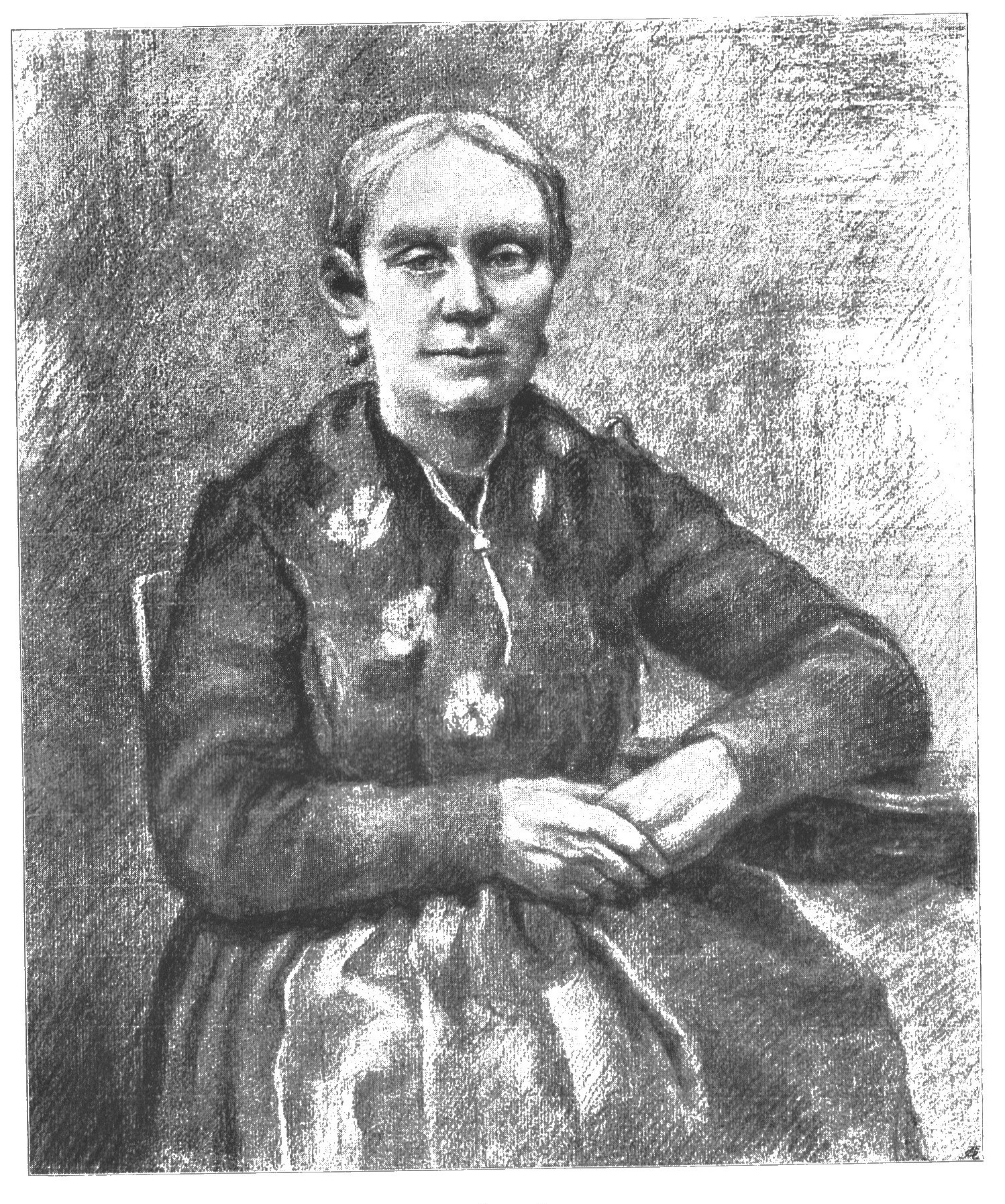 Margherita SansonAntonio, we are told in Shakespeare’s play, ‘The Merchant of Venice,’ commissioned his dearest friend, Bassanio, to write his epitaph. Robert Emmett would have no man write his epitaph, insisting that he and his cause be left to the verdict of history. Both history and the one dearest to her could be said to have written the epitaph of Margherita Sanson, the mother of Saint Pius X.
The historian would crystallize her greatness into a brief, impersonal, ‘She was the mother of a modern Pope who was raised to the honours of the Altar.’
Antecedent to history’s verdict are the words of an unpretentious tombstone over a humble grave in the Italian town of Riese. Saint Pius X, or Cardinal Giuseppe Sarto, as he then was, left over her grave this tribute to his mother: ‘Margherita Sanson: the exemplary wife, the prudent woman, the incomparable mother, who, May 2, 1852, lost her husband, Gianbattista Sarto. In sad and happy days, she kept brave-hearted courage and devotion; raised as good Christians her nine children, and crowned a life of toil and sacrifice by her death, February 2. 1894. Cardinal Giuseppe Sarto and his brothers and sisters pray for everlasting peace for their dear parents.’
By these words, Cardinal Sarto did more than show his filial affection for the woman whom God gave him for mother. ‘The exemplary wife, the prudent woman, the incomparable mother,’ was the ideal he would keep before all mothers as their true vocation. The epitaph and the subsequent history of her son give us the real picture of Margherita Sanson. The son painted the picture; history has projected it and, in the process, focussed the attention of mothers throughout the Christian world.
Margherita Sanson never occupied an important official or social position. She lived the ordinary life of a simple, hardworking mother of a large family. ‘In sad and happy days she kept brave-hearted courage and devotion; raised as good Christians her nine children.’
But Margherita was by no means an ordinary person – no mother is. Her influence was as deep and as enduring as it was far reaching; for Margherita influenced, as God would have her influence, those whom He entrusted to her care, and, of these, Giuseppe was to influence the whole world.
For this woman, who never spared herself in her ‘life of toil and sacrifice,’ motherhood was not a burden to be dreaded or a last shift to be endured. It was a vocation from God, and it was part of the mother, Margherita, to fashion under God, a soul to whom God was to give the highest possible honour on earth – the occupancy of the Chair of Peter.
Margherita Sanson was not destined to live to see her son – the parish priest of Tombolo – crowned Pope and become the parish priest of the world; nor were her ears to hear the world’s acclaim, June 3, 1951, when he was raised to the honours of the Altar.
But Margherita had her consolations. She experienced a mother’s pride when her beloved Giuseppe was ordained, became Archbishop, and later, a member of the Sacred College of Cardinals. Observers have recorded her simple utterance when she met her son after his Consecration as Archbishop. Pointing to her wedding ring and to the episcopal ring of the future Pius X, she said: ‘My son, if I had not had this, you would not have had that.’
Margherita knew that Our Divine Lord instituted Sacraments for two states of life only – the married and the priestly. It was not in spite of marriage, but in and by marriage that she herself was to be sanctified. Such was the calibre of her soul that marriage, mutilated and debased and rendered sterile by selfishness was simply beyond her comprehension. God’s Will alone counted. Does not marriage supply God’s Church with priests and religious? This was Margherita’s truly Christian outlook. How pleasing to the profound, theological mind of her son must have been that simple utterance: ‘If I had not had this, you would not have had that.’
Margherita was of the people. Her skill later withstood many demands when providing for the needs of her rapidly growing family.
Widowed after nineteen years of marriage, Margherita held the large family together by the sheer force of her maternal love and influence. She provided for Giuseppe’s education to the priesthood and balanced the domestic budget as only the good housewife can.
The years passed and left their mark. Giuseppe was made a Cardinal in 1893. He hastened to the aged and infirm mother at Riese as soon as official ceremonial permitted. Margherita’s cup of happiness was almost overflowing. Almost, but not quite. Real woman that she was, Margherita had one request. Would Giuseppe don his Cardinal’s robes that she might see him in them? He agreed and changed. Margherita could only sit and look at him speechlessly, while the tears of pride and joy and gratitude to God ran down her cheeks.
Then the mother faded into the true daughter of the Church. She tried to kneel for his blessing. His Eminence gently restrained her. Having blessed her, he kissed her affectionately. It was Margherita’s ‘Nunc dimittis.’ (‘Now, O Lord, You can dismiss Your servant.) After that day, she never saw her son again in this life.
Giuseppe Sarto never forgot the influence of Margherita, his mother. He could declare that, through the years, he had always been aware, even when distant from her, of her love reaching out to him; of her strength giving him strength.
Whatever may be added of Margherita, her son’s wording of her epitaph – ‘the exemplary wife, the prudent woman, the incomparable mother,’ remains the highest tribute that could be paid to any mother.
Text taken from Mothers of History, by J T Moran, C.SS.R., Australian Catholic Truth Society, 1954
Pope of the Eucharist
The car swished up to the curb and came to a halt. The rain was falling more heavily, thought Father Lawrence, as he turned off the ignition. Of all the nights a man chooses to go out, he picks this one ! Still, he had promised the Mortons so often in the past that he would be over and something had always happened to prevent him. There was the time when he was all set to come and a non-Catholic enquirer had called in unexpectedly just as he was leaving. Another time, he was struggling with a bout of influenza and he had to stay on duty. The last time, Mrs. Murphy had a stroke — her last, poor soul — and he had to call the Mortons and cancel. No, he had stood them up too often in the past and a few drops of rain would not keep him away. Besides, he always enjoyed himself when he went to the Mortons. Perhaps the world was falling to pieces, but people like the Mortons gave one hope for the future. Mary and Frank had been married only eight years; soon after the war it was; and the first years had not been easy for them. They had four sturdy children now and were a real credit to their religion and their Catholic way of life. Pity there weren’t more like them!
Father Lawrence slammed the car door and walked up the path towards the veranda. Br…rr…rr…r.
The door was opened by a young woman in her late twenties. Nobody would believe that Mary Morton was the mother of four children, thought the priest.
“Oh, it’s you, Father, I’m so glad you were able to come! What a night you chose, though,” she laughed, “here, let me take your coat and hat; you must be frozen.”
The priest unbuttoned his overcoat. Fie was not a young man by any means and his thirty years as a priest had aged him in many ways. “It is rather cold,” he agreed, “that’s a nice fire burning away in there!” He nodded towards the living room.
“Yes, come on in, Frank will be here in a minute; he is just getting some more wood.”
“By the way,” she added confidentially, “Mother has just dropped in. We were having a few words just before you arrived. It started over young Tony of all people, perhaps you could persuade her.”
Father Lawrence heard the back door shut and Frank Morton appeared, carrying an armful of wood. “Good evening, Father,” he called airily, “It’s good to see you.”
“I was just talking about Mother, Frank.”
Frank smiled ruefully. “You know, Father, some people can never be convinced. But what are we standing out here for? Come on inside. The baby is in bed, but the rest of the children are up. We told them they could stay up and see you.”
“Now,” said the priest, “what’s all the trouble?”
Mrs. O’Shaughnessy, Mary’s mother, immediately assumed command saying, “This concerns Tony, Father. As you know, he is to receive his First Communion next month, and…. Well, I think he is too young. Why, when I was girl, no one would.”
Father Lawrence stroked his chin, a characteristic action of his. Mrs. O’Shaughnessy had the best intentions in the world, of course, but why, oh why, did she try to bring up her own daughter’s children.
“Yes, Mrs. O’Shaughnessy,” he interrupted good-humouredly. “When you were a girl – when we both were young for that matter — children didn’t receive Holy Communion until they were ten or eleven. Honestly, looking back, do you really think it was a good thing? You forget that it was Christ Himself who said, ‘Suffer the little ones to come unto Me, and prevent them not.’ Why weren’t they allowed to receive Our Lord into their hearts when, in fact, they had been ready years previously?”
“You see,” he continued, “it all arose from a wrong idea of Communion. When Christ instituted the Eucharist, He was not so much seeking His own glory. What He wanted was to make mankind holier. Holy Communion is not meant to be a reward for virtue. It is spiritual nourishment – in plain English, food for the soul. That has always been the mind of the Church, who advises all, young and old, to receive Communion provided they have the right intention. However, a bad custom grew up in Europe, especially in France, to make children wait for many years. Early in the 20th Century, somebody changed all that.”
Margaret, aged six, and Bill, aged four, had been quiet all this time. “Who was that, Father?” they suddenly asked in chorus.
“Aw,” crowed Tony, importantly, “everyone knows that. Sister Clare was talking about him at Communion Class this morning.”
“Tell us about him, Father,” piped in Margaret and Bill, “please!”
“Careful, Father,” said Frank Morton, “you know what these kids of mine are like.”
Father Lawrence gazed into the fire. “Well, his name is in the news these days,” he said taking a sip of his coffee, “and besides, his life may have interest for you older children too!”
Once Upon a Time…
“To begin, his name was Giuseppe Sarto — in English that would be Joseph Taylor — Sarto being the Italian for Tailor — but you wouldn’t know him by that name though you all have heard of him. It was this little lad, Giuseppe, who later became the famous Pius X. Anyway, young Giuseppe was born in the village of Riese in Northern Italy — Venetia it was — on 2 June 1835. His father was the local postman and he had to struggle pretty hard to feed and clothe his family of ten — four boys and six girls. The Sartos were what you might call a model Christian family and, like good Catholic parents the world over, they brought up their children with a great love of God and His holy Mother. Just as they co-operated with God in bringing their eldest son into the world and training him, I am sure they are now sharing his glory in heaven.”
“You know, Father,” Frank Morton reflected, “occasionally I do get the urge to read the lives of saints and other holy people, but, oh, I don’t know! All that praying, and those fasts and the rest of it. Well, I couldn’t imagine myself doing all that sort of thing.”
“I know what you mean,” smiled Father sympathetically.
“Some saints did lead extraordinary lives and they are to be admired, but they are not easily imitated. God, you know, raises up all the saints, and the more austere saints seem to have been placed in those times when the majority of the people were leading very loose lives. Perhaps God wanted to shock those people into a holier way of life by putting into their midst one whose life was a direct contrast to theirs. However, not all saints were of that sort. Look at Saint John Bosco or the Little Flower — saints who did the ordinary things that we have to do but with this difference — they did the ordinary things extraordinarily well. We can both admire and imitate them. Giuseppe Sarto was, thank God, one of these — he was like many young Venetian boys — he worked hard, always enjoyed a joke, and, it seems, was not above raiding a neighbor’s cherry orchard now and again.”
Tony’s eyes opened wide. “He’s no different from the kids around here, then?”
“He improved later, though, Tony,” winked the priest. “When he was old enough, he became an altar boy, like many a young people today. Even at that age he liked to drop in and talk to Our Lord in the Blessed Sacrament; perhaps this was the beginning of his life-long devotion to the Blessed Eucharist.”
Lather Lawrence took a sip of his coffee and slowly, deliberately paused to consider his next words. “Yes, the Sartos were poor people and young Joseph had to tramp over four miles to school every day, his lunch stuffed inside his shirt and his shoes strung around his neck to save the leather. Later on, things got a little better and he and his brother were given a donkey and cart.”
Vocation
“That briefly sums up the childhood of the future Pope. By now, Joseph was a youth of seventeen and it was high time he decided on a career. He had done well at school, really well, we are told, and had topped his class at the secondary school at Castelfranco. During his last years at school, the thought of the Priesthood had presented itself. However, the Priesthood involves long years of training and training involves expense. In a family such as the Sartos, every penny had to be considered. It seemed as though Joseph would have to put the thought of becoming a priest out of his head.”
Frank nodded. “But Father, surely, if God gave a man a vocation, the man would be bound to follow up on that — and God would somehow find the means.”
“A good point, Frank, but are you sure you have the correct idea on vocations?”
“Yes, Father, I think so. God gives the call to certain men to become priests and they answer that call. That is what ‘vocation’ means, isn’t it — a calling?”
Father Lawrence paused before answering. “If you mean that a man will hear an interior voice saying, ‘Come, follow Me,’ you are wrong. There is only one audible vocation given by God and the priest hears it on his Ordination morning. Then the young Deacon hears the words, Accedant qui ordinandi sunt ‘ or ‘Let those to be ordained, come forward. ‘ Then, the bishop is bound to make enquiries about the men he is going to ordain. He must be sure the candidate has certain qualities and, if these are present, the bishop may then lawfully ordain the Deacon.”
“What are those qualities, Father?” asked Mrs. Morton.
“Well, the Code of Canon Law — that is, the book of laws that govern the Church says that the candidate must have sufficient learning, sound morals, good health, no impediments, and what is called a supernatural motive — that is just an involved way of saying that the motive must be concerned with God in some way. For instance, if I wanted to be a priest to win esteem from my fellow men, that obviously would not be a supernatural motive! This is what the Church requires when she talks of a vocation.”
“Yes, Father, I can see that,” said Frank. “It seems that I did have the wrong slant on vocations. I thought there would be some sort of supernatural attraction or an invitation from God to become a priest.”
“There is no mention of it in Canon Law, Frank. At the same time, there may have been especially chosen souls who got some sort of divine message but, for the general run of us, positively no! If the average young man expects to hear an angelic voice in his ear, he is going to be disappointed. The only signs of a vocation are the five things I mentioned earlier. All the desires in the world will make no difference if any of these are missing. That is the Church’s teaching on the subject and, as we shall see later, it was the view on vocations formally approved by Pius X.”
“To return to Giuseppe Sarto — he had the five essential requirements but, unfortunately, no money. He had offered himself to God for a life of service and God wasn’t going to be put out by a small consideration like expense. Besides, God had special plans for this young man.”
“God often works through human agents to bring about His plans. That’s what happened in the case of young Sarto. Joseph’s parish priest, Don Tito Fusarina, was a great friend of the Prefect of Studies at the Seminary of Treviso, so he asked the Prefect to put Joseph’s case to the Patriarch of Venice. The Cardinal himself was a peasant’s son from Joseph’s own village. This, combined with the fact that Joseph had passed with honors in every subject in his examinations, was too much for the Cardinal, and Giuseppe Sarto was awarded a free scholarship at the Seminary of Padua.”
Padua
“Everything was now ready for Joseph to begin his seminary course with its Philosophy, Theology, Canon Law, Ecclesiastical History and all the rest. In all the things Joseph tackled, he set himself to do the job at hand and he mastered them all.”
Father Lawrence paused. “You know the old saying, ‘Genius is 1% inspiration and 99% perspiration.’ I think there is a lot in it. We often look at the results and forget about the work spent in getting those results. So, when you hear of the brilliant young student, Joseph Sarto, graduating with honors each year at the Seminary, don’t forget the hard work he had to put in to get those results.”
“We are told he was a model seminarian, but don’t get the idea that he was in any way narrow-minded. He was in love with God and he quickly learned that the best way to please God was through obedience. He knew that God wanted him to do whatever his superiors told him to do — so he did it! And, he did it with a liveliness and naturalness that won him the esteem of all in the Seminary. Later he could say, “Before one commands, it is necessary first to have learned how to obey.”
“He first acquired his taste for Gregorian chant in the Seminary. At that time, Gregorian chant had almost completely lost its popularity and had been replaced by a more operatic form of music. Oh, good music it certainly was, but not very conducive to prayer. Later on, he became choirmaster. Perhaps the experience he gained as choirmaster was the beginning of the reforms that, later on as Pope, he introduced into church music.”
“Joseph often remarked in later life that his happiest years were those spent in the Seminary at Padua. However, that happiness was overshadowed by an event that seriously threatened his career as a priest. His father became ill and died, leaving his wife and family in very poor circumstances. Joseph’s mother would not be able to provide for such a large family and, as the eldest, Joseph would have to help out. His mother would not hear of it. The younger boys were growing up and would soon be able to do their share. Meanwhile, she would see that the family would have what they needed.”
“You know,” he said, “it is the Margherita Sartos’ who are the backbone of the Church — valiant women that one reads about in the Book of Wisdom! One day someone should write a book on these women — Blanche of Castile, Margherita Bosco, Margherita Sarto — for it is they who pointed out the way their saintly sons were to follow. Our Divine Lord placed his own Mother over the angels in heaven and these mothers, too, I am sure, will have places in paradise comparable with the places held by their sons. They certainly deserve it!”
“But where are we? Oh yes, by now, it was 1858 and Ordination time was approaching. Joseph was only twenty-three and he had to get a dispensation to be ordained that year because the age for Ordination is twenty-four. On September 18, 1858, Joseph was ordained a priest at the Cathedral of Castelfranco. There, he received from the Bishop the power to perform the greatest act possible for man — the power to offer God the Son to His Eternal Father. To utter the words, ‘I absolve you.’ The next day, Joseph returned to Riese, along the road where as a boy he walked with shoes strung around his neck, along the street he knew so well, to the Church he had loved so much — and there he offered his first Holy Mass.”
Father Lawrence paused. “You know, not even a wedding day can be as happy as the day on which a priest says his first Mass. Few engagements have lasted so long and no preparation is so intense. When the great day arrives, he holds a piece of bread in his hands and, perhaps for the first time, realizes the tremendous power behind the words ‘For This Is My Body.’ ”
There was a silence. . .
“I have become rather eloquent, I’m afraid,” grinned the priest, “but the joy of Ordination time is unforgettable. So it was with Joseph Sarto — even forty years later, as Pope, he would speak with feeling of the rough, hardworking peasant folk who knelt at the feet of the young ‘Ordinatus’ to receive his benediction.”
First Appointments
“After ordination, a priest receives his first appointment and, in due course, Father Giuseppe Sarto was sent as curate to the village of Tombolo, a pretty little place in hilly, well-timbered country. The people were mainly dairy farmers. They were hard working and they had a vice not altogether unknown in our own country — they were inveterate swearers. Not that they meant anything by it, I am sure, but they had grown up amid it. Father Sarto set out to check the habit and his method was simple. He opened a school for his people — the adults as well as the children — and all could be enrolled provided each ‘pupil’ gave up his habit of swearing. That was his condition and the people accepted him on his terms. Thus, in a comparatively short time, he was able to achieve what normally could be achieved only after many years of preaching and persuading.
Salzano
“After a while he was moved to another village where he was made Parish Priest.
Salzano was the name of it and here, as at Tombolo, he gave himself heart and soul to his flock. Soon after he arrived, there was a serious outbreak of cholera. A nineteenth century Italian village did not boast social service facilities, and the new parish priest became its doctor, nurse and sanitary inspector.
“I like this part of his life best. He worked by day attending the sick and dying, and by night burying the dead — and even digging their graves. No wonder he had such power over his people. Gifted orator he certainly was, but it was the kindness of Father Sarto that spoke far more forcefully.”
Canon and Bishop
Father Lawrence leaned back.
“If you were to ask me what was the most outstanding quality of Joseph Sarto, I would say it was his generosity — a generosity that sprang from a great and genuine love. He loved Christ; he saw all men in Christ — members of Christ’s Body — and because he gave his own heart and soul to Christ, he gave himself to men — Christ’s members!”
“He was moved to the Seminary at Treviso in 1875, as Canon, where he was known for his generosity. Many of the poorer students were helped financially, which resulted in the Canon nearly always being penniless. At the Seminary, he corrected many abuses that had unfortunately crept in and in this he was motivated by a burning zeal for good and holy priests. He was greatly respected at the Seminary — so much so that, when his time came to leave, he felt a general farewell would be too painful. Instead, he gave a letter to the Rector of the Seminary.
“‘Tell them I keep them all in my heart, and that they must pray for me,’ he said upon leaving. Then, slipping unnoticed out of the house, he went to meet the carriage ordered for him and left for Mantua.”
Bishop of Mantua
“We shall see later that Pius X took as his motto, ‘Instaurare Omnia In Christo ‘ — ‘to restore all things in Christ.’ These are words he carried with him through life. As Bishop of Mantua, he had ample opportunity to practice those words. The clergy and people were divided; the recently founded Seminary was almost empty of students; many parishes were without priests; and parish priests often neglected their duties. He immediately set about his work of restoration. He was able to increase the number of seminarians to one hundred and forty-seven; he reformed the clergy; he started sodalities; he set up charitable institutions; he re-introduced Gregorian chant into church music; and he taught the catechism.”
“Not only that, the government was mostly anti-clerical, a not uncommon state of affairs in nineteenth century Italy, and he did his best to establish friendly relations with the state. One letter to the mayor was typical of him. ‘Your new bishop,’ he wrote, ‘poor in everything else, but rich in his love for his flock has no other object than to work for the salvation of souls and from among you one family of friends and brothers.’ Even though the government was Masonic and often bitterly antagonistic, he saw it as the lawfully constituted authority, to be followed in all things not contrary to faith and morals. However, when they overstepped that authority — as later happened in the case of France — he was emphatic in his denunciation and decisive in his action.”
Prince of the Church
“Still greater honors were destined for Bishop Sarto. He had been renowned throughout Mantua for his piety and zeal and, upon the death of Cardinal Agostino, Patriarch of Venice, in 1893, he was chosen as Cardinal Agostino ‘s successor. Sixteen months passed before he was able to take possession of his See because the Italian Government claimed the right to nominate the new Patriarch — a right that they, of course, in no way possessed — and they refused to recognize Cardinal Sarto’s appointment. The Municipality of Venice backed up the Government’s action since they were also bitterly anti-clerical and only too glad to show their hostility to the Church. By September of 1894, the growing indignation of the Venetians made the Government relent. In due course, Joseph’s appointment was confirmed and Cardinal Sarto arrived in Venice to a tremendous welcome from the people. The guns of the arsenal boomed out in salute and, as he stepped into the magnificent launch that carried him to Saint Mark’s, all the bells of the city rang out. Every balcony was thronged with cheering crowds; every building bedecked with flags and streamers — with the exception, that is, of the governmental buildings — for the Italian Government was determined to show its opposition to the new Patriarch.”
The priest reached for a poker to retrieve a log that was close to falling onto the hearth.
He prodded it and they watched the sparks as they raced upwards and disappeared.
“What shall I tell you about him during this time? Shall I tell you of the magnificent Eucharistic Congress, the equal of which Venice has never since seen? Shall I tell you of his attempts to come to peaceful terms with the mostly Masonic part of the Italian Government and, at length, succeeding by the sheer weight of his personality? Shall I tell you of the rebuilding of the bell tower of Saint Mark’s? — you’ll get that in any life of Pius X. He, no doubt, deserves to live on for those great achievements. However, I like to think of him as the man who visited the slums, the hospitals, and the prisons of Venice. I like to think of him spending long hours in prayer, leading the humble life of a peasant, insofar as he could; and pawning his watch and even his episcopal ring to obtain money for the needy. You see, it was in doing these things that he imitated his Master and it was this that endeared him to the hearts of his people — and helped to make him what he is today, one of the Blessed in Heaven.”
There was a silence, but his audience did not press him. It was good to hear Father telling a story.
The Conclave
“I’m getting oratorical again,” Father Lawrence confessed. “As you can probably guess, Pius X is a favorite of mine and one of the great lessons he teaches me is that the way to sanctity lies in doing all our daily duties and doing them well. The Little Flower called this round of daily tasks her ‘Little Way.’ That, I think, is a very happy expression because in our daily lives, there are only the little common humdrum tasks. Not much splash; not much success. Yet it is through these things that you and I will get holier.”
Frank’s eyes sparkled. “Do you mean, Father, that I’m going to get to heaven by my office work, digging in my garden, and chopping wood?”
“You will, by those and your religious duties as well — attending Sunday Mass and saying your prayers. You see, the ordinary things of our lives are very, very important.”
Father let those points sink in before stirring himself to continue.
“But stop interrupting me;” he cut in playfully, “it’s rude. By now, we have come to the year 1903 — July 20th, to be exact — and the world was saddened by news of the death of Leo XIII. Leo XIII had awakened the world to its duties towards the working classes and if he had written ” Rerum Novarum ” and nothing else, he would still be remembered and loved. Leo’s activity on behalf of the working class was only part of the untiring work he performed — work that eventually wore out even his lion heart until, on July 20th, God called His faithful servant home.”
Father took another sip of his coffee. “As you know, when a Pope dies, his successor is chosen by the College of Cardinals. The Cardinals are called to Rome for the election; they go, each accompanied by his secretary. Meanwhile, a large part of the Vatican is set aside and divided into apartments or cells. Access to that area is made by one door only — a door that is barred from the outside by the Marshal of the Conclave and from the inside by the Cardinal Camerlengo. Inside this area, all communication with the outside world is at an end until the result of the election is announced.
“Well, that’s what happened in 1903, when Cardinal Sarto was summoned to Rome for the election. Always with an eye to business, he bought a return ticket — to save money. However, that return ticket was destined not to be used.”
Veto
“Before you go on,” Frank interrupted, “I remember reading somewhere that at this election it seemed certain that another Cardinal was going to be elected, but Austria vetoed him — and then, when he was out of the running, Pius X was elected. Was that a fact?”
The priest knitted his brows saying, “No, Frank. That has commonly been said, but it is far from the truth. Austria did attempt a veto, but it was ignored.”
“You see, tradition guides election of a Pope. After Mass, the Cardinals assemble in the Sistine Chapel where the voting takes place. Each Cardinal takes an oath that he will elect the man whom he considers most fitted for the task and places the name of his candidate in a gold chalice on the altar. The Cardinal finally elected must have a two- thirds majority. If this is not attained at the first sitting, the nominations are placed in a stove with a handful of damp straw — to make the smoke black. The chimney extends through a window of the Chapel, so the crowd outside can see clearly that the conclave has not reached a decision. The Conclave meets twice a day until the required two-thirds majority has been reached. When this is done; the ballots are again burnt in the stove, but this time the straw is not dampened. The smoke given off is white, as a sign to the people waiting outside that they have a new Pope.
“And so it was in 1903. At the first sitting, a certain Cardinal Rampolla had 29 votes and Cardinal Sarto had 5. Then, a Cardinal, at the instigation of Austria, pronounced a veto on Cardinal Rampolla. This veto supposed that the Austrian Emperor had the right to disagree with a nominee, and even to exclude him from election.
“You can imagine what a stir went up at the pronouncing of the veto. Of course, it was disregarded and, as a matter of fact, it increased Cardinal Rampolla’s chances, since sympathy had now been gained in his favor.
“At the next scrutiny, his votes had increased, but, at the same time, the Patriarch’s had doubled and at the next session had doubled again.
“With his increasing favor, Cardinal Sarto’s anguish was apparent to all. Again and again he begged them to forget him as he was utterly incapable of the responsibility. Finally, on the fourth day, the ballots were taken and Joseph Sarto had polled fifty out of the possible sixty-two, eight more than the number required for a valid election. And so, Giuseppe Sarto, son of a peasant, had been elected 259th successor to Peter, the Fisherman.”
Father Fawrence glanced towards the window. The rain was coming down steadily, now.
“Tell me, what was he like to look at, Father?” It was Mrs. O’Shaughnessy who was speaking.
“Well, were you to look at his photo, you would be immediately struck by his expression of great sadness. You would not have called him good looking, but yet, there was something extremely attractive about him. His face was full, his hair white and somewhat unruly, his nose broad, and his mouth generous. But perhaps the most striking feature about him was his eyes — large, solemn, soulful, such as you only see in the very young or the very wise.
“So much for his appearance — now for the man himself. He was one of those people who has a natural charm and makes friends easily. He had a great sense of humor and a quick tongue; the sort of tongue that could sting, but rarely did so. Getting right at the heart of the man, he was an ardent lover of Our Ford and then he loved all men for His sake. His reputation for holiness spread far and wide. ‘I hear you are a Santo, (Saint),’ an enthusiastic lady exclaimed during an audience. ‘You almost have it; but you are wrong on one consonant. It is a Sarto that I am, not a Santo,’ laughed the Pope.”
Pope of Reforms
The Pastor moved his chair nearer the fire. “Well, what shall I tell you about Pius X? It is difficult to pick, because there was so much. For instance, there was his fight against Modernism; the ‘Motu Proprio,’ as his famous encyclical letter on church music is called; his clash with the French Government; his decree on Holy Communion; and much more besides.”
“Well, Father,” said Frank, “I’ll give you the lead. What’s all this talk about his reform of Church music? I mean to say, there is a lot of talk these days of ‘Back to Gregorian chant,’ — can’t see much in it myself. You can’t compare it with a full choir. Besides, when you…”
“Just a second, Frank,” continued Father Lawrence, “we can’t let this develop into a discussion on sacred music or we’ll be here till midnight. At the time Pius X wrote, there was little to distinguish a full-blooded Credo from an operatic aria. Singers were paid and there was often a full orchestra — including drums — perched up in the choir loft. You have never experienced it. I have, unfortunately, and, believe me, it is something to shock the sensibilities. In his ‘Motu Proprio, ‘ Pius X set down hard and fast rules to govern ecclesiastical music. Operatic effects were relegated to their proper place, which was the theatre. On the other hand, while he did say that Gregorian chant was the most suitable one, he did not exclude other forms of music, provided they were kept within certain defined limits. Pius X had set as his motto ‘To restore all things in Christ, ‘ and this was one of the first of his works of restoration.”
Pope of the Eucharist
“However, his greatest, or to be more accurate, his most famous reform was restoration of the Eucharist to its proper place.”
Father Lawrence leaned down towards young Tony who had long since ceased to take interest in proceedings.
“You see, it was like this, Tony. When Our Lord was alive, He promised that He would come to people in Holy Communion and for many centuries the people used to receive Him often. Then, some wicked men, Jansenists, they called them, said we ought not to receive Our Lord, unless we had shown we were good enough. They also said little boys like you could not receive Our Lord at all and made them wait till they were older because they didn’t know whom they were receiving.”
“But Father, that’s silly! We receive Jesus. And He’s alive as He was on earth, and He stays in us just as He is in the Tabernacle. All the kids in our class know that!” There was no mistaking Tony’s sincerity.
The priest looked up past Tony, to where Mrs. O’Shaughnessy was sitting opposite him. “That reminds me of an English lady who had a private audience with Pius X. She had her little son aged four with her. During the conversation, the little boy ran to the Pope, put his hands on his knees and looked up into his face.”
“How old is he?” asked Pius X.
“He’s four,” answered the mother, “and I hope in a few years he will be old enough to receive his first Communion.”
The Pope took the boy on his knee. “Whom do you receive in Holy Communion?” he asked. “Jesus Christ,” was the prompt answer.
“And who is Jesus Christ?”
“Jesus Christ is God,” he replied no less quickly.
“Bring him to me tomorrow,” said the Pope, turning to the mother, “I will give him Holy Communion myself.”
Father Lawrence continued to look at the chair opposite. Mrs. O’Shaughnessy gave no reply, but he knew he had won his point.
“You see,” he concluded, “for children, Communion is the loving embrace of a Father. For us more sophisticated Catholics, it is more of a welcome to a loved and much honored Guest, with,” he added dryly, “the preoccupations of a hostess.”
Modernism
“Father, about this Modernism you spoke of. You say the Pope condemned it. It seems to line up with all that talk about the Church being the enemy of science ! I have always thought that the Church encouraged science and modern thought — and well, if the Pope condemned it…”
“You’re right, Frank, and, in a sense, you’re also wrong. The Church does, and has always championed the cause of science. Anything we discover in the world that leads to a greater appreciation and knowledge of the creator of these wonders is good and the Church encourages it. Unfortunately, lies and perversion can hide under the cloak of science. When this happens, the Church must, and to her credit does, unmask this deception. She encourages, for example, cancer research and physiology as genuine science, but condemns birth control methods and euthanasia which are merely masquerading as such.”
“It was that way with the heresy of modernism. I don’t want to enter into a detailed discussion on Modernism at this hour of the night; I’ll merely say that it was founded on the philosophy of a man named Kant, a German professor and a Rationalist into the bargain. He believed that science had progressed so far as to be irreconcilable with Christian teaching. Of course, this assumption is absurd, as though a scientific truth could possibly conflict with a revelation from the Author of Truth.”
“Many people were tricked by this new theory and took it for a fact that there was conflict between religion and science. The conclusion should, of course, have been either there was no conflict at all or else the so-called ‘scientific truth’ was unsound. But your Rationalist wouldn’t have it that way. He said there was conflict — the scientific truth was established; therefore bring your religion into line with these new discoveries.”
“It’s interesting to note,” Father Lawrence commented, “that many of the scientific truths have long since been refuted by science itself, but that is beside the point.”
“Rationalism had many offshoots. One of them was, as we have said, Modernism. It made out that religion consisted only in a nice and pious feeling of the heart. If I felt something was good or true, then for me it was good or true. This went by the intellectual name of ‘Immanentism. ‘ Religion was internal; God revealed Himself to me personally; whatever I felt was right, was right. Therefore, there was no need of a Church to reveal anything to me when God spoke directly to me.”
“This heresy, for heresy it was, threatened the whole set-up of Christianity, the supremacy of the supernatural order, and the authority of the Church and Sacred Scripture. God was expected to dance to the tune of every crackpot scientific theory that presented itself.”
“Believe it or not, Modernism was making great strides in parts of Europe, particularly France, and swift action was called for. It came in the form of the encyclical, ‘Pascendi, ‘ which is recognized as the clearest and most concise exposition of Modernism. It was swift and effective; Modernism was incompatible with Catholicism; it was also incompatible with true science, and Pius said so. ‘Religion has nothing to fear from science,’ he wrote, ‘but much to fear from ignorance.’ Ignorance, yes, he had put his finger right on the cause of the trouble. He formulated drastic measures to stop this cancer from spreading to the clergy and demanded that all, prior to ordination, and professors in seminaries, take an oath not to teach or adhere to Modernism. So the heresy was crushed in its infancy, thanks to Pope Pius X. This man of God showed once again that he had his two feet planted firmly on the ground.”
Pope of the Priesthood
“Dear me,” Father observed, looking at Tony sleeping ever so peacefully. “The child isn’t interested in Modernism — a tragedy! Can’t say I blame him, though.”
“Don’t stop, Father, tell us more,” the others begged.
“Well,” said the priest looking at his watch, “I can’t tell you much more, time won’t permit. But I will tell you of his interest in priests, and I hope that you will pray often for them; pray hard for them.”
“Oh, Father,” laughed Mrs. Morton, pray for priests! We, the poor people, need praying for. Priests are living in the shadow of the Church all the time, and . . . Well, I’m afraid I rarely, if ever, say a prayer for them.”
Father Lawrence looked serious. “Priests need your prayers far more than you imagine. You must remember that the priest is a mediator between God and man. He is prize game for the devil and Satan knows if he gets a priest he gets other souls as well for, if a priest goes to hell, that priest is bound to drag down many other souls with him. So remember that, won’t you, and pray often for your priests. Three ‘Hail Marys’ when he comes onto the altar is not asking too much, I am sure. Yet, if everyone in the church did that, who could even guess the results?”
“I must remember to do that,” said Mrs. O’Shaughnessy.
“Also,” continued Father Lawrence, “the World and the Flesh have a hand in dragging him down too — it’s very easy for the priest to slip, believe me. Pius X thought so, too, and he wrote an encyclical letter to the priests of the world, especially to those who were growing cold in God’s service. ‘Haerent Animo ‘ was the name of it, and in it he outlined a rule of conduct for his priests. He gave them rules for discipline, study, and prayer and he gave rigid instructions for the choice of candidates.
“He also appointed a Commission of Cardinals to examine the subject of vocations to the priesthood. The commission came to the following conclusions:
Firstly, nobody has a right to ordination prior to his pre-selection by the Bishop;
Secondly, the priestly vocation does not require a certain interior attraction to the subject or an invitation of the Holy Ghost to enter the priesthood;
Thirdly, all that is required to be lawfully called by the Bishop is the ‘right intention, probity of life, sufficient knowledge, and the other requirements that give a well-founded hope that the candidate will fulfill his priestly obligations in a worthy manner.’
“These three propositions dealt the deathblow to the old theory about secret promptings and whispered invitations to become priests. Thanks to Pius X, that theory has been buried for all time. His motto was, as we have seen, ‘To restore all things in Christ,’ and in his work of restoration, he naturally did not forget his priests.”
Other Reforms
“And so his reforms went on. He ordered the codification of the Canon Law, which was completed and promulgated by his successor, Benedict XV. He reformed the Breviary and the Missal. There was his decree, ‘Ne Temere’ concerning Christian marriage.
Many of his reforms brought criticism and abuse upon his aging head (for instance, his clash with the French Government), but subsequent history has shown how wise his actions were.
“Well,” said Father Lawrence, “you have asked me for an account of the life of Pius X and that is about all there is — except, on 20 August 1914, he died.”
“What did he die of?” asked Mrs. Morton.
“A broken heart, I should say — towards the end of his life he saw the clouds of war beginning to loom on the horizon. Again and again, he appealed to the nations to come to agreement, but to no avail. One of the saddest moments of his life, he is reported to have said, was his saying goodbye to a band of seminarians of different nationalities who were recalled from Rome to their own countries, soon to blast each other to pieces. He died on 20 August, peacefully and calmly as he had lived, and you may see his tomb in Saint Peter’s as I have, plain and unostentatious, inscribed with the words:
Pope Pius X
Poor and Undaunted Champion of the Catholic Faith
Zealous to Restore all Things in Christ
Crowned a Holy Life with a Holy Death
20th August, A.D. 1914
The priest rose to go — it had stopped raining.
“That briefly, is the life of one of the several great Popes we have had in modem times. Leo XIII, has been known as the ‘Pope of the Social Order;’ Benedict XV, ‘Pope of Peace;’ Pius XI, ‘Pope of Catholic Action;’ Pius XII. ..who knows? Surely, nobody would deny to Pius X the title, ‘Pope of the Eucharist.’ Surely he deserves a prayer of thanks occasionally from us for it is he who re-introduced the practice of frequent Communion. On 29th May, forty years after his death, the world had the opportunity of showing its thanks, when Eugenio Pacelli, another Pius, declared Joseph Sarto to be among the Saints in Heaven.”
The Mortons accompanied the priest to his car.
“Good night, Father,” said Frank, “and thanks for coming.”
“I’ll remember those three Hail Marys,” added Mrs. Morton.
“You see that you do, now,” smiled Father Lawrence.
The engine purred.
“It will be your part in the work of the restoration.”
The car moved off slowly.
“Mmmm,” muttered the priest as he wiped the windscreen, “to restore all things in Christ. My God, what a life. . .and it is yours, O priest of Jesus Christ. . .”
Text taken from the booklet Saint Pius X – Pope of the Eucharist, by Father D G Byrne; it has the Imprimatur of Archbishop Daniel Mannix, Archdiocese of Melbourne, Australia, 20 June 1954
We were very loath to leave the old Venetian town of Castelfranco behind us. We should have liked to linger in the cool shade of the mediaeval walls; to wander through the old streets of the town; to inspect the cathedral with its famous altar-piece by Giorgione. But we had no time to spare for these pleasant occupations, so we turned our backs upon the town and set out along the road which leads to Riese.
It was an uninteresting road, dusty and sun-baked, and it seemed interminably long. Our thoughts went back to those days, more than a century ago, when a little peasant boy tramped through rain and sleet in winter and the scorching rays of the sun in summer, to and from school, fourteen kilometers every day, along this monotonous road. He was a sturdy little fellow with curly hair and a bright intelligent face. He did not seem to mind the roughness of the way, for he had taken off his shoes and had slung them over his shoulder. Of course, there was an added reason for that: he knew that his parents could not really afford to buy shoes for him so he made them last as long as possible. It was a pleasant sight to see him as he walked along merrily in his bare feet, not minding the dust or the frost, and holding in his hand a little satchel which contained his dinner, a piece of black bread. How easy it was to see in him the warm, generous heart, humble and self-sacrificing, which within a few years was to cast its glory over the whole Church.
So we trod in the footsteps of little Bepi Sarto until, turning a corner, we saw in front of us the little cluster of houses which is Riese, and above them the tall bell-tower of the village church.
And here on our right was the humble cottage which we had come so far to see. Our pilgrimage was at an end. We were crossing the doorstep of the house where Pius X was born.
EARLY YEARS
It was on the 2nd of June in the year 1835 that a second son was born to Giovanni (Gian) Battista Sarto, the village postman, and his wife, Margherita Sanson. On the following day, according to the good custom of those parts, he was taken to the church to be baptised, receiving the names Giuseppe Melchiorre. Little did the old parish priest think that the baptismal book in which he made a note of the event would one day be bound in gold and guarded jealously, as one of the greatest treasures of Riese.
Of little Bepi’s childhood we need say little. Under the wise care of his mother, he was brought up to love God and His holy Mother. It was his great delight to serve Mass, and very often, when the church bell rang while he was in the fields, he would hasten to borrow the shoes of one of his companions, so that he might run and serve at the altar. It is no wonder, then, that before many years had passed he conceived a great desire to be a priest and to offer the holy sacrifice himself.
Up to this he had been frequenting the elementary classes at Riese, receiving special instruction in Latin from the curate, who noted with satisfaction his quick intellect and remarkable memory. In 1846, he was old enough to attend the grammar school at Castelfranco. He made great progress there so that at the examinations held in 1850 he was first in every subject.
The next thing to be done was to send him to a seminary, for he had now told the parish priest of his desire; and the good old man, full of joy and enthusiasm, had persuaded Gian Battista to submit to the divine will and to give his son to God. But where was the necessary money to come from? Neither Gian Battista nor the parish priest had any to spare. But little Bepi was not dismayed; he trusted in divine Providence and it was quick to come to his aid.
Cardinal Monico, the Patriarch of Venice at that time, had the privilege of nominating students for several free places in the seminary of Padua. When he was told of the plight of little Bepi Sarto, the Cardinal, who had himself been a poor boy of Riese, at once agreed to send him to the great seminary to continue his studies for the priesthood. So Bepi received the cassock, and was for eight years a student of Padua, doing all things well for the glory of God; striving all the time after that goal which was to be the ideal of his whole life — to be a holy priest.
CURATE AND PARISH PRIEST
Once again, Giuseppe Sarto passed along the road from Riese to Castelfranco, but this day of 1858 he did not notice the dust; he did not see the familiar landmarks which had relieved the monotony of the long road in his childhood. One thought filled his mind to the exclusion of everything else: “Today I shall be a priest of the Most High.” And he strained his eyes to catch a first glimpse of the old city where he was to be ordained.
For his mother that was the happiest day of her life. Many years afterwards, she was to see him clad in all the splendour of the Cardinalate, but her heart did not beat with the same intense joy as on that morning when he became one of the anointed of God — a priest.
A few days after his ordination he was appointed as curate to Don Antonio Costantini, the archpriest of Tombolo, a village of about 1,500 inhabitants. Don Antonio conceived an immediate liking for the young curate, and being a zealous man, determined that he should be as well prepared as possible to labour for souls. To this end, he tried to form him in the ways of parish life, paying special attention to the criticism of his sermons, and showing him how he might improve his delivery and manner of address. But in private, Don Antonio wrote delightedly to a friend: “They have sent me a young priest as curate with orders to form him to the duties of a parish priest, but I assure you that it is likely to be the other way about. He is so zealous, so full of good sense and other precious gifts that I could learn much from him; one day or another he will wear the mitre, of that I am certain, and afterwards? . . . Who knows?”
Gradually Don Giuseppe acquired quite a reputation for his preaching, and the neighbouring towns strove to secure him for their special sermons. This success, however, had no effect on the young priest except to make him humble himself and give all the glory to God, He saw in himself only a poor and unworthy disciple whom the Master was pleased to use as a humble instrument for the salvation of souls.
The young curate of such a parish did not receive much for his upkeep, but even out of his slender allowance, he gave the greater part to the poor. He found it impossible to refuse them anything, so that time and time again he had to pawn his watch. As for the fees which he received for his sermons, he never returned to Tombolo with them in his pocket: they had gone to the relief of some poor soul on the way. When Don Antonio remonstrated with him and pointed out that he should save some for his mother, he would reply: “These poor people were in greater need than she; our Lord will provide for her also.” So great was his faith in divine Providence.
Don Antonio at this time had very bad health, and was often so weak that he could not even rise to say Mass. Accordingly, all the work of the parish fell upon the curate. But no one would have imagined that it was hard work for him, so cheerfully did he fulfil all his duties. He was at the beck and call of everyone, especially of the sick and needy, for affliction of every kind made a deep impression on his tender heart. Well might the people of Tombolo apply to him the words used with reference to his divine Master “Pertransiit benefaciendo!” He went about doing good.
In May, 1867, Don Giuseppe was appointed parish priest of Salzano, an important parish of over 4,500 inhabitants. The heart of Don Antonio was full of sorrow at the departure of his young curate, and the peasants of Tombolo were inconsolable. The people of Salzano, on the other hand, were surprised that a curate from such a place should have been chosen as their parish priest, for they expected that as usual, some dignity of the diocese would receive the appointment. But when they had heard his first sermon, their admiration knew no bounds. “What was the Bishop thinking of to leave a man like this buried for so long among the yokels of Tombolo?” they said.
It was not long before his new parishioners discovered that the virtues of their parish priest were not confined to his sermons. His warm heart opened out and gathered in his new children, and they, in their turn, seeing his Christ-like charity and care for their souls and bodies, responded accordingly. Although he was now receiving more money than he had done before it was not sufficient for his inexhaustible almsgiving, so that on many occasions he found himself with no food in the larder and no money to buy any. No wonder that his sister, Rosa, who kept house for him, was almost at her wits end!
His people often saw him early in the morning, opening the church doors and performing many of the humblest offices of the sacristan. “When I am old and infirm it will be the sacristan who will have to get up early,” he would say, laughingly.
In the year 1873, however, when cholera broke out, his self- consuming charity shone forth in all its splendour. He nursed and tended his beloved people; prepared the sick for death, administered the sacraments, and comforted the living. “If it had not been for Don Giuseppe I would have died of fear and sorrow,” said one old man years later.
Not even at night did he get any rest, for he had to attend the funerals of the victims of the plague, who could not be buried during the daytime on account of the infection. Sometimes it happened that he had to help to carry the coffin and to dig the graves himself.
It is quite certain that his strength could not have lasted much longer under so great a strain. Fortunately, the Bishop had already been informed of his too great exertions, so that at the earliest opportunity he was moved from Salzano.
CANON OF TREVISO
Once more, a flock was deprived of the loving care of its pastor, but this time the people were consoled by the great honour which Don Giuseppe received. He was appointed Canon of the Cathedral of Treviso, Spiritual Director of the seminary, and Chancellor of the diocese.
As soon as he learned of the Bishop’s decision to promote him to the Canonry, he begged, with his customary humility, to be allowed to remain a simple parish priest. But the Bishop could not be persuaded to let him stay at Salzano, where he had been overworking and starving himself for his people. So Don Giuseppe went to Treviso and undertook his new labours cheerfully and with the self-sacrificing zeal which was characteristic of him. Perhaps the new work was not so congenial to him after the more active life at Tombolo and Salzano, but, if such was the case, he showed no sign of it. He did everything for the glory of God and not for his own satisfaction, so that he undertook every kind of work with the same cheerful readiness.
He threw himself with special ardour into his work as Spiritual Director for it was a task most dear to his heart, to form priests who would be worthy ministers of Christ and of His Church. As a professor who was there at the time tells us “He never wandered into vain speculations, but was always most practical, striving to form priests who would be able to face the world and its difficulties; to evangelise, correct, instruct, and counsel the faithful.” His opening discourse to the students was remarkable for its humility:
“You expect to find in me a man of great experience, of profound ascetical and theological knowledge, but I have none, or practically none of these qualities; I am only a poor country parish priest, who has come here by the will of God; but just because I am here by the will of God you must resign yourselves to listening to the words even of a poor parish priest, and bear with me.”
From the famous Encyclical which, as Pope, he addressed to the priests of the world, we can gather some of the thoughts which he must have impressed on the minds of the students at Treviso.
“A priest cannot stand alone; for good or for evil, his life and behaviour necessarily affect his people, and when that life is truly good how great a blessing it is to them.”
“Since you are merely God’s instruments in the salvation of souls, these instruments must be such as He can handle. And why? Do you think that God uses us to further His glory because of any inborn excellence or of any qualities acquired by our own personal effort? Not so, for it is written: ‘The foolish things of the world has God chosen that He may confound the wise; and the weak things of the world has God chosen that He may confound the strong; and the base things of the world, and the things that are contemptible, has God chosen, and things that are not that He might bring to nought things that are.’ There is one thing, however, which unites man to God, one thing which makes him pleasing, and His not unworthy coadjutor, in the dispensation of His mercy, and this one thing is sanctity of life. If this holiness, which is the surpassing knowledge of Jesus Christ, be wanting to the priest, he lacks everything.”
Very soon, an even greater burden was laid upon the shoulders of Monsignor Sarto. In 1879, the Bishop died and he was elected Vicar Capitular, so that to him fell the administration of the diocese while it remained vacant. He filled this office until June of the following year when Monsignor Callegari, the new Bishop, took possession of the diocese. Two years later, in 1882, Monsignor Callegari was succeeded by Monsignor Apollonio. Both of these Bishops appreciated to the full the sterling qualities of their Chancellor. They noticed with admiration the prudent and competent way in which he solved the most intricate problems of the diocese. They found in him not only an efficient administrator, but also a trusted companion and counsellor. Slowly but surely the reputation of Monsignor Sarto began to spread, even beyond the limits of the diocese, and men looked upon him as one who would before long be called to the episcopate.
One day a friend said to Monsignor Sarto: “There is one thing which I cannot understand.”
“What is that?”
“Why they do not realize at Rome that you have all the qualities necessary for a Bishop?”
“Do you think that that is the kind of thing you should wish for a friend?”
“And why not? Doesn’t Saint Paul say . . .?”
“Leave Saint Paul alone! . . . The cross is a joyous burden so long as a priest wears it under his cassock; but as soon as he has to wear it outside, even though you attach it to a chain of gold, it becomes a real burden. Let us talk about something else.”
BISHOP OF MANTUA
It was towards the end of the summer of 1884 that Monsignor Apollonio summoned Monsignor Sarto one day to his private oratory.
“Let us kneel here before the Blessed Sacrament and pray about a matter which concerns us both.”
The poor Chancellor did not know what to think, and feared that something had happened at Riese; but when he had risen to his feet again, the Bishop said with emotion: “I am happy and yet at the same time sorry to tell you that the Holy Father has appointed you Bishop of Mantua.”
The humble soul of Monsignor Sarto was filled with dismay. Convinced as he was of his own unworthiness he felt that it was his duty to write to Pope Leo XIII and beg him to appoint some more suitable person. But his reputation had gone before him to the Vatican, and his efforts were of no avail. So, confessing his own weakness, and trusting in the divine strength to help him, he resigned himself to the will of God and set out for Rome.
After he had received episcopal consecration in the Eternal City, he returned to Treviso, where he remained for some time. Before taking possession of his diocese he addressed a letter to the Mayor of Mantua; it ended with these striking words: “Your new Bishop, poor in all things but rich in love, has no other desire than to procure the salvation of souls and to form among you one family of friends and brothers.
“For the advantage of souls I shall spare myself neither care, nor vigils, nor fatigues, and shall have nothing more at heart than your salvation. Perhaps someone will ask on what I am relying for the fulfilment of my promises. I reply: on hope . . . the hope of Christ . . . (Quoting Saint Paul,) I can do all things in Him who strengthens me!” Such was the message of the Bishop to his flock.
The new Bishop found Mantua in a lamentable condition. Innumerable political wrangles had uprooted all charity and brotherly love from among the citizens, and class was set against class. The people no longer observed the feast days, and were quite ignorant of Christian Doctrine. Many of the priests were imbued with the ideas of the “new Italy,” and had lost the ecclesiastical spirit: some of them had even gone so far as to embrace heretical doctrines and had made shipwreck of their faith.
Monsignor Sarto viewed with sorrow this terrible state into which his diocese had fallen, but did not allow himself to be disheartened. In exhorting his priests to join with him in fighting the evils which existed, he said: “Do not believe that there are such things as insurmountable difficulties; a strong will, a sincere love for the sacred ministry, as also an intelligent pastoral zeal, united to the grace of God, can accomplish everything.”
Under his firm but gentle rule, Mantua became once again a city of peace and concord. The seminary, which had been in a sorry plight, was re-organised and put on a firm basis, so that before long it held as many as 147 students; the priests who had been neglectful of their flocks were brought back to a realization of their priestly duties, and the sheep who had strayed were brought back to the fold by their zealous pastor. Not even the hardest hearts could withstand the onslaught made upon them by the noble example of their Bishop. How true were the words of Leo XIII! “If the diocese of Mantua does not love its new pastor, it is a sign that it is incapable of loving anyone, for he is the most worthy and the most lovable of Bishops.”
One morning a knock was heard at the door of the Bishop’s palace. Monsignor Sarto went to open the door himself, as he had no servants and his sisters had not returned from Mass. He found a young Monsignor waiting outside who had come to ask for permission to make some researches in the diocesan archives. He had just been to say Mass in the cathedral.
“Then you have not yet had breakfast? You must let me get you a cup of coffee ” — and the kindly Bishop led the young Monsignor into the kitchen.
Thus did the future Pius X prepare the breakfast of Monsignor Ratti, the future Pius XI. The following episode illustrates the Christ-like charity of Monsignor Sarto while he was Bishop of Mantua.
A certain business man of Mantua wrote an anonymous pamphlet full of libels against his Bishop. It was not long, however, before the latter discovered the author of the scandalous document. “That poor man has more need of prayers than of punishment,” he replied to those who advised him to take legal action.
Shortly afterwards the same man found himself in great financial straits. His creditors wished to have him declared guilty of fraudulent business transactions. All seemed lost, when some anonymous person sent him the sum of money necessary to cover the large deficit. Afterwards it was discovered that the generous friend was Monsignor Sarto, the Bishop whom he had maligned.
In this way, by charity and gentleness, did the Bishop of Mantua conquer for Christ.
IN THE CITY OF THE LAGOONS
On the death of Cardinal Agostini, Patriarch of Venice, in 1891, Monsignor Apollonio was appointed to succeed him. Owing to his weak state of health, he begged that he might be excused. The Pope agreed and nominated Monsignor Sarto as Patriarch in his stead. The dismayed prelate had no alternative but to accept, as the Cardinal Secretary of State had warned him beforehand that a refusal would be very displeasing to the Holy Father.
In the next Consistory, Monsignor Sarto, Bishop of Mantua, was raised to the Cardinalate and three days afterwards was promoted to the Patriarchate of Venice.
The new Patriarch found it impossible to take immediate possession of his diocese. On the pretext that the privileges conferred upon the Republic of Venice by the Papacy in times past had passed to the Italian Government, the latter claimed the right to nominate the Patriarch. They accordingly refused to recognize the appointment of Cardinal Sarto. In the meantime, the Cardinal returned to Mantua, intending to remain there until such time as it would be possible for him to go to Venice.
His first visit after his return was to Riese. Once again, Giuseppe Sarto passed along the dusty road from Castelfranco, but this time as he entered his native village all the bells were ringing and the whole countryside had turned out to meet him. He recognised many old familiar faces, while the young people whom he did not know cried out to him, “I am the daughter of Bartolomeo who was your friend; give me your blessing!” “I am the son of Andrew, your comrade . . .” His fine eyes shone with pleasure as he looked round on them all, while the merry smile, which they had known so well, played on his lips. But there was one face missing from the crowd, and he hastened to the little cottage where his mother, now too old and infirm to go to meet him, was awaiting her son.
On the following day, which was Sunday, the Cardinal celebrated Mass for the people. After the Gospel, he preached with such simplicity and feeling that many of the congregation were in tears. That night every house was decorated with lanterns and the whole village was filled with peasants from the outlying districts. It was a feast day in Riese.
On the third day, he robed himself in all the glory of the Cardinalate, and went to show himself to his mother. As he stood by her humble bedside, a Prince of the Church, she wept for joy; yet her heart was full of sorrow, for she knew that this would be their last meeting on earth. Later in the day, he embraced her tenderly for the last time, and so they parted; sadly, for the heart beneath the purple was as tender and as humble as ever.
At length, on the 24th of November, 1894, Cardinal Sarto made his entry into Venice. As he made a triumphal progress along the Grand Canal his launch was followed by a fleet of gondolas and boats of all descriptions, while the bridges and roofs were packed with a shouting and exultant multitude of citizens. Only the windows of the municipal buildings remained undecorated, and among the thousands of Venetians who went out, almost delirious with joy, to meet their Patriarch, the members of the anti-clerical municipality alone had no place.
The following day he addressed the people in these words: “I have not seen you before, but I will bear you all in my heart; parish priests, clergy, magistrates, nobles, rich men, sons of the people, and beggars, you are my family; my heart and my love are yours. From you I seek nothing but a corresponding affection. This is my only desire, that you will be able to say with all sincerity: our Patriarch is a man of upright intentions, who holds high the untarnished banner of the Vicar of Christ, who seeks nothing except to maintain and defend the truth and to do good.”
The new Patriarch set to work immediately to establish better relations between the civil authorities and himself. Although he was dealing with men who were bitter in their hatred of the Church, he always acted towards them with the greatest charity. His first letter to the Mayor of Venice was a manifestation of his fearless and apostolic spirit.
“Although our fields of action are far apart, in both of them we are striving after one end alone, namely, the good of the citizens. There can be no collision between the two powers since there is one Author of religion and of society. Accordingly, I hope to find in the representatives of the city the help which will render my pastoral duties less onerous. I hope for it and I feel sure of it.”
Within a short time, he had organised the Catholic forces so well, besides winning over the more moderate members of the opposition to his side, that at the forthcoming election a government more worthy of so Catholic a people was elected.
The Venetians were not slow to realize what a treasure they had in their midst. When they saw the crowds of beggars and poor suppliants who flocked daily to the Patriarch’s door, knowing that here at least they would find help and sympathy, it seemed to them as though the days of the Apostles had returned. But even they could not perceive the depths of his simplicity and humility. When they saw the grand figure receiving the dignitaries of the State with becoming splendour they did not realise that as soon as the ceremony was over he would retire to his little study to set about the business of the day, a humble priest once more. Nor did the visitors who dined with him realise that it was only by the efforts of the Patriarch’s sisters that the table had been set so elegantly and the food so daintily prepared. When he was alone he dined as frugally as in the old days and in the simplest possible manner. Even as a Patriarch he had very little money to spare, so that every penny that he could save by stinting himself was so much the more to give to his beloved poor. Once again, the Patriarch’s watch and ring found themselves in pawn, and the little presents which he had received disappeared one by one as some case more pitiful than the rest met his compassionate gaze.
When the Venetians saw the distinguished figure disappear into some miserable hovel or climb up the stone steps to a poverty-stricken attic, they would say to one another: “He never thinks of himself; he is wearing himself out for us.” So beloved was he by the rough gondoliers that his appearance among them was greeted by shouts of joy. “Here comes the Patriarch of the gondoliers,” they would cry.
The Eucharistic Congress, which was held at Venice in the month of August, 1897, gave Cardinal Sarto an opportunity of doing honour publicly to our Lord in the Holy Eucharist. His great love for the Blessed Sacrament manifested itself in his untiring efforts to make the Congress a great success, by fostering in the hearts of the people a fervent devotion for their Eucharistic Lord.
The people responded, and the Congress was the signal for an unparalleled outpouring of love for our Lord in the Blessed Sacrament. Never, even in the days of her glory, had Venice witnessed such scenes of splendour. As the final procession of the Blessed Sacrament passed by, men thought that they had never seen a sight so wonderful. Jesus Christ surrounded by His Cardinals, Bishops and priests, had come to reign among the people of Venice: they knelt in humble adoration, and the heart of the Patriarch was full of gratitude as he knelt with them to adore his Lord and Master.
ON THE CHAIR OF SAINT PETER
The death of Leo XIII on July 20th, 1903, filled the whole world with sorrow, but no one mourned the dead Pontiff more than Cardinal Sarto. As he spoke of the virtues of the late Pope, his eyes filled with tears. “If you only knew how much he had done for me. After our Lord I owe everything to him,” he said sorrowfully.
Six days afterwards, he had to leave for the Conclave. At the same time, he arranged to call for his sisters at Passagno on his way back from Rome. But his sisters, and indeed, the whole city, which turned out to greet him as he made his way to the station, seemed to have a premonition that they had seen him in Venice for the last time.
“Bless us once more,” they cried in a kind of anguish; and the eyes of the Patriarch were full of love as he
turned to give one last blessing to his people.
“Come back! Come back!” they cried.
“Alive or dead I will come back.” But he was not to be seen again in the city of the Lagoons.
At eight o’clock on the evening of July 31st, all the doors leading to the part of the Vatican where the Conclave was to be held were sealed up, not to be opened again until the Pope had been elected. In the Sistine Chapel, where the actual voting took place, thrones had been placed round the walls for the Cardinals. All was ready for the Conclave.
Next day after Mass, the Cardinals assembled and the voting began. Each in turn wrote the name of his candidate on a piece of paper and then placed it in a chalice on the altar, at the same time taking the following oath: “I call to witness the Lord Christ, who will be my Judge, that I am naming the one whom before God I think ought to be elected.” A majority of two-thirds of the votes was required.
The results of the first three scrutinies were as follows: 1st scrutiny: Rampolla, 24; Gotti, 17; Sarto, 5; other votes, 16 – total, 62. 2nd scrutiny: Rampolla, 29; Gotti, 16; Sarto, 10; other votes, 7 – total, 62. 3rd scrutiny: Rampolla, 29; Sarto, 21; Gotti, 9; other votes, 3 – total, 62.
After the second scrutiny, when it seemed likely that Cardinal Rampolla would be elected, Cardinal Puzyna rose during the voting for the third scrutiny, and delivered the veto of the Emperor of Austria against the election of Cardinal Rampolla. (One of the first acts as pope was to abolish right of veto.)
The Cardinals were astounded at this intolerable interference of the secular power, with the result that, far from the veto having the desired effect, the fourth scrutiny showed that the votes for Cardinal Rampolla had increased to 30. But the votes of Cardinal Sarto had also increased to 24. The humble Cardinal could stand it no longer and with tears in his eyes, he begged the other Cardinals not to think of him, who was so unworthy of this, the highest dignity on earth.
At last, it became quite obvious that before long he would be elected. After the fifth scrutiny, the Cardinal Dean sent young Monsignor Merry del Val, the Secretary of the Conclave, to persuade Cardinal Sarto not to persist in his refusal. The young man entered the Pauline Chapel and found the Cardinal kneeling alone before the Blessed Sacrament, with his face buried in his hands. He approached quietly and communicated to him the message of the Cardinal Dean. The older man turned imploring eyes upon him, while the tears ran down his cheeks. “No, no, tell him, I beseech you, not to think of me: tell him to do me this kindness, not to think of me,” was his only reply.
But at the seventh scrutiny, Cardinal Sarto was elected Pope, and with bowed head accepted the cross laid upon him. “If this chalice may not pass away, but I must drink it, Your will be done,” he said in a low voice.
When he was asked what name he would take, he replied, “Because the Popes who have suffered most for the Church in these times have borne the name of Pius, I also will take that name.”
So on the 4th of August the windows on the balcony of Saint Peter’s opened, and Cardinal Macchi appeared before the thousands assembled in the Piazza of Saint Peter’s. In the breathless silence which followed, he said in a clear voice: “I announce to you tidings of great joy: we have a Pope, the most eminent and most reverend Cardinal Sarto, who has taken the name of Pius X.” In the thunderous acclamation which followed this announcement, only the great bell of the basilica could be heard sending forth the joyous news to the whole city. Habemus Pontificem. ‘We have a Pope – a bridge-builder – a Pontiff.’
No longer was Giuseppe Sarto the pastor and father of only one people. The paternal care which had strengthened and comforted so many must now be universal. His heart, which had embraced the villagers of Tombolo and the people of Salzano, had been large enough to enfold the diocese of Mantua and the Patriarchate of Venice. It was now to become evident that his love for souls knew no bounds. His protecting arms were to encircle the whole world, his tender glance was to rest affectionately upon every nation under heaven. He was to be the good shepherd, solicitous for the sheep that had strayed, and strong enough to withstand every danger that might threaten his flock. The wolves, and there were to be many of them, would never find the sheep deserted; the shepherd would always be there, ready to lay down his life, if necessary, for his flock.
When the election of Cardinal Sarto to the Papacy was first made known, the enemies of the Church rejoiced, thinking that they would soon be able to bend to their own wills a man so simple and unversed in international diplomacy. But they were soon undeceived. When his first Encyclical sent forth this message and challenge to the world, they were compelled to admit that with Pius X at any rate gentleness did not spell weakness. Sanctity may mean unworldiness, but it does not necessarily signify ignorance of the world.
“There will be no lack of men who, measuring divine things by human standards, will try to penetrate the innermost purposes of Our mind, wresting them to earthly ends and the aims of parties. To cut off every vain hope of theirs We declare to them with all sincerity that in the midst of human society, We desire to be nothing, and with the divine aid, We will be nothing, but the minister of God, whose authority We bear. The interests of God will be Our interests and We are resolved to devote all Our strength and life itself to them. Therefore, if any one should ask Us for some phrase to express Our purpose, We will always give this one and no other: ‘To restore all things in Christ’.”
A few days after the election had taken place, Monsignor Merry del Val presented himself before the Pope in order to pay his respects to Pius X before leaving the Vatican. Now that the Conclave was over the Secretary had no reason for remaining there any longer.
“What! Monsignor, do you wish to abandon me?” asked the Pope kindly.
“No, Holy Father,” replied Monsignor Merry del Val with emotion, “I do not wish to leave Your Holiness, but my task is finished. The Secretary of State, whom Your Holiness will appoint, will take my place.”
“Come, come, Monsignor, remain here as Pro-Secretary of State until I have time to make my decision.” Several days passed; the Pope consulted the Cardinals and finally appointed Monsignor Merry del Val as his Secretary of State, at the same time signifying his intention of creating him Cardinal at the next Consistory.
“Let us work together, let us suffer together for love of the Church,” were the words of Pius X to the young prelate. Thus were two noble souls joined together in one great work — the restoration of all things in Christ.
One of the first duties of the new Pope was to receive the members of the Diplomatic Corps accredited to the Holy See. After their audience with the Holy Father, they proceeded to the Borgia apartments, where the Pro-Secretary of State was waiting to receive them.
“What impression did the audience make upon you?” inquired Monsignor Merry del Val. The answers which he received astounded him. When they were all seated, the Prussian minister suddenly rose and put the question which was uppermost in the minds of them all: “What strange quality does this man possess which can attract us so strongly?”
The keen observer and great historian, Baron von Pastor, asks the same question, but he tries to find the answer himself. “There are some men,” he writes,” who exercise so strong a fascination that no one can resist them. Among these chosen men, we must number Pius X. It was not only his touching simplicity or his angelic goodness which conquered everyone: he united with these qualities a charm so irresistible that the only way to describe it is to say that everyone who came near to him felt that he was in the presence of a saint.”
The diplomats and great families were not the only ones who had the privilege of an audience with Pius X in those early days of the Pontificate. Every Sunday the people of each of the Roman parishes in turn came to the Vatican, and there the Pope received them in the open air, and preached them homely little sermons on the Gospels.
“The great parish priest of Rome and of the world,” writes Rene Bazin, “spoke like Saint Peter, with power and love. Those who heard him, the poor and those who were not quite so poor, were deeply moved, perceiving how the Pope loved them. When he had finished speaking and had given them his blessing, they sang the hymn: ‘Noi vogliam Dio,’ (‘We Long for God’) and so departed, bearing in their minds a great picture: that of a Pope whose countenance shone with regal majesty and infinite tenderness, like the face of Jesus as he gave to the multitudes the treasures of His divine world.”
“Pius X,” writes Father Fachinetti, “felt all the weight of the tiara and of the great responsibility which it signifies, and perhaps it was this which made him avoid all pomp even in the most solemn functions, at least as far as his own person was concerned. ‘What a punishment’ — he was heard exclaim one day — ‘what a punishment to have to follow all these usages of Court! I feel like Jesus captured in the Garden when they lead me along surrounded by soldiers!’ Thus he felt!” Wilfred Ward saw him during one of the functions in Saint Peter’s, and wrote: “His face amid the scene of triumph spoke of the vanity of all earthly glory. He had ever the look of one who is weighed down by the sins and sorrows of mankind — a look befitting the Vicar of Him of whom we speak as the Man of Sorrows.”
The heart of Pius X was often laden with sorrow. Day by day news reached him of persecutions, in Spain and Portugal, in Russia and Germany, and he wept as he thought of the sufferings which his children had to undergo. But it was on France that he turned his most anxious gaze, for it was in that country that the enemies of the Church were making their greatest efforts to tear the people from their allegiance to the Vicar of Christ.
PIUS X AND FRANCE
For many years, even before the ascension of Pope Pius X to the throne of Saint Peter, the anti-clerical governments of France in union with the French Freemasons had made it their aim to separate the Church and State, to seize the property of the Church and to make a complete and definite break with Rome.
With this end in view, religious instruction had been forbidden in the elementary schools, divorce was re-established in the civil code, prayers at the opening of Parliament were abolished, members of Religious Orders were not allowed to teach in public schools, clerics were not to be exempted from military service, children were compelled to read irreligious books in the schools, officers in the Army and Navy and other public officials, who practised their religion, were refused promotion or dismissed from their posts.
This was the situation which Pius X was called upon to face. In a letter which he addressed to the President of the French Republic he protested against the injuries inflicted upon the Church and reminded him that these acts were violations of the Concordat signed by the Holy See and Napoleon I. Monsieur Loubet replied by denying that the French Government had any intention of breaking the Concordat. This protestation brought no conviction with it, for it was obvious to everyone that the French Government was only waiting for an opportunity to break with Rome. As Monsieur Combes said in the previous March: “To denounce the Concordat just now without having sufficiently prepared men’s minds for it, without having clearly proved that the Catholic clergy themselves are provoking it and rendering it inevitable, would be bad policy on the part of the Government, by reason of the resentment which might be caused in the country.”
It was not long before they managed to trump up an excuse.
About this time, the Pope found it necessary to summon two French Bishops to Rome. The French Government, maintaining that the Pope had no right to correspond directly with any French prelates, pretended to find in this act a violation of the Concordat. Diplomatic relations with the Vatican were severed and on the 9th of December, 1905, the Law of Separation was passed, by which the annual revenue of the Church was suppressed, and lay “associations” were ordered to be set up in each parish to administer the Church property.
Then the Pope spoke: “We denounce and condemn this law passed in France on the separation of Church and State, as being injurious to God, whom it officially rejects by stating that the Republic should not recognise any cult. We denounce and condemn it because it violates the natural law, the law of nations, and the public fidelity which is owing to treaties. (We condemn it) as contrary to the divine constitution of the Church, to her essential rights and to her liberty . . . We denounce and condemn it because it is seriously injurious to the dignity of this Apostolic See, to Our person, to the Episcopate, to the clergy and to all French Catholics.”
The Pope then condemned in unequivocal terms the proposed “associations,” showing clearly that such lay administration would be most harmful to the Church.
The French Government replied to this condemnation by seizing all the property which remained to the Church, so that the clergy of France were rendered penniless.
Pius X had foreseen this and had deliberately rejected wealth and slavery, in favour of poverty with liberty. He had relied upon the fidelity of the French clergy and had called upon them to lose all for the good of the Church.
At a word from the Pope, the Bishops gave up their palaces and the priests their presbyteries; their incomes were gone, so that they had to depend on the charity of the faithful for their sustenance. But in their poverty, the poverty of Christ, the Church in France found its freedom, so that a few years later a French writer could say: “Our Church is truly and entirely Roman; and, therefore, all these attacks on its members have no effect except to attach them more securely to the fount and centre of their life. The religious life is everywhere increasing in depth and in intensity.”
The anti-clericals had tried to stamp out the Church, but their very efforts in that direction had only made her spring up with renewed life; they had tried to bind her, but they had failed because the ropes which they used were the goods of this world, and upon the throne of Saint Peter sat a man who despised the world and everything which it could offer.
PIUS X AND MODERNISM
We now come to what is always a sad page in the history of the Church — the defection of her own children.
Pius X had read with grave concern the writings of many intellectual men of various nations who were trying as they expressed it, to “modernise” the Church, “to form a new credo,” which, they thought, would be more in accordance with the discoveries of modern science. They wished to reject everything which they could not reconcile with their own preconceived ideas. They treated the Church not as an infallible and living body, but as some archaic document which they could change to suit their own convenience. But why should they respect the Church, the Mystical Body of Christ, when they rejected our Lord Himself? They attacked Revelation and the Gospels, denying, not only the authority and inspiration of the Holy Scripture, but the divinity, miracles and teaching of Jesus Christ Himself; nay, even the very demonstrability of the existence of God.
But they did not state all this in so many words: at least not at first. They were much more subtle than that. Sometimes, as was the case with the Abbe Loisy, they published under assumed names pamphlets and articles against the Church and her doctrines, although at the same time they posed to the outside world as loyal sons of the Catholic Church.
But their tricks and stratagems could not deceive the vigilant Pontiff, who saw, under their protestations of loyalty, the spectre of heresy which lay hidden in their souls. On the 15th of April 1906, in a letter full of heavenly wisdom, Pius X defined Modernism as “the synthesis and poison of all heresies”: on the 3rd of July, 1907, he denounced as heretical 65 of the Modernist doctrines, and, finally on the 8th of September came the Encyclical, “Pascendi dominici gregis,” like a roll of thunder throughout the Catholic world. With calm and measured words, it tore the veil from the concealed heresies of the Modernists, and exposed their insidious doctrines to the light of day.
In an Encyclical Letter, which he wrote for the Centenary of Saint Anselm, Pius X has the following momentous passage: “The Modernists fell into so great a pit, not because they possessed a profound and solid culture, for in reality there can be no opposition between reason and the faith. The true cause was this: they had an extraordinary opinion of themselves.” And, as he wrote in another Encyclical, “True reformers are distinguished from false ones in this, that the latter seek their own good and not that of Christ.”
With words of fire, Pius X had cast out the serpent.
THE POPE OF THE BLESSED SACRAMENT
The Blessed Sacrament is and has always been the centre and mainspring of the Christian Life. The Apostles, gathered round the supper table, received from Our Lord His Body and Blood, and were united most closely with Him, and through Him with each other. The early Christians, dispersed by persecution, nevertheless met in the catacombs around the Eucharist table and were joined together once more by the sweet bond of Christ. From the Holy Eucharist they drew the strength and comfort which they needed, just as millions of Christians were to do after them.
Wherever devotion to the Blessed Sacrament waxed strong, the Faith burned with a clear and steady flame, but where this devotion was lacking the Christian life lost its inspiration and grew cold. Time and time again, the devil had attempted to crush this love for the Eucharist, but his efforts had all met with failure. Persecution had broken out and churches had been destroyed, but Catholics had met in cellars and on the bleak hillsides, risking life and fortune, in order to receive their Eucharistic Lord. Heretics had denied the Real Presence of Our Lord in the Blessed Sacrament and had tried to poison the minds of men with their doctrines, but the lamp of faith was not extinguished and the Catholic people still approached the altar rails to receive the Bread of Life.
Then a new heresy arose; a much more subtle and dangerous heresy, for it made its appeal to the very reverence which Catholics had for the Holy Eucharist. Under a pretext of respect due to God, the Jansenists, for so the new heretics were called, demanded such conditions of perfection from the faithful before they could approach the Sacrament of the Altar, that it would have been impossible for most Catholics ever to receive Holy Communion.
The results of the heresy were widespread, and this despite the repeated condemnations of the Popes. Frequent Communion became an almost unheard of thing, and, as for the children, they were not allowed to make their first Holy Communion until their 12th or 14th year, with the result that many died without receiving the Holy Viaticum.
This deplorable attitude towards the Blessed Sacrament lasted for more than two centuries, so that even when the twentieth century dawned there were still to be found priests of the old school who were unwilling to give Holy Communion frequently to their people.
As Bishop of Mantua, Monsignor Sarto had striven vigorously to uproot the last traces of Jansenism from his diocese, and had unceasingly urged his priests to remember the words of our Lord: “Unless ye eat the flesh of the Son of Man and drink His Blood ye shall not have life in you,” reminding them that it had been the custom in the early Church for the faithful to communicate frequently, even daily.
But when he became Pope, he no longer urged and begged that the people might be given the Bread of Life: he authoritatively put an end to all controversy and commanded that the faithful should be brought back to the practice of frequent Communion.
“Frequent and daily Communion since it is a thing most desired by Jesus Christ and His Church, cannot be denied to the faithful so long as they are in a state of grace and have the right intention, which consists in an ardent desire to please God, to unite oneself more closely with Him, and to make use of this remedy against the weaknesses and defects of human nature. And, although it is most desirable that those who receive Communion frequently should be free from venial sins, at least from those that are fully deliberate . . . nevertheless it is sufficient if they are free from mortal sins and have a firm resolve not to commit any in the future.”
This first decree on Frequent Communion evoked a storm of criticism. Even good and learned men murmured against it and openly accused the Pope of indiscretion, fearing that it would lead to a decrease of reverence for the Blessed Sacrament. The Pope replied by pointing out that the primary reason for the institution of the Holy Eucharist was not that men might show honour to God, but that they might receive, through this close union with Christ, strength to conquer concupiscence, to wash out little everyday faults and to avoid the grave sins to which they might be tempted. So, undismayed by their criticism, he set out bravely once again to complete this part of his restoration of all things in Christ and issued a special invitation to the children, so that they also might be brought to the feet of Jesus in the Blessed Sacrament. He did this by means of two further decrees.
The first decree established the right of all children to communicate frequently as soon as they had made their first Holy Communion; the second, the famous decree, “Quam Singulari,” fixed the age at which children should be allowed to make their first Holy Communion at the age of discretion; that is, the age when they can distinguish between ordinary bread and the Bread of Life. This, the decree stated, would normally be about the seventh year; of course, it might be much earlier than that.
All the biographers of Pius X describe how an English lady, together with her little boy of four years, received a private audience with the Holy Father.
The Pope watched him attentively and then, drawing the child to him, inquired how old he was.
“He is only four, Your Holiness.”
The Pope turned to the child and asked gently: “Whom do you receive in Holy Communion?”
“Jesus Christ!”
“And who is Jesus Christ?”
“Jesus Christ is God,” answered the child without hesitation. The Pope was delighted.
“Bring him to me tomorrow and I will give him his first Holy Communion myself.”
The good effects of the Eucharistic decrees of Pius X, which constitute, as Rene Bazin says, “one of the greatest acts of the Papacy at all times,” became most evident in the increased and ever-increasing love for our Lord in the Blessed Sacrament which manifested itself all over the world. At the Vatican, hundreds of letters were received from people of all classes, including many from children who wrote to thank the Vicar of Christ for giving Jesus to them. They delighted the heart of the aged Pontiff who read them all with tears of thankfulness that he had been chosen as the humble instrument of bringing Jesus into their hearts.
Undoubtedly one of the happiest days of his life was when, in the spring of 1912, four hundred little first Communicants came from France to thank the Pope personally in the name of the children of France. Their audience with the angelic Pontiff made a lasting impression on them. They had not been at all shy — they said — that had not been possible, he was so kind. “There were tears in his eyes; but many of us cried too.” Almost all who could get near enough to speak to him asked him for some favour: ‘Heal my sister, Holy Father’; ‘convert my father’; ‘I want to be a priest’; ‘and I a missionary’. It must have been like that when the people flocked round Jesus in Galilee.
“Suffer little children to come unto me,” had been the words of our divine Saviour. Pius X, in leading them to the feet of Jesus, received from His divine Master an aureola of glory which will surround his name for ever.
“The Pope of the Eucharist”: “the Pope of the Blessed Sacrament”: could there be more glorious titles?
THE WONDER WORKER
“These signs shall follow them that believe: In my name they shall cast out devils . . . . They shall lay their hands upon the sick and they shall recover.” This was the final promise of our divine Lord to the Apostles. It does not astonish us then when we read in the Acts of the Apostles that the people of Judea ” brought forth their sick into the streets and laid them on beds and couches, that, when Peter came, his shadow at the least might overshadow any of them and they might be delivered from their infirmities.” Why therefore should we be astonished if nineteen centuries later the 258th successor of Saint Peter brought the sick back to health by the power of his word and healed the infirm with the touch of his garment?
It had already been murmured at Mantua and at Venice that the saintly Bishop and Cardinal had laid his hands upon the sick whom he visited, and that many of them had recovered immediately. When he was elected Pope, and prodigies of the same nature were witnessed by hundreds of people in audience, it was not so easy as it had been before to hush them up. Before long all Rome spoke of the graces and miracles which had been obtained by his prayers or by his blessing.
Pius X turned away with some laughing remark all references to these marvellous happenings. “At present,” he said on one occasion, “they are saying in the newspapers that I am working miracles, as though I have nothing else to do.” But when they insisted, he said quietly: “I have nothing to do with it; it is the power of the keys.”
On the 8th of September, 1912, the wife of the Belgian Consul in Rome went to the Vatican to ask the Pope to bless her husband, who for a long time had been suffering from a malignant disease. The Holy Father raised his eyes to heaven: “Have faith, have faith, my child; the Lord will hear you.” She hurried home and found her husband waiting to tell her the joyful news that he was completely cured.
On another occasion, a poor man who was paralysed went to one of the public audiences. When the Pope drew near, he implored him to heal him. The Pope smiled kindly and touched the crippled arm, saying in a gentle voice: “Yes, yes, yes!” At the same moment, the man felt a strange sensation in his arm. Hardly daring to hope, he tried to raise it and found to his amazement that it had regained all its vigour. Before he could cry out with joy, the Pope motioned to him to keep quiet. Then, blessing him once more, Pius X moved on in silence.
In the diocese of Nimes in France lived a little girl who had been paralysed from birth so that she could make no movement except with her lips. In the year 1909, her parents took her to Rome, as she had expressed a wish to go there. In her own mind, she was convinced that if she could speak to Pius X she would be cured.
Her father took her to a public audience, unconscious of her purpose. When she had kissed the Pope’s ring, the child said trustingly: “Holy Father, I have a favour to ask.”
“May God grant you all that you desire,” replied the Pope simply. At these words, the child sat up and immediately walked down the audience hall, to the amazement of the people present.
In Spain, there was a nun who for fifteen years had had cancer of the stomach. Eventually it spread to the throat and prevented her from taking food, so that her life was despaired of. But she applied a collar worn by Pius X to the affected part and drank a few drops of water in which she had placed a few threads drawn from another relic of the Pope.
Within a few days, the cancer had disappeared.
Miracles do not make saints, but they make manifest their singular virtue and the power and efficacy of their intercession with God. Whether the wonders worked at the Vatican by the saintly Pontiff were true miracles it was for the Church to decide. Miracles were not needed to make men realise the astonishing sanctity of Pius X. His whole life spoke of the heights of perfection which he had reached. Poor with the poverty of Christ, humble with the humility of Christ, meek with the meekness of Christ, his soul was a flame of fire which swept the earth and kindled the love of God wherever it went. He was a man “beloved by God and men, whose memory will be held in benediction.”
THE DEATH OF THE POPE
On 2nd June, 1914, Pius X entered his eightieth year. It was to be a year of suffering for him. The war clouds were gathering on the horizon. “1914 will not pass without the outbreak of war,” he said to Cardinal Merry del Val. And on another occasion: “I would willingly give my life if I could banish this horrible scourge.”
On 28th June, the vigil of the feast of SS. Peter and Paul, a telegram arrived from the Nuncio in Vienna bearing the news of the assassination of the Archduke Francis of Austria. Pius X realised the full significance of the tragedy. “Here is the spark which will start the blaze,” he said sorrowfully. That evening he went down into Saint Peter’s to pray before the tomb of the Apostle. “We go to pray for the dead also,” he said. Slowly and sadly, he made his way to the Confessional, blessing with a weary hand the few guards who remained in the great basilica. Alone he knelt before the tomb of the Fisherman and poured forth his soul in prayer, imploring his divine Master to spare His people.
A few days afterwards the aged Pontiff was taken ill. “May the will of God be done,” he said, “I believe that all is over.” On the 18th of August, he received Holy Viaticum. He lost his power of speech, but his eyes were fixed on the figure of our Lord on the cross. For a long time he held the hands of the Secretary of State, who had served him so faithfully and so well. The great Cardinal was overwhelmed with grief. At a quarter past one on the morning of the 20th of August, the pure soul of Pius X passed to its eternal reward.
In the years since Pius X died, the fame of his sanctity has spread to the ends of the earth and many countries have striven to outdo one another in honouring his memory. The miracles attributed to him in Rome during his lifetime were few in comparison with those reported throughout the world after his death. His tomb in the Crypt of Saint Peter’s became a place of pilgrimage for countless thousands of all nationalities and petitions for his Beatification poured in from every corner of the earth. His Cause, introduced in 1923, proceeded slowly but surely. The war retarded its progress but as soon as the conflict ended and the Apostolic process began in Rome, it was rapidly brought to a happy conclusion. On June the 3rd, 1951, only 37 years after his death, Pius X was Beatified, to the joy of the whole Catholic world.
Three years later, on 29th May, 1954, Pope Pius XII, the ‘Pastor Angelicus’, the Angelic Shepherd’, descended into the Basilica of Saint Peter’s, to announce solemnly and authoritatively that his beloved predecessor, Pius X, was to be venerated as a Saint.
Text taken from the booklet Scourge of Modernism, by Monsignor John P. Carroll Abbing, Catholic Truth Society of Ireland, 1963
Venerable Brothers,
“If you love . . . feed.” These words which are a command of our Divine Redeemer to the Apostle Peter are the commencement of the Mass in honor of one or more Supreme Pontiffs. They show clearly the meaning of apostolic labor, its exalted virtue, and the reason for its merit.
Jesus Christ is the eternal High Priest and Shepherd of souls, Who taught, labored, and suffered greatly for our sakes. Pius X, Bishop of Rome, whom it has been Our great joy to enroll in the list of the Saints, following closely in the footsteps of his Divine Master, took that command from the lips of Christ and strenuously fulfilled it: he loved and fed. He loved Christ and fed His flock. He drew abundantly on the heavenly treasures which our merciful Redeemer brought to the earth, and distributed them bountifully to the flock: namely, the nourishment of truth. heavenly mysteries, the munificent grace of the Eucharistic sacrament and sacrifice, charity, earnestness in governing, fortitude in defense. He gave fully of himself and of those things which the Author and Giver of all good things had bestowed on him.
Your presence in Rome, Venerable Brothers, and participation in these solemn celebrations, gladdens Us. You have come in order that in union with Us you may pay a tribute of admiration and honor to a Bishop of the city of Rome whose life was the glory of the entire Church; and to give thanks to Almighty God for those whom His paternal mercy, with a great abundance of favors, guides to salvation through this Pontiff.
And now, beloved Brothers, as we stand among you gathered together from all parts of the world, Our heart is overjoyed. We, that is, the Vicar of Christ, one who is also an “ancient” among you “the ancients.” What We have to say to you We wish to sum up first of all in words taken from the letter, which We have just quoted, of the first Supreme Pontiff and Prince of the Apostles himself: “The ancients therefore that are among you, I beseech, who am myself also an ancient and witness of the sufferings of
Christ . . . feed the flock of God which is among you, taking care of it not by constraint, but willingly according to God . . . being made a pattern of the flock from the heart” (cf. I Pet. 5:1-3). These words have the same purport as the Divine utterance: “If you love . . . feed !” encouraging pastors to active charity in their ministry.
We wish to develop briefly what We have just summed up in the words of Blessed Peter.
Care of all the Church, and the daily vigilance which Our supreme office demands of Us, compel Us to consider and weigh certain ideas, sentiments, and ways of acting. We draw your attention to them, and ask you to unite your vigilant care with Ours, in order thus to provide more quickly and effectively for the needs of Christ’s flock. There are evident the symptoms and effects of a certain spiritual contagion, which require your pastoral care, in order that they may not spread, but may be remedied in time and extirpated.
Our purpose will be best effected by explaining the triple office and privilege, which by divine institution belongs to you, the successors of the Apostles, under the authority of the Roman Pontiff (cf. can. 329): namely, of teacher, priest, and ruler. But since time will not permit today, We will limit Ourselves to the first point, putting the others off to another occasion, if God so permits.
Christ Our Lord entrusted the truth which He had brought from heaven to the Apostles, and through them to their successors. He sent His Apostles, as He had been sent by the Father (John 20:21), to teach all nations everything they had heard from Him (cf. Matt. 28:19 f.). The Apostles are, therefore, by divine right the true doctors and teachers in the Church. Besides the lawful successors of the Apostles, namely the Roman Pontiff for the universal Church and Bishops for the faithful entrusted to their care (cf. can. 1326), there are no other teachers divinely constituted in the Church of Christ. But both the Bishops and, first of all, the Supreme Teacher and Vicar of Christ on earth, may associate others with themselves in their work of teacher, and use their advice; they delegate to them the faculty to teach, either by special grant, or by conferring an office to which the faculty is attached (cf. can. 1328). Those who are so called teach not in their own name, nor by reason of their theological knowledge, but by reason of the mandate which they have received from the lawful Teaching Authority. Their faculty always remains subject to that Authority, nor is it ever exercised in its own right or independently. Bishops, for their part, by conferring this faculty are not deprived of the right to teach; they retain the very grave obligation of supervising the doctrine, which others propose, in order to help them, and of seeing to its integrity and security. Therefore the legitimate Teaching Authority of the Church is guilty of no injury or no offense to any of those to whom it has given a canonical mission, if it desires to ascertain what they, to whom it has entrusted the mission of teaching, are proposing and defending in their lectures, in books, notes and reviews intended for the use of their students, as well as in books and other publications intended for the general public. In order to accomplish this, We do not contemplate extending the prescriptions of canon law on previous censorship of books to include all these kinds of teaching; for there are many ways and means at hand for investigating and acquiring accurate information on what professors are teaching. And this care and prudence of the legitimate Teaching Authority does not at all imply distrust or suspicion-(nor does the profession of faith which the Church requires of professors and many others; cf. can. 1406, nn. 7 f.)-on the contrary, the fact that the office of teacher has been bestowed implies confidence, high regard, and honor shown the person to whom the office has been entrusted. Indeed the Holy See, whenever it inquires and wishes to be informed about what is being taught in various seminaries, colleges, universities, and institutions of higher learning, in those fields which pertain to its jurisdiction, is led by no other motive than the consciousness of Christ’s mandate and the obligation by which She is bound before God to safeguard and preserve without corruption or adulteration sound doctrine. Moreover the exercise of this vigilance aims also at protecting and upholding your right and office of feeding with the genuine teaching of Christ and with His truth the flock entrusted to your pastoral care.
Not without serious reason, Venerable Brothers, have We wished to recall these things in your presence. For unfortunately it has happened that certain teachers care little for conformity with the living Teaching Authority of the Church, pay little heed to her commonly received doctrine clearly proposed in various ways; and at the same time they follow their own bent too much, and regard too highly the intellectual temper of more recent writers, and the standards of other branches of learning, which they declare and hold to be the only ones which conform to sound ideas and standards of scholarship. Of course the Church is very keen for and fosters the study of human branches of learning and their progress; she honors with special favor and regard learned men who spend their lives in the cultivation of learning. However matters of religion and morals, because they completely transcend truths of the senses and the plane of the material, pertain solely to the office and authority of the Church. In Our encyclical letter, Humani generis, We described the attitude of mind, the spirit, of those whom We have referred to above; We also recalled to mind that some of the aberrations from the truth which We repudiated in that Encyclical had their direct origin in a neglect of conformity with the living Teaching Authority of the Church. Time and again Saint Pius X, in writings whose importance is known to all of you, urgently stressed the need for this union with the mind and teaching of the Church. His successor in the Supreme Pontificate, Benedict XV, did the same; in his first Encyclical (Ad Beatissimi Apostolorum Principis, Nov. 1, 1914), after solemnly repeating Pius’ condemnation of Modernism, he thus describes the attitude of mind of followers of that doctrine: “He who is influenced by its principles disdainfully spurns whatever appears old, and eagerly pursues the new: in his manner of speaking of divine things, in performance of divine worship, in Catholic usages, even in private devotions” (AAS VI [1914], 578). And if there are any present-day teachers making every effort to produce and develop new ideas, but not to repeat “that which has been handed down,” and if this is their whole aim, they should reflect calmly on those words which Benedict XV, in the Encyclical just referred to, proposes for their consideration: “We wish this maxim of our elders held in reverence: Nihil innovetur nisi quod traditum est (Let nothing new be introduced but only what has been handed down); it must be held as an inviolable law in matters of faith, and should also control those points which allow of change, though in these latter for the most part the rule holds: Non nova sed noviter (Not new things but in a new way).”
As for the laity, it is clear that they can be invited by legitimate teachers and accepted as helpers in the defense of the faith. It is enough to call to mind the thousands of men and women engaged in catechetical work, and other types of lay apostolate, all of which are highly praiseworthy and can be strenuously promoted. But all these lay apostles must be, and remain, under the authority, leadership, and watchfulness of those who by divine institution are set up as teachers of Christ’s Church. In matters involving the salvation of souls, there is no teaching authority in the Church not subject to this authority and vigilance.
Recently what is called “lay theology” has sprung up and spread to various places, and a new class of “lay theologian” has emerged, which claims to be sui juris; there are professors of this theology occupying established chairs, courses are given, notes published, seminars held. These professors distinguish their teaching authority from, and in a certain way set it up against, the public Teaching Authority of the Church; at times, in order to justify their position, they appeal to the charismatic gifts of teaching and of interpreting prophecy, which are mentioned more than once in the New Testament, especially in the Pauline Epistles (e.g. Rom. 12:6 f.; I Cor. 12:28-30); they appeal to history, which from the beginning of the Christian religion down to today presents so many names of laymen who for the good of souls have taught the truth of Christ orally and in writing, though not called to this by the Bishops and without having asked or received the sacred teaching authority, led on by their own inward impulse and apostolic zeal. Nevertheless it is necessary to maintain to the contrary that there never has been, there is not now, and there never will be in the Church a legitimate teaching authority of the laity withdrawn by God from the authority, guidance, and watchfulness of the sacred Teaching Authority; in fact, the very denial of submission offers a convincing proof and criterion that laymen who thus speak and act are not guided by the Spirit of God and of Christ. Furthermore, everyone can see how great a danger of confusion and error there is in this “lay theology”; a danger also lest others begin to be taught by men clearly unfitted for the task, or even by deceitful and fraudulent men, whom Saint Paul described: “The time will come when men . . ., always itching to hear something fresh, will provide themselves with a continuous succession of new teachers, as the whim takes them, turning a deaf ear to the truth bestowing their attention on fables instead” (cf. II Timothy 4:3 f.).
Far be it from Us by this admonition to turn away from a deeper study and dissemination of sacred doctrine those men, of whatsoever class or group, who are inspired to it by such a noble zeal.
With daily increasing diligence, Venerable Brothers. as both the duty and the privilege of your office demand of you, devote yourselves to searching and penetrating more and more into the sublimate and profundity of supernatural truth, whose exponents you are by right, and with eloquence inflamed by zeal make known the holy truths of religion to those who at the present time, not without the threat of extremely grave dangers, are being engulfed by the darkness of error in matters of both mind and heart. And thus through salutary penance and rectitude of affection men may at last return to God, “to turn away from Whom is to fall, to turn towards Whom is to rise again; to remain in Whom is to stand firm; . . . to return to Whom is to come to life again; to dwell in Whom is to live” (Saint Aug. Soliloquiorum, lib. I. 3, Migne PL 32, col. 870).
In order that you may accomplish this, We call down heaven’s help upon you; and that it may be poured out in abundance, with great affection We impart to you and to your flocks the Apostolic Blessing.
Delivered by Pope Pius XII to the Cardinals, Archbishops, and Bishops who came to Rome for the canonization of Saint Pius X. The Allocution was read at a special audience granted on 31 May 1954.
epub
Chapter 1 – Child and Student
In the village of Riese in the Venetian plains was born on the 2nd of June, 1835, a child who was destined to leave his mark on the world’s history.
Giuseppe Melchior Sarto (Joseph, Beppo, Beppino, Bepi and Beppe are all diminutives of the same name. “Sarto” is the English “Taylor”) was the eldest of the eight surviving children of Giovanni Battista Sarto, the municipal messenger and postman of Riese, and his wife Margherita. They were poor people, and it was difficult sometimes to make both ends meet. The daily fare was hard and scanty, and the future pope was clothed, as an Italian biographer puts it, “as God willed.” But both Giovanni Battista and his wife came of a hard-working, God-fearing stock, who could endure manfully and suffer patiently, and who taught their children to do the same.
Little Bepi was remarkable both for his intelligence and for his restless activity. The village schoolmaster, who at once singled him out as a pupil worth cultivating, was, we are told, not infrequently obliged to use means more persuasive than agreeable to calm his vivacity. Indeed, the seraphic element in Bepi seems to have been considerably leavened by that of the human boy. “That little rascal!” exclaimed an old inhabitant of Riese when he heard of Cardinal Sarto’s elevation to the papacy, “Many a cherry of mine has found its way down his throat!”
It was not long before Bepi had mastered the rudiments of reading and writing, which were all that the village school could offer. He became an efficient server at Mass, and such was his influence over his companions that at the age of ten he was appointed leader of the somewhat unruly band of acolytes who served in the village church. The young master of ceremonies proved himself perfectly equal to the occasion. There was such a serene good temper and such a merry wit behind the somewhat drastic methods of Bepi that his authority was irresistible and unquestioned.
To most boys who serve daily at the altar the thought of the priestly life will sooner or later suggest itself; to some it comes as an overwhelming call. Giuseppe’s vocation seems to have grown up with him, to have been, from his earliest years, the very centre of his life. About half a mile beyond Riese stands a chapel dedicated to the Blessed Virgin, containing a statue known as the Madonna delle Cendrole. Here young Bepi loved to come and pray, pouring out his joys and sorrows at the feet of the Mother of Christ, and perhaps she was the first confidant of his desire to consecrate his life to God. Certainly this sanctuary was especially dear to him in after-life, as one round which clung the happiest memories of his childhood.
At twelve years old the boy made his first communion. Did he think the time was long in coming, and was it the memory of the desire of his own childish heart that moved him in after years to shorten the time of waiting for the children of the Catholic world?
Anything that tended to the knowledge of God seemed to have an irresistible fascination for Bepi. Never was he known to miss the classes where the parish priest, Don Tito Fusarini, and his curate, Don Luigi Orazio, taught Christian doctrine to the children of the parish. So quick was his intelligence and so remarkable his aptitude that Don Luigi, who at the time was teaching Latin to his own younger brother, took Bepi also as pupil. The boy’s progress soon convinced his tutor that he had the makings of a scholar, and the two priests determined to prepare him for the grammar school at Castelfranco.
Distant about four miles from Riese, Castelfranco, with its medieval and romantic atmosphere, its ancient fortress and picturesquely crowded market-place, is not the least attractive of the old Venetian cities. Here, in 1447, was born Giorgione, and here, in the beautiful old cathedral, is to be seen one of his most famous Madonnas. On either side of the Virgin Mother, seated on a throne with the Divine Child in her arms, stand Saint Francis of Assisi, and Saint Liberalis, the patron saint of Treviso, a young knight in armour. Many a time must the boy Giuseppe have slipped into the quiet cathedral to pray before the Madonna. Did he ask for the strength of the warrior and the humility of the friar, to be loving like the Christ and pure like His Mother? Those who knew him in after-life could bear witness that these gifts were his.
Day after day, in all weathers, the boy tramped the four miles into Castelfranco, his shoes slung over his shoulder, and a piece of bread or a lump of polenta in his pocket. In the fourth and last year of Giuseppe’s school life he was joined by his brother Angelo, and as the financial affairs of their father had slightly improved, the two brothers were promoted to a rather ramshackle donkey-cart.
The day’s work was far from over when the lads came home from school. There was plenty to be done in the house and outside it. Both the cow and the donkey must be attended to; there was work in the garden and work in the fields. It was Bepi’s delight to help his mother in the care of the house, and to look after his baby brothers and sisters, that she might have a little sorely needed rest. His merry nature and thoughtful unselfishness made him a general favourite, while the younger members of the family looked up to him almost as much as to their parents.
From the beginning of his first year at Castelfranco Giuseppe Sarto had shown himself a hard-working and brilliant pupil, qualities which do not always go together, At the end of his fourth year, in the examinations held at the diocesan seminary of Treviso, he came out first in every subject. The two priests of Riese were justly proud of their scholar, and dreamed of great things in the future. Education, however, costs money; and the Sarto family were not only poor, but had eight children to provide for. That Bepi had a vocation to the priesthood was evident to everyone who had had to do with him. The next step was obviously the seminary; but who was to pay the expenses? The stipend of an Italian parish priest leaves no margin for such undertakings. Don Tito Fusarini therefore went to Canon Casagrande, prefect of studies at the seminary, who had examined the boys of Castelfranco; he would surely interest himself in the brilliant youngster who had passed with honour in every subject.
Now it happened that the patriarch of Venice, Cardinal Jacopo Monico, was himself the son of a peasant, and a child of that very village of Riese. Distinguished no less for his love of letters than for his zeal for religion, it belonged to him to name the few students who were entitled to a free scholarship at the seminary of Padua. That his heart would be touched at the thought of his young fellow townsman, like himself a child of the people, and unable to continue his priestly education for lack of means, was a likely surmise. Don Tito applied to Canon Casagrande, begging him to plead Giuseppe’s cause with the patriarch, a request which met with a prompt and hearty assent.
At Riese all was suspense and hope. The postman was a man of firm faith, whose trust in God had never failed him; Margherita prayed unceasingly. As to Bepi his whole future lay in the balance; the dearest hopes of his heart depended on the patriarch’s answer. At last the letter arrived. Canon Casagrande announced to Don Fusarini that Giuseppe Sarto had been proposed and accepted as a student at the seminary of Padua, and that the patriarch had himself written to the bishop of the diocese recommending young Sarto to his care.
Giuseppe’s joy was not unmixed with sorrow at the thought of leaving for the first time the humble village home with all its dear associations. In the dusk of an early November morning the fifteen-year-old boy packed his few belongings into the country cart, in those days the only means of conveyance for the poor, and, bravely choking back the tears that could hardly be repressed, bade farewell to his family.
If the medieval charm of Castelfranco had influenced the young student so profoundly, there was enough and to spare in the city of Padua to satisfy his love of beauty. Famous throughout the world is the basilica of Il Santo, built in the thirteenth century, and dedicated in honour of the great Saint Antony. Sculptures by Donatello, bas-reliefs by Lombardi and pictures by Mantegna, Veronese and Giotto adorn its walls. The cathedral, partly destroyed in the twelfth century, was rebuilt by Michelangelo. The university, founded in the thirteenth century, and counting among its students such men as Vittorino da Feltre, the great educator, and Giovanni da Ravenna, the friend of Petrarch, was famous throughout the Middle Ages for its schools of medicine and of law.
The seminary, founded in 1577 and greatly enlarged a century later, boasts a handsome church and a noble library rich in precious manuscripts. It was probably the first library that Bepi had seen, certainly the first of which he had had the freedom, and one can imagine the delight of the young student as he wandered through its lofty halls, and realized that its treasures were henceforward part of the endowment of the new life that was now his.
The intelligence and cheery good-humour of Giuseppe, joined to the charm of manner that seems to have been his from childhood, soon made him a general favourite both with boys and masters. “His mind is quick,” wrote one of the latter to Don Pietro Jacuzzi, who had succeeded Don Orazio as curate of Riese and was a firm friend of Bepi’s, “his will strong and mature, his industry remarkable.” The somewhat strict discipline of the seminary presented no difficulties to a boy who had all his life been accustomed to self-denial; a willing and intelligent submission to authority was indeed a characteristic of Giuseppe Sarto throughout his life. “In order to command,” he was to say hereafter as pope, “it is necessary to have learned to obey.”
At the end of his first year at Padua, Giuseppe was first in all his classes. The home-coming to Riese was an unclouded joy, both to the young seminarist and to his family. The holidays were spent in the company of the friends of his childhood in the country that he loved. To Don Jacuzzi and Don Fusarini he was as a beloved son, and much of his time was spent either at the presbytery or in long rambles with the good curate. Neither could studies be altogether neglected, although it was holiday time; and the autumn days passed quickly enough.
Back again at Padua, Giuseppe set to work vigorously, without a presentiment of the sorrow that was so soon to overcloud his happiness. In the month of May his father died after a few days’ illness, leaving his wife and large family in very straitened circumstances. The thought of the struggle which his mother was waging against poverty lay like a weight upon Giuseppe’s heart. He was the eldest of the family and would have come to her assistance, but not for worlds would the good Margherita have allowed her son to give up his priestly career. She was full of courage, and the other boys were growing up; they would soon be able to help to support the family. A second grief followed upon the first. Don Tito Fusarini, who had been like a second father to Bepi, and whose failing health had caused him for some time past to rely more and more upon the devotedness of his curate, was at last obliged to give up his work at Riese.
Don Pietro Jacuzzi, who succeeded him as rector, had been, from the day of his arrival in the village, Giuseppe’s firm friend and chief adviser in all his boyish difficulties. The lad looked up to him as the model of everything that a priest should be, and corresponded with him continually from Padua. To him he owed the love and the knowledge of music that was to prove so valuable in after years, for had he not assisted at the transformation that had taken place in the village choir under the able tuition of Don Pietro? He had been witness, too, of the rector’s unselfish and untiring devotion to his priestly duties which had won him the love and reverence of his parishioners; but within a year Giuseppe was to lose this second friend also. Don Pietro was transferred to Vascon, to the grief of the people of Riese.
When Giuseppe came home for the autumn holidays in 1853 the fullness of his loss became clear to him; Riese was hardly Riese without Don Tito and Don Pietro. The new parish priest, whose somewhat morose character formed a striking contrast to the genial kindliness of his two predecessors, was not popular. He did not like sick calls in the night, and told his parishioners so plainly from the pulpit. But sickness and death have a knack of not considering the convenience of the parish priest, or indeed of anybody else; and of this the inhabitants of Riese were fully aware.
By his very position as a church student Giuseppe was bound to be on friendly terms with the presbytery. On the other hand, mixing as he did with the people of the place, he could not avoid hearing some severe criticisms of their pastor. While forced to admit to himself that the methods of the new arrival were a little singular, the boy’s loyal and upright nature forbade him to discuss matters with his friends. In this difficult and awkward position the lad of seventeen showed a tact and discernment which would have been admirable in a man of experience, “These holidays have been perfectly miserable,” he wrote to Don Jacuzzi, who had learnt from other correspondents how things were going on; “I shut myself up in the house as much as I can and try when visiting the members of my family to keep off dangerous subjects.”
“No greater grief than to remember days
Of joy when sorrow is at hand,”
he quotes, for he knew his Dante well. “Even the singing has gone down. I long for my little room at the seminary and the quiet life of study.”
In 1856 Giuseppe distinguished himself more than ever, He had now only two years more to spend at the seminary. His brilliant successes as a student left him modest and humble as before, whilst his cheery kindliness and sympathy made him a powerful influence for good amongst his young companions. Such was the trust reposed in him by his superiors that he had for long been prefect of discipline in the general study room. “My masters call me ‘Giubilato’,” he wrote to Don Pietro. “I wish I could do more to show my gratitude for their kindness.” Nevertheless he greatly appreciated the private room allotted to him during his last two years at Padua. “Here I read and work,” he wrote to the same dear friend, “and prepare myself for the life of solitude and study that will be mine as a priest.” His favourite studies were the Bible and the Fathers of the Church. The pastoral letters and papal encyclicals of later years bear witness to the fact that this predilection lasted throughout his life.
His knowledge and love of music had obtained for him the direction of the seminary choir. “I have worked so hard at the music for the feast of Saint Aloysius,” he wrote in the June of 1857, “that I am fairly dried up.”
On the 27th of February of the same year he was ordained subdeacon in the cathedral of Treviso, and on the feast of the Sacred Heart went to Riese to preach. “Last Sunday I went to Riese to give a little discourse on the Sacred Heart,” he writes to Don Pietro. He does not mention that the little discourse was so striking and so eloquent that the enthusiasm of the congregation knew no bounds.
At the end of August, 1858, Giuseppe Sarto’s seminary life was over. As he was only twenty-three, and the canonical age for ordination is twenty-four, the Bishop of Treviso wrote to Rome to obtain a dispensation. The young cleric had finished his last year as he had finished his first, with honours in every subject. The record of his triumphal progress is still to be seen in the books of the seminary of Padua, the professors united in praising the qualities of his character no less than those of his intellect. In September the dispensation arrived, and with it the day so long desired, when Giuseppe Sarto was to be for ever consecrated to the service of God. The Bishop of Treviso was then at Castelfranco, and it was here that the ordination was to take place.
An autumn mist lay like a veil over the familiar landscape as the young man drove along the road which led from Riese to Castelfranco. The horse trotted swiftly, yet the way had never seemed so long. How often had he tramped it in the old days through dust and mud and snow, barefoot to save the shoes that were such a heavy item of expense in the Sarto family. And it was the thought of the day which at last had dawned, a day that seemed then so far away and so impossible, which had been the inspiration and the strength of that life of hardships, making everything easy to bear. The supreme happiness that now possessed him blotted out all the past. The first glimpse of the ivied walls of Castelfranco made his heart beat almost to suffocation. “To-day I shall be a priest,” was the one thought that possessed him; and when, a little later, he knelt at the altar of the cathedral where he had so often prayed as a child, to receive the sacred laying-on of hands, it seemed to him as if earth had nothing more to give.
On the following day the newly-made priest sang his first Mass in the parish church of Riese. Who shall describe the joy of his mother as that beloved voice, clear and resonant as it remained even to old age, yet tremulous with the joy and fear of the moment, pronounced the words of the great Mystery? The Mass ended, the congregation flocked to kiss the hands of the young priest whom they had known and loved from childhood — hands that had touched to-day for the first time the Body of the Lord. To say that it was a feast day in Riese but feebly expresses the general jubilation.
A few days later Don Giuseppe received a letter announcing his destination. The Bishop of Treviso had appointed him curate to Don Antonio Costantini, the parish priest of Tombolo.
Chapter 2 – Curate and Parish Priest
The village of Tombolo, in the province of Padua and the diocese of Treviso, is surrounded by hilly and well-wooded country, watered by the tributary streams of the Brenta. The parish church, Saint Andrew’s, stands in the centre of the little township. Tombolo boasts of no commercial industries; it is a pastoral country, and the greater part of the population is occupied in dairy farming and the rearing of cattle. The people have clearly marked characteristics; strong and robust in build, hardened to sun, rain, and wind, rough-voiced and somewhat ungentle in manner, they have, nevertheless, good hearts and are in their own way religious.
But the Tombolani have one vice — or had when Don Giuseppe became; their curate. They swore systematically and profusely at everything, at each other, and at the world at large. “No offence is intended to Almighty God,” they explained ingenuously to the horrified young priest. “He certainly understands. Just go to market, and try to sell your beasts and your grain with a ‘please’ and a ‘thank you,’ and you will see what you will get!”
There may have been some truth in this; and intention, no doubt, goes a long way; but the argument did not satisfy Don Giuseppe. For the moment he dropped the subject, but he had not done with it.
The rector of the parish, Don Antonio Costantini, was habitually ailing. Devoted to his people and wholly desirous to do them good, his ill-health was a constant impediment. He had many tastes in common with his curate, notably the love of music and of biblical and patristic studies. He soon learnt to look upon Don Giuseppe as a son, and highly appreciated his good qualities.
“They have sent me a young man as curate,” he wrote to a friend, “with orders to form him to the duties of a parish priest. I assure you it is likely to be the other way about. He is so zealous, so full of common sense and other precious gifts that I could find much to learn from him. Some day he will wear the mitre — of that I am certain — and afterwards? Who knows?”
The good rector nevertheless did his best to fulfil his commission. “Don Bepi,” he would say to his young curate, “I did not quite like this or that in your last sermon.” When the church was empty he would make Don Bepi go into the pulpit and preach, criticizing and commenting the while both on matter and method; comments well worth having, for Don Antonio was a man of wide learning and an excellent theologian. Meanwhile Don Bepi, whose sermons were already becoming famous throughout the countryside for their zeal and eloquence, would listen humbly and promise to try to do better.
The income of the young curate was next to nothing, for Tombolo was a very poor parish; but he had not been used to luxury. He had planned his priestly life before his ordination, and was busy carrying out the scheme. To study deeply in order to fit himself more fully for preaching; to do as much good as was possible in the confessional and in the pulpit; to help his people both materially and morally, to visit the sick, to succour the poor and to instruct the ignorant — such was the programme, and with all the vigour of his soul he threw himself into the work.
The widowed niece of Don Antonio who kept house for her uncle used to see a light burning in the window of Don Giuseppe’s poor lodging the last thing at night and the first thing in the morning.
“Do you never go to bed, Don Bepi?” she asked at breakfast one day, for the curate took his meals at the rectory.
Don Bepi laughed. “I study a good deal,” he replied. He confessed later that he slept for four hours, and found it quite sufficient for his needs.
“He was as thin as a rake,” said the good lady when pressed in after-life for reminiscences, “for he scarcely ate enough to keep body and soul together, and was never off his feet.”
In the morning he would often ring the church bell for Mass, in order not to disturb the sacristan. Then he would go to fetch Don Antonio, having prepared for him all that was needed. Sometimes he would find his chief unwell and unable to rise.
“What is the matter?” he would ask in his cheery way — ”another bad night?”
“I am afraid I cannot get up,” would be the plaintive answer.
“Don’t try to; stay quiet, and do not worry yourself I will see to everything,” the cheery voice would continue.
“But you have already one sermon to preach to-day, my Bepi.”
“What of that? I will preach two.”
During the days of sickness Don Giuseppe, as well as doing double duty, would himself nurse the poor invalid. How he managed it was known to himself alone.
He had not forgotten — there was no chance of forgetting — the deplorable language of his parishioners. The curate mixed with them as much as he could, making friends especially with the young men and the boys. He interested himself in their work and in their play, treating them with such a spirit of friendly comradeship that they would crowd to talk to him whenever he appeared. One day some of them lamented that they could neither read nor write.
“Let us start a night school,” proposed Don Bepi, “and I will teach you.”
“It would be too difficult,” objected another; “some of us know a little, some less, and others nothing at all.”
“What of that?” replied the priest. “We will have two classes-those who know something, and those who know nothing. We will get the schoolmaster to take the upper class, and I will teach the alphabet.”
“Why shouldn’t he teach the alphabet?” protested a loyal admirer of Don Giuseppe.
Bepi laughed. “The alphabet is hard work,” he answered, “I had rather keep it.”
“But we can’t take up your time like that for nothing,” declared another. “What can we do for you in return?”
“Stop swearing,” answered Bepi promptly, “and I shall then be more than repaid.”
The school of singing made rapid progress in his hands. Don Antonio, who, like his curate, was an ardent lover of Gregorian music, warmly seconded all his efforts. The somewhat unmelodious, if extremely powerful, vocalization of the village choir became quiet and prayerful under his tuition. If one of the acolytes showed signs of a vocation to the priesthood, Don Giuseppe would teach him privately until he knew enough to go up for examination at the diocesan seminary.
On one point Don Antonio and his curate could never agree. Everything that could be saved out of Don Giuseppe’s tiny income went straight to the poor. They knew it, and when he went to preach in a neighbouring village would lie in wait for him as he returned with his modest fee in his pocket. It sometimes happened that when he reached home not a penny would be left, and Don Antonio would remonstrate.
“It is not fair to your mother, Bepi,” he would say; “you should think of her.”
“God will provide for my mother,” was the answer; “these poor souls were in greater need than she.”
Invitations to preach in other parishes became more frequent. What he said was always simple, but it was full of teaching and went straight to the heart. The young priest had, moreover, a natural eloquence and a sonorous and beautiful voice. It was so evident that he spoke from the fullness of a soul on fire with the love of God that his enthusiasm was catching, and his sermons bore fruit. It happened on one occasion that a priest who had been invited to preach on a feast-day in the neighbouring village of Galliera was prevented at the last moment from coming. There was consternation at the presbytery. What was to be done?
“Leave it to me,” said Don Carlo Carminati, curate of Galliera and a friend of Don Giuseppe; “I promise you it will be all right,” and jumping into the presbytery pony-cart he took the road to Tombolo.
It was a Sunday afternoon and the hour of the children’s catechism class. Don Giuseppe was at the church door, about to enter.
“Stop, stop,” cried Don Carlo, “I want to speak to you.” Don Giuseppe turned.
“You must come and preach at Galliera,” said Don Carlo; “our preacher has fallen through.”
“What are you thinking of?” exclaimed Don Giuseppe. “I cannot improvise in the pulpit!” and he turned once more to go into the church.
“You have got to come, your rector says so, and there is not a minute to lose,” replied his friend; and, laying hold of the still expostulating Don Giuseppe, he packed him into the pony-cart, bowed to Don Antonio who stood smiling at the scene, and whipped up his steed. Arrived at Galliera, Don Carlo conducted his victim to an empty room, provided him with pencil and paper and left him. An hour later, having been set at liberty by his triumphant fellow-curate, Don Giuseppe vested and entered the church. The sermon that followed was so eloquent and so appropriate to the occasion that what had threatened to be a calamity became a cause for rejoicing. “Did not I tell you?” exclaimed Don Carlo.
Don Giuseppe’s energy was boundless, and to him no labour was amiss. “Work,” he used to say, “is man’s chief duty on earth.” When the presbytery cook fell ill, he both nursed him and took his place; for in his eyes any kind of work was a thing to draw men nearer to the Christ who was “poor and in labours from His youth.”
Whether it was preaching, teaching, playing with the village children, visiting the sick, helping the dying, hearing confessions, catechizing the young or studying theology, it was all the same to him — work for the Master, and as such ennobling and honourable.
So the time passed, until Don Giuseppe had been eight years at Tombolo. Much as Don Antonio loved and appreciated his curate, or rather because of this very love and appreciation, it distressed him to think that his talents should have no wider sphere than a little country parish. He spoke of this one day to one of the canons of Treviso. The two curates of Galliera who were present joined enthusiastically in the praise of their friend. The canon became thoughtful.
“Do you think he could preach in the cathedral of Padua for the feast of Saint Antony?” he asked after a moment of reflection.
“Most certainly, Monsignor,” was the answer.
“Well,” continued the canon, “if you will be responsible for his accepting, I will see to it that he is asked.”
The feast-day sermon was naturally a topic of much interest in Padua. “Who is to preach?” was the question on everybody’s lips on the morning of the great day.
“Don Giuseppe Sarto, a young priest who is curate of Tombolo,” was the reply.
Now it was customary on the feast of Saint Antony to ask a preacher of some distinction to occupy the cathedral pulpit.
“The curate of Tombolo!” was the apprehensive comment. “Oh dear! A country curate from an out-of-the-way village!” The cathedral was crowded for the high Mass. When the slight young figure of Don Giuseppe mounted the pulpit stairs there was a gasp of astonishment, which gave place to an expectant silence.
“His intelligence and culture were no less remarkable than his eloquence,” wrote one of the congregation to a friend. “His imagery was beautiful, his style perfect.” The sermon lasted over an hour, and no one thought it too long.
In the May of 1867 Don Giuseppe was appointed rector of Salzano. A wail of lamentation arose from the little parish where he had worked so faithfully for nearly ten years. “He was our father, our brother, our friend, and our comfort,” cried the Tombolani. In the heart of Don Antonio grief for his loss contended with joy at the thought that the merits of his beloved Don Bepi had been recognized at last.
Salzano is a small country town in the province of Venetia. It has a handsome church with a graceful campanile and a somewhat imposing presbytery. The country is fertile, and the people, who are wholly given to agriculture, are quiet, steady and hard-working. The new rector arrived on a Saturday evening in July. At Mass the next morning, in spite of the heat, the church was crowded, for the inhabitants of the neighbouring villages had assembled in force to hear the sermon of the newly appointed parroco.
The result was a delightful surprise. “What was the bishop thinking of,” they asked one another when Mass was over, “to leave a man like that buried all these years at a place like Tombolo?”
As for Don Giuseppe, he set to work at once to visit his people. His frank simplicity, his understanding sympathy and zeal for their welfare gained their hearts at once. As at Tombolo, he gave special attention to the instruction of children; and, not content with this, inaugurated classes in Christian doctrine for the adults. “Most of the evil in the world,” he would often say, “comes from a want of the knowledge of God and of His truth.”
In spite of the large parish and the handsome rectory, Don Giuseppe’s habits were as frugal as ever. There was more to give to the poor, that was all. His sister Rosina kept house for him.
“Bepi,” she said one day, “there is nothing for dinner.”
“Not even a couple of eggs?”
A couple of eggs there were, and on these they dined.
But there was always a welcome at the rectory and a share of anything that was going for any old friend who dropped in. Don Carlo came one evening for a visit, and found Don Giuseppe in the kitchen playing games with some little children. They were sent home with a promise that the game should be continued on another occasion, and Don Carlo was pressed to stay. The next morning he was accosted by Rosina.
“Don Carlo, you are an old friend, and a very kind one,” she began hesitatingly; “there is a man coming to-morrow who sells shirting.”
“Really?” answered Don Carlo, rather at a loss to connect the statements.
“Yesterday my brother got a little money,” continued Rosina, “and he has hardly a shirt to his back. Now if you were to try to persuade him to buy some shirting, I think he perhaps would do it. Will you do your best?”
Don Carlo promised, and took the first opportunity of broaching the subject.
“Nonsense, nonsense,” was the answer, “there is no necessity at all,” and the plea was cut short.
But Don Carlo was not so easily beaten; he knew the sunny nature of his friend, and determined to have recourse to strategy. On the arrival of the pedlar, he examined his materials, selected what he considered suitable, and set to work, after the manner of his country, to bargain. Having agreed on what he considered a fair price, he ordered the required length to be cut off, and turned to Don Giuseppe who had been innocently watching the transaction. “So many yards at such and such a price,” he declared. “Pay up, Don Giuseppe!”
The rector was disgusted; but there was nothing to be done but to obey. The bargain had been made and the shirting cut off. “Even you come here and plot to betray me,” he complained.
As for Rosina, her delight knew no bounds. “God bless the day you came, Don Carlo,” she said, meeting him outside the door. “If you had not been here to-day, to-morrow there would have been neither money nor linen!”
Salzano was a large parish, and the rector had to keep a conveyance. It was not much to look at, but it did hard service, being at the disposal of everybody who appealed to the well-known charity of its owner. The horse came home one day with both knees badly damaged.
“I am very sorry,” pleaded the borrower, “an accident . . . .”
Don Giuseppe swallowed hard. “Never mind, never mind,” he said; “it is all right.”
One day — there had been a bad harvest that year, and there was much poverty in the parish — the rector asked a friend who was in easy circumstances to sell the horse for him. “You have so many relations with money,” he pleaded.
The horse having been disposed of, it was then suggested that the same friend might also sell the carriage.
“I don’t think I shall succeed,” he remarked doubtfully, “for you must allow that it is not in the best condition.” His fears were too true; no purchaser was found, and the carriage remained in the presbytery stable at the disposal of anyone who possessed a horse without a vehicle.
In 1873 there was a serious outbreak of cholera. The people of Salzano knew little of hygiene and less of sanitation; it was hard to make them take the most necessary precautions. Don Giuseppe was everything at once: doctor, nurse and sanitary inspector, as well as parish priest. Not only were there the sick and the dying to be tended, but the living to be heartened and consoled. “If it had not been for our dear Don Giuseppe,” said an old man in later days, “I should have died of fear and sorrow during those dreadful times.” Some of the people took it into their heads that the medicines and remedies ordered by the doctor were intended to put them quickly out of their pain, and would not take them unless they were administered by the priest’s own hand.
For fear of infection, the dead had to be buried by night, and no one was allowed to attend the funeral. Anxious lest in the fear and the haste of the moment due honour should not be paid to these victims of the epidemic, Don Giuseppe was always there to see that all was done as it should be. Not only did he say the prayers and carry out the rites prescribed by the Church, but would take his place as coffin bearer, and even helped to dig the graves. Sorrow at the heartrending scenes he had to witness, added to these incessant labours by night and by day, would have ruined a less robust constitution than his. It is small wonder that Don Carlo Carminati, coming to visit him soon afterwards, was horrified at his appearance.
“You are ill!” he exclaimed.
“You think so?” was the quiet answer.
“He is ill,” interposed Rosina vehemently, “but what can you expect? He is everybody’s servant, he never spares himself. He has not only given away the food from his own mouth, but his night’s rest. Look at him, nothing but skin and bone!”
“Your sister is right, you are doing too much. Remember that the pitcher can go to the well once too often; and when it is quite worn out, it will break.”
“You are becoming quite an orator,” commented Don Giuseppe with a smile.
Don Carlo was a man of action. He wrote to Don Antonio Costantini telling him that their dear Giuseppe was killing himself, and begging him to give a hint to the diocesan authorities. The hint was duly conveyed and duly taken. The bishop wrote to the rector of Salzano, ordering him to take more care of himself; but this was an art which Don Giuseppe had never studied, and he did not know how to begin. He continued to devote himself body and soul to his flock, leaving himself to the care of God.
With Don Giuseppe the service of Christ in His poor went hand in hand with the service of Christ at the altar. During his ministry at Salzano the parish church was greatly improved and beautified. He got together a choir of young men and boys and taught them to sing the stately Gregorian music that he loved for its devout and prayerful spirit. Even those who knew the stark poverty of the rector’s private life did not always understand how the means could be obtained to carry out the plans he had at heart.
“But how will you get the money?” they would sometimes ask.
“God will provide,” was the quiet answer, given with the serene faith characteristic of the strong.
Chapter 3 – Canon and Bishop
In the early spring of the year 1875 the chancellor of the diocese of Treviso was removed to Fossalunga. A canon’s stall was also vacant, while the seminary was in need of a spiritual director. It was the general opinion that if these three offices could be held by one holy, wise and purposeful man, it would be an excellent thing for all parties concerned.
“I have it!” said Bishop Zinelli, “Don Giuseppe Sarto is the very man we need.”
No sooner said than done. The rector of Salzano was named chancellor and residential canon of the cathedral of Treviso, and appointed spiritual director of the seminary. The bishop had not forgotten the warnings of Don Giuseppe’s friends. By this arrangement the newly appointed canon would reside at the seminary, where the care of his health would not be left entirely in his own hands. He would, moreover, preside at the professors’ table, and therefore would be unable to indulge his tendency to starve so as to feed the poor.
The news was received with mixed feelings by the people of Salzano. Joy that their beloved father should receive such a mark of honour struggled hard with their grief at losing him. It comforted them a little, they said, to think that his precious gifts, instead of being spent on Salzano alone, would now find full scope in a diocese that counted two hundred and ten parishes.
It was not until the autumn of the same year that Don Giuseppe bade farewell to his sorrowing parishioners, and, taking possession of his stall, sang the first vespers of Advent Sunday in the cathedral of Treviso. Like all the other professors of the seminary, Canon Sarto had three small rooms set apart for his use. From the windows he could look across the neatly-kept garden to where the quiet waters of the Sile, flowing by the ivy-coloured walls, widened out into little lakes amongst the thickets of poplar and plane trees that lay beyond.
The rector of the seminary was Don Giuseppe’s old friend Pietro Jacuzzi, and there were in the college 160 lay students and 54 aspirants to the priesthood. “I well remember Monsignor Sarto’s first instruction,” said one of the latter in after years. “‘You are expecting to find in me,’ he began, ‘a man of profound learning and of wide experience in spiritual matters, a master in asceticism and doctrine. You will be disappointed, for I am none of these things. I am only a poor country parish-priest. But I am here by God’s will — therefore you must bear with me.’ I have forgotten the instruction,” added the narrator, “but the preamble I shall never forget.”
A regular course of instruction and meditation was begun at once, and immediately won the attention of the students. The lucid simplicity with which Monsignor Sarto spoke carried the minds of his hearers straight into the heart of the truth which they were considering. The students were never tired, never puzzled, his conferences being eminently practical and within the grasp of his audience. His aim was to inculcate real solid piety which would endure throughout the troubles and temptations of life. It is not everybody who has the art of appealing to the young: it was one in which Monsignor Sarto excelled. Even in his familiar talks, full of merriment and sympathy, there was always something helpful and uplifting. Personal cleanliness, not as a rule the most prominent characteristic of southern nations, was a thing on which he laid particular stress. Gentle and kind as he was to all weakness and suffering, he could be stern enough when it was necessary, and his reproofs were seldom forgotten. If any of the students fell sick, he would nurse them with a mother’s tenderness; and to those of the seminarists who were the sons of poor parents he gave material as well as moral help.
It happened that one of these students was in great distress by reason of a family difficulty. His father, a poor working man, was in urgent need of a few pounds, and there was no means of obtaining the sum. He confided his trouble to one of his companions, who asked him why he did not go to Monsignor Sarto and tell him all about it. The advice was taken, and he knocked at the familiar door. Monsignor Sarto was seated at his table reading. “What can I do for you?” he asked kindly.
The young man, who found it difficult to put his trouble into words, stammered out the whole story, Monsignor Sarto listening with compassion. “I am so sorry,” he said when the tale was ended, “but I have only a few lire, nothing like the sum you require.” The poor student broke down completely, for his last hope was gone.
“Come, come; cheer up!” cried the good canon, greatly distressed; “come to me to-morrow, and if I cannot give you all, I may be able to give you part of the money.”
Next morning the seminarist returned.
“Well?” said Monsignor Sarto.
“Well?” answered the student nervously.
“Do you really think,” continued the canon, “that I can manufacture banknotes?” Then, seeing the young man’s distress, he added hastily: “Come come, my son, I was only joking, I have got the money,” and, opening a little drawer, he took out the required sum.
“You will soon be a priest,” he continued, “and when you can do so without inconvenience, you must give it back to me, for you see I have had to borrow it myself.”
The winters were sometimes bitterly cold at Treviso, and the house was unwarmed. The needy students would often find warm clothing provided for them by the same charitable hand. A tradesman of Treviso certified that he received many orders from Monsignor Sarto for warm cloaks, with strict injunction to keep the matter secret. That the canon had seldom more than a few lire in his possession was not surprising.
It was a labour of love to him to prepare the little boys for their first communion. The vice-rector begged that this task might be left to those of the staff who had more time to spare.
“It is my duty,” was the answer. “Am I not their spiritual father?”
In order to obtain the necessary time Monsignor Sarto deprived himself of the evening walk which was his only recreation after a day of hard work; and, assembling his lively little band of neophytes in the church, he would hold them spellbound.
His kindness and quick sympathy made him as popular with the staff. Laying aside the cares of his office together with the big bundle of papers that accompanied him everywhere, he set himself to make the time spent in the refectory as refreshing for the minds as it was for the bodies of his colleagues. The amusing stories told by him and the interesting discussions he set afoot were long remembered, as was his sly teasing of certain professors. These were not the moments, he held, for discussing serious questions; anyone who mentioned the word logic, for instance, was obliged to make amends by telling an interesting or useful story. When Monsignor Sarto’s place was empty, everything fell flat.
He still kept up his old habit of working during part of the night. His neighbour in the seminary would often hear him moving in his room long after everyone else had retired to rest. “Go to bed, Monsignor,” he would sometimes call out. “He works ill who works too long.”
“Quite true, quite true, Don Francesco,” would come the answer; “put that into practice. Go to bed and sleep well.” It was past midnight before Monsignor Sarto’s light went out, and he was up again by four o’clock.
In 1879 Bishop Zinelli died, and Monsignor Sarto was elected vicar capitular to administer the diocese while the see remained vacant. He announced his nomination in characteristic words.
“Called by the votes of my colleagues to administer the diocese of Treviso in place of him who for so many years has ruled it with such wisdom, prudence and zeal, I must frankly confess that I have accepted this heavy burden, not only because I feel assured that they will help me in my task, but because I know the spirit of the clergy. That you will earnestly co-operate with me in upholding the most precious prerogatives of the priesthood I have no doubt. I ask you, therefore, to remember the words of the Apostle: ‘Walk carefully, that our ministry be not blamed’; let our actions be such that our enemies shall find nothing in us worthy of reproach. You are full of zeal for souls: seek to win them rather by love than by fear. The supreme wish of our Lord for His own was that they should love one another, and this wish found its fulfilment in apostolic times, when the Christians were one heart and one soul in Christ. A priest’s life is a continual warfare against evil, which cannot fail to raise up powerful enemies. In order that they may not prevail against us, let us be united in charity amongst ourselves; thus we shall be invincible and strong as a rock.”
Monsignor Sarto administered the diocese for less than a year, but in this short time he accomplished much. Although still spiritual director of the seminary, he preached oftener in public, his sermons invariably rousing enthusiasm. In the February of 1880 he was relieved of this office on the nomination as bishop of Monsignor Callegari, who was to find in his chancellor a devoted and faithful friend. The new bishop, however, was destined to remain but a short time at Treviso. In 1882 he was promoted to Padua, Monsignor Apollonio succeeding him at Treviso.
In September, 1884, Monsignor Apollonio, who had been making the pastoral visit of his diocese, returned home rather unexpectedly, and Monsignor Sarto was not a little surprised at being summoned somewhat mysteriously to the bishop’s private oratory. “Let us kneel before the Blessed Sacrament,” said Monsignor Apollonio gravely, “and pray about a matter which concerns us both intimately.” Still more astonished, Monsignor Sarto knelt, and the two prelates prayed for a moment in silence. Then the bishop rose, and, handing a letter to his companion, bade him read it. Thus did Monsignor Sarto learn his nomination to the bishopric of Mantua.
The strong man who all his life long had welcomed hardship and suffering with a cheery smile, wept like a child. He was, he declared, utterly incapable, quite unworthy of such a trust. The bishop, who knew better, but whose heart was touched at the sight of his friend’s distress, comforted him as best he could. “It is God’s will,” he said; “trust in His help.” Convinced, however, in his own mind that Pope Leo XIII was wholly mistaken in his judgment of him, Monsignor Sarto wrote to Rome to profess his incapacity and worthlessness. His arguments were not accepted.
Early in November, amidst enthusiastic demonstrations, the bishop-elect set out for Rome. At Padua he met with a fresh ovation, Monsignor Callegari himself came to the station to greet his old friend and to wish him well. On the evening of the 8th he was received by Pope Leo, and left his presence consoled and full of courage as to the future. Consecrated on the 16th, he remained in Rome for ten days longer, returning on the 29th to Treviso, where he was to remain for some months before entering on his episcopal charge.
It was during this time that he went one day, accompanied by a friend, to visit a Venetian city. In the railway carriage were two gentlemen, who, while conversing on local subjects, touched on the election of the new bishop of Mantua. They wondered what kind of a man Monsignor Sarto was; not very intelligent, they feared, nor very gifted. The bishop-elect, with a sign to his companion to keep quiet, joined in the conversation, endorsing most heartily everything that they said in his own disparagement. He then proceeded to contrast the poor picture he had painted of himself with the qualities that were necessary for an ideal bishop, and this with such ability and discernment that his two hearers were greatly impressed. Monsignor Sarto was the first to leave the carriage.
“Who is that delightful priest?” asked the gentlemen of his companion, who was preparing to follow.
The latter made a low bow. “Monsignor Sarto, Bishop-elect of Mantua,” he answered with elaborate irony.
He spent Holy Week and Easter that year with his mother and sisters at Riese. It was a double festival for his family and the friends of his childhood who crowded round him. Back again at Treviso, where he had spent so many happy days, he had not the courage to face a public farewell. “Read them this letter at dinner,” he said to the rector of the seminary; “tell them I keep them all in my heart, and that they must pray for me.” Then, slipping unnoticed out of the house, he went to the carriage ordered to wait for him at a little distance, and so set out for Mantua.
At the station a large crowd had gathered to receive him, priests, people, representatives of the noble families of the place, and of the divers associations of town and country. Outside the bishop’s house, in the great square of Saint Peter, a multitude of townspeople were awaiting his arrival. “We want to see our bishop,” they cried tumultuously, and their desire was immediately satisfied. Stepping out into the balcony which overlooked the square, their new pastor greeted them with warm affection and gave them his blessing.
Mantua, say the Italians, has always been a fighting city, and in 1885 it was still true to its reputation. Of Etruscan origin, and the birthplace of Virgil and Sordello, throughout the fifteenth and sixteenth centuries its see had been usually held by members of the famous family of Gonzaga. The task which lay before the new bishop was no easy one. There were divisions between clergy and people; the seminary was almost empty of students; many parishes were without a priest; no synod had been held within the memory of man. The spirit in which Monsignor Sarto took up his new work showed itself in his first pastoral letter to his flock.
“I shall spare myself neither care nor labour nor watchfulness for the salvation of souls. My hope is in Christ, who strengthens the weakest by His divine help; I can do all in Him who strengtheneth me! His power is infinite, and if I lean on Him it will be mine; His wisdom is infinite, and if I look to Him for counsel I shall not be deceived; His goodness is infinite, and if my trust is stayed on Him I shall not be abandoned. Hope unites me to God and Him to me. Although I know I am not sufficient for the burden, my strength is in Him. For the salvation of others I must bear weariness, face dangers, suffer offences, confront storms, fight against evil. He is my hope.”
His first care was the seminary, and in a little more than a year he was able to write to a friend: “I have a hundred and forty-seven boarders, young men with healthy appetites who can digest anything and everything.”
The scarcity of priests in the country villages was indeed disastrous. The bishop lost no time in convoking a synod. “If people do not hear of God, of the sacraments, and of eternal life,” he said to the priests assembled, “they will soon lose every good feeling, both civil and social. No difficulty is insurmountable; nothing is impossible to those who will and those who love.” The difficulty that at that moment seemed most insurmountable was the want of money. The hundred and forty-seven young men required feeding, and the seminary was poor. The bishop sold the few fields at Riese that were all he possessed to meet the immediate need, and others, stirred by his zeal and eloquence, came forward to help him.
A thorough visitation of the diocese enabled Monsignor Sarto to understand its needs more fully. He liked to hear both sides of every question, and asked everyone to be perfectly frank with him in discussing both good and evil. “Joy shared is joy doubled,” he would say, “and grief imparted becomes easier to bear.” An old man who came one day was received with such kindness that, concluding he had to do with the bishop’s secretary, he talked to him at great length about a little personal affair. “Can I believe you?” he asked wistfully, as the kind priest assured him that all would be right.
“What!” was the answer, “can you not trust your bishop?”
In order that the pastoral visitation might be no burden on the country priests, whose life was a continual struggle with poverty, he ordered that no preparations whatever were to be made for his reception. Nothing extra was to be provided; he would share with them what they had. Instead of a demonstration at the station, he begged that the people might gather in the churches for Mass and communion. “That is the greatest honour they can do me,” he said; “that will be my greatest reward. I desire no useless pomp, but the salvation of souls.”
One of his first acts was to write to the mayor of the city to ask his assistance, thus holding out the right hand of fellowship to the civil authority, and enlisting it in his behalf. “Your new bishop,” ran the letter, “poor in everything else, but rich in love for his flock, has no other object than to work for the salvation of souls and to form among you one family of friends and brothers.” The question of church and state, then a thorny one in Italy, had not of late years found a happy solution in Mantua. This gracious act of the new bishop was the first step towards a better understanding. He interested himself much in social questions; and it was through his efforts that the first Italian social congress was held at Piacenza in 1890. He understood the power of the press, and started a flourishing paper called the Citizen of Mantua.
As at Tombolo, at Salzano, and at Treviso, so at Mantua was the teaching of Christian doctrine one of the bishop’s first cares. Schools and confraternities were established everywhere throughout the diocese, and on his pastoral visits he would catechize the children himself to see that they were properly instructed in the faith. Parents who would not allow their children to attend were threatened with severe penalties; on this subject the bishop, so gentle towards sorrow and suffering, was stern and inflexible. The children’s souls were at stake, he said, and he would not see their birthright withheld from them. He insisted that church music should be decorous and religious, and that the Gregorian chant should be used when possible.
The bishop’s day was a strenuous one. At five he celebrated Mass in his private chapel, and, his thanksgiving ended, went straight to his confessional in the cathedral. After breakfast of black coffee and a mouthful of bread, he began the oft-interrupted day’s work, for he would have no set hours for receiving visits. Those who wanted him were admitted at any hour, and received with the most genial kindness. “No matter with what faces they go in,” it was said of his visitors, “they always come out smiling — that is, unless they have done something dreadful.” On these occasions Bishop Sarto could scorch the offender with words of fire, but at the first sign of repentance he was ready to forgive, to lift up the sinner and set him on the right road. Towards evening he would take a walk in the town, speaking familiarly to all he met. At nine he said the rosary with his household, after which he worked or studied till midnight.
St. Anselm of Lucca, friend of Gregory VII, and, like him, inspired with holy zeal for the reform of the clergy, is the patron saint of Mantua. In 1886 his centenary was celebrated with great splendour in the cathedral where he lies buried. Nor did the tercentenary of Saint Aloysius Gonzaga, whose family was one of Mantua’s olden glories, pass without special honour. A stirring address was given by the bishop himself to the young men, of whom Saint Aloysius was the special patron.
“Religion has no fear of science,” said Monsignor Sarto, attacking one of the most popular fallacies of the day; “Christianity does not tremble before discussion, but before ignorance. Tertullian proclaimed as much to the emperors of Rome. ‘One thing,’ he said, ‘our faith demands: not to be condemned before it be known,’ and it is this that I ask of you, young men, not to condemn religion before you have studied it.” Pilgrimages were inaugurated to the birthplace of the saint at Castiglione; a mission was preached to the boys and young men of the district; processions were held. The celebration of the festival did a great deal of good in the diocese, impressing as it did upon the people the fact that the best way to honour their saints was by following in their footsteps.
In 1887 the sacerdotal jubilee of Pope Leo XIII was celebrated throughout the world. The words in which the Bishop of Mantua announced the approaching celebration to his flock found an echo in every Catholic heart. “The moment has come,” he said, “to prove to the great Vicar of Christ our unchanging affection and fidelity. For us Leo XIII is the guardian of the Holy Scriptures, the interpreter of the doctrine of Jesus Christ, the supreme dispenser of the treasures of the Church, the head of the Catholic religion, the chief shepherd of souls, the infallible teacher, the secure guide, who directs us on our way through a world wrapped in darkness and the shadow of death. All the strength of the Church is in the pope; all the foundations of our faith are based on the successor of Peter. Those who wish her ill assault the papacy in every possible way; they cut themselves adrift from the Church, and try their best to make the pope an object of hatred and contempt. The more they endeavour to weaken our faith and our attachment to the head of the Church, the more closely let us draw to him through the public testimony of our faith, our obedience and our veneration.”
The fame of the zeal and piety of the Bishop of Mantua soon spread beyond the bounds of his own diocese. His conspicuous merit and ability had not escaped the vigilant eye of Leo XIII, who had marked him out for higher dignity still. “If the Mantuans do not love their new bishop,” he had said on the appointment of Monsignor Sarto, “they will love no one.”
But the Mantuans were not so hard of heart, and the quarrelsome city, in the hands of one who, like his Master, was meek and humble of heart, had become a city of peace.
Chapter 4 – Patriarch of Venice
In the consistory of June 12, 1893, Pope Leo XIII named Bishop Sarto cardinal of the Holy Roman Church, and three days later appointed him archbishop and patriarch of Venice. (Patriarch is an honorary title. The only real patriarch in the Western Church is the pope himself.) On June 7 the bishop had set out for Rome, and on the 15th, in the presence of representatives from Venice, Treviso, Mantua and Riese, he received the cardinal’s hat, with the title of San Bernardo alle Terme. The wisdom and modesty of the new cardinal, added to his charm of manner, won him many friends during his stay in Rome. For sixteen months Cardinal Sarto was unable to take possession of his see; for the Italian government, having claimed the right to nominate the patriarch, refused to sanction his appointment; and the municipality of Venice, which was largely anti-clerical, was only too glad of a pretext to show hostility to the Church.
The cardinal’s first visit after his return from Rome was to his mother at Riese. At one of the stations on the way thither he was met by a deputation of his old friends the Tombolani, headed by their parish priest. Quite forgetting in their joy the respect due to a prince of the Church, the simple peasants rushed at their old curate, shouting vociferously, “Don Giuseppe! Don Giuseppe!” The cardinal, pleased with their enthusiasm, laughed and greeted his old friends with much affection.
All the bells were ringing in Riese as he entered it; all the people, young and old, were there to meet him and to escort him, the centre of a laughing, weeping, shouting crowd, to the church. Everyone was at Benediction, and when old friends had been greeted and good wishes given and received, the greatest joy of all was still to come — the meeting in the little home of his childhood, where Margherita had her son at last to herself. Next morning the cardinal preached to the people, thanking them for their welcome, and speaking of all the precious memories that centred for him round the altar where he had made his first communion and offered his first Mass. The day was spent in receiving visits; there was a kind word of greeting for new friends, and a still kinder word of remembrance for the old.
Early next day, having vested in his scarlet cappa magna, Cardinal Sarto went to his mother’s room and, standing beside her bed, showed himself in all the glory of the “sacred purple.” Margherita wept with joy; but there were tears of sorrow before night. It was the last day at Riese, and although neither of them knew it, that parting kiss was to be the last on this side of the grave. The old mother clung to her son with a passionate tenderness as he clasped her frail figure in his arms. She was eighty years old, and at that age partings are hard. A few months later the sorrowful news of her death reached the cardinal, now back at Mantua and busy with his episcopal duties. The joy of the last meeting and the grief of the last parting had been too much for the old mother’s heart.
In September 1894 the government gave way at last, and the exequatur or confirmation of the papal bull arrived. A few weeks later Cardinal Sarto pontificated for the last time in the cathedral of Mantua, and, bidding a loving farewell to the diocese where he had laboured so long and so strenuously, set out for Venice.
For years a government hostile to religion had waged relentless war on the Church in Italy. Laws had been passed forbidding religious teaching in the schools; charitable works had been “laicized”: in other words, the goods of religious fraternities and charitable societies had been confiscated by the state, the revenues of bishoprics had been refused to prelates appointed by the pope, and rights of patronage had been claimed by the government over many sees. The result was soon to be seen in a growing materialism in all ranks of society.
“God is driven out of politics by this theory of the separation of church and state,” wrote the new patriarch in his first letter to his flock. “He is driven out of learning by systematized doubt; from art by the degrading influence of realism; from law by a morality which is guided by the senses alone; from the schools by the abolition of religious instruction; from Christian marriage, which they want to deprive of the grace of the sacrament; from the cottage of the poor peasant, who disdains the help of Him who alone can make his hard life bearable; from the palaces of the rich, who no longer fear the eternal Judge who will one day ask from them an account of their stewardship. . . . We must fight this great contemporary error, the enthronement of man in the place of God. The solution of this, as of all other problems, lies in the Church and the teaching of the Gospel.”
The Venetian people were determined to show their new pastor that the representatives of the government were not the representatives of popular feeling. Amidst the decorations which adorned the town, the municipal buildings alone remained untouched; amongst the crowds that gathered to meet the patriarch, the members of the municipality were conspicuously absent. The people resolved on an ovation the like of which had never before been seen. As the patriarch entered the launch that had been sent to receive him, the bells of all the towers in the City of the Sea rang out a joyous welcome; from every balcony and bridge came bursts of cheering, while a closely packed and enthusiastic crowd occupied every available space along the route. At the prow of the launch stood Cardinal Sarto in all the splendour of scarlet robes, a noble manly figure, full of dignity and sweetness, blessing the crowd with the winning smile that was characteristic of him.
On the following morning in Saint Mark’s, having listened to the congratulatory speeches addressed to him, the cardinal turned to the people, and in the breathless silence that followed, his clear voice rang out to the farthest recesses of the cathedral.
“I should be ashamed,” he said, “to be the object of such honour, did I not know that it is offered, not to my poor person, but to Jesus Christ, whose representative I am and in whose name I come among you. You wish to show that you see in me your bishop, your father, and your patriarch, and I am bound to love you in return. When Jesus Christ gave to Saint Peter the charge of His sheep and of His lambs, He asked him three times for the assurance of his love, thus giving him to understand that love is the greatest necessity for a shepherd of souls. From this moment I gather you all into my heart; I love you with a strong and supernatural love, desiring but the good of your souls. For you are all my family — priests, citizens, great and small, rich and poor. My heart and my love are yours, and from you I ask nothing but the same love in return. My only desire is that you should say of me, ‘Our patriarch is a man of upright intention, who holds high the banner of our Lord Jesus Christ, who seeks only to defend the truth and to do good.’ And since God has raised me, a son of the people, to this high dignity, He will certainly give me the strength and the grace necessary for so great a mission. It is the duty of a bishop to proclaim God’s truth, to interpret it to the people; and I look upon it as a holy duty to speak frankly in its defence. I am ready to make any sacrifice for the salvation of souls. You who have zeal for the things of God, work with me, help me, and God will give us the grace that is necessary to achieve our ends.”
The Venetians were deeply moved; they felt that their new patriarch was a truly apostolic man, and the impression only gathered strength as time went on. The doors of his house were always open to anyone, rich or poor, who wished to speak to the patriarch; the troubles of the least of his flock were his own. He threw himself with all his heart into every movement for the bettering of the condition of the poor, often settling, by his tact and zeal, bitter disputes between capital and labour. The municipality was, as we have seen, anti-clerical. He rallied the Catholic forces with such success that within a year they prevailed. For he knew the way to obtain his ends; and while throwing into the struggle the whole influence of his forceful personality, he inaugurated throughout the diocese, before and during the elections, a regular crusade of prayer. Wherever he went, peace and reconciliation followed. “Possessed of much sweetness and charm of manner,” wrote one who knew him, “and uniting a certain stateliness and dignity with a graceful address and a delightful sense of humour, he preached the gospel of personal culture, putting cleanliness next to godliness, and good manners next to good morals, himself setting the example in these things.”
As at Mantua and at Treviso, he insisted strongly on religious instruction for all classes. Ignorance of Christian teaching, he said, was the great defect of the times, and very many evils sprang from this alone. Many who were learned in secular sciences were deplorably ignorant of the truths of their faith. Preachers were apt to take too much for granted that their congregations were well instructed, and on this account their sermons bore little fruit.
“There is too much preaching and too little teaching,” said the patriarch; “put aside these flowery and elaborate discourses, and preach to the people plainly and simply on the eternal truths of faith and on the teaching of the Gospel. Think of the good of souls rather than of the impression you are making. The people are thirsting for truth; give them what they need for their souls’ health, for this is the first duty of a priest.”
He insisted on religious instruction for adults as well as children, but reminded his priests that all these things require study, preparation and prayer. As nothing pertaining to the dignity of the priesthood was small in his eyes, he insisted that the clergy should be tidy in dress and scrupulously clean. He mixed freely with the people, often stopping to talk to those he met in friendly and familiar fashion. The Venetians loved him dearly. “There goes our dear patriarch,” they would say, “intent on some good. God bless him and the mother who bore him.” His home life was as simple as ever, and his charities as great. His two sisters and his niece kept house for him. His steward had to put him on an allowance, so unmeasured was his almsgiving, and it was said that the episcopal ring of the chief pastor of Venice was more than once in pawn.
“Times are changed,” said an old friend who was visiting him, as the cardinal pulled out a gold watch from his pocket. “Do you remember the silver one which was always going to the pawnbroker at Tombolo?”
The patriarch looked ruefully at the watch. “The person who gave it me,” he said, laughing, “had the unfortunate inspiration to get the patriarchal arms engraved on the back!”
“I am so sorry to have to send you such a wretched sum,” he wrote to a priest in Mantua who had applied to him for money for some charity; “I was poor at Mantua, but here I am a perfect beggar. Take what I send in the same spirit, and forgive me.”
The diocesan visitation begun soon after his arrival in Venice was no small affair, and took several months to accomplish. “We appreciate greatly the zeal and charity of our patriarch,” said the people, “but we are praying that he may sometimes think a little of himself; for such men are precious, and we want to keep him as long as we can.” As at Mantua, he begged that there might be as little pomp and ceremony as possible, and that no extraordinary preparations might be made in the different parishes for his arrival. With quick intuition he saw at a glance exactly what was needed in the way of reform or development, and at the synod which followed showed a perfect knowledge of the requirements of the archdiocese.
The eucharistic congress in Venice which took place in August, 1898, was prompted and carried out by the zeal and energy of Patriarch Sarto, who spared no pains to make it a success. Inaugurated as a reparation for the many sacrileges offered to Jesus Christ in the Blessed Sacrament, its aim was to stimulate the faith of the people and to arouse in them a greater love for this mystery of their faith. Each parish was to take its part in the celebration, the whole congress being carefully organized by the cardinal himself. “The heart of man,” he said, “is inconstant in good; it grows cold and careless if it is not stirred up to action from time to time.” Conferences were held and missions preached in many of the Venetian churches to prepare the people. The bells of all the city rang out to announce the beginning of the congress, which opened with a magnificent procession to Saint Mark’s. The inaugural address was preached by Cardinal Svampa, Archbishop of Bologna; and on the following day the patriarch himself addressed the people.
“Jesus is our king,” he said, “and we delight to honour as our king Him whom the world dishonours and disowns. We, His true subjects, offer our true homage to Christ the King; the warmth of our love shall be greater than the coldness of the world. We meet around the tabernacle where Jesus remains in our midst until the end of time; there faith springs up anew in our hearts, while the fire of His charity — the very fire that He came to cast upon the earth — burns within us. The object of this eucharistic congress is to make reparation to our Lord Jesus Christ for the insults offered to Him in the Blessed Sacrament; to pray that His thoughts may be in our minds, His charity in our institutions, His justice in our laws, His worship in our religion, His life in our lives.”
On the afternoon of the third day the final procession was one of the most magnificent of all the magnificent pageants ever seen in the City of the Sea, even in the days when the doge went in solemn state to wed the Adriatic. Cardinal Svampa carried the monstrance, while before and after him went cardinals in scarlet, bishops in cope and mitre, religious orders, the confraternities with their banners and insignia, hierarchs and priests of the Byzantine and Armenian rites in their vestments. “Splendid as a dream,” wrote one who was present, “it seemed as if the very Greek saints had stepped out of the mosaics in the cathedral to be present at the solemn passage of Christ in their midst.”
Cardinal Sarto had not been long at Venice before he determined on a thorough reform of church music. He summoned Don Lorenzo Perosi, a young cleric whom he had known at Mantua and a skilled musician. Music, said the patriarch, was intended to excite the faithful to devotion and to help them to pray: the music in vogue did neither. The fearful and wonderful performances of string orchestras, dear to the hearts of many, were banned, as was the use of drums, trumpets, tambourines and whistles. No instrument but the organ was to be used in the churches, and even that was to be subordinate. The words of the Mass were to be sung to the Gregorian chant with solemnity and dignity, and by men and boys alone. That the change was not acceptable in all quarters was hardly to be wondered at. The operatic efforts of loud-voiced ladies singing the O Salutaris during Mass to the air of the Serenade from Faust, or a Creed that was like the Brigands’ Chorus from an opera, still found many admirers.
Nevertheless, when a Mass of Palestrina was sung under the leadership of Perosi for the first time in the cathedral of Saint Mark, the Venetians realized the difference. “Enchantingly beautiful,” they said. But it was uphill work, and Don Lorenzo would have lost heart altogether had it not been for the support and encouragement of his holy patron.
One of the poorest of the island parishes of Venice was Burano, which in ancient times had been famous for its point lace. The cardinal, moved by the misery of its inhabitants, determined to revive the industry; but only one old woman remained who knew the art. A benevolent lady, persuaded to interest herself in the work, got the old woman to teach her, started a school of lace workers, and soon had six hundred girls in training. Clubs were started for young men and boys, not only here, but in many other parishes. There was no difficulty, no misery for which the patriarch did not try to find a cure. He had the art of giving without offending people whose decent appearance covered a poverty often more bitter in that it had to be hidden. He went one day to see a friend who had fallen on evil times, and who was in dire need of help. “I am so sorry,” said the patriarch, “I have absolutely nothing left, but take this,” giving him an exquisite ivory crucifix which had been given him as a present; “it is valuable, and will realize a good sum.”
Although unflinchingly firm in everything that concerned the faith and the rights of the Church, the frank courtesy of Patriarch Sarto and his conciliating spirit kept him always on good terms with the government. He bade his priests and people respect all lawfully constituted authority, recognizing that “the powers that be are ordained of God.” “Render unto Caesar the things that are Caesar’s, and unto God the things that are God’s,” he would often say. When King Humbert of Italy was assassinated he ordered that a requiem should be sung for him in Saint Mark’s; and when the widowed queen came to Venice for rest and change of air, he visited and consoled her with the most heartfelt sympathy. “The restoration of society in Christ is the only cure for all the world’s evils,” he would constantly repeat. “No good is good which is not rooted and founded in Christ.” He had the gift of inspiring others and rallying them to his own charitable schemes, filling them with a fire and energy like his own.
The 14th of July, 1902, was a day of grief for Venice. The great campanile of Saint Mark’s, which had stood for centuries watching over the glories of the City of the Sea, crumbled and fell in ruins. The universal lamentations were changed, by order of the patriarch, into thanksgivings that no one had been injured, and that the cathedral itself had not suffered. The reconstruction of the campanile was immediately determined on, and on the 25th of April, 1903, the feast day of the evangelist and patron saint of Venice, the first stone was laid. The square of Saint Mark was a sea of heads; every window and balcony was crowded. The Duke of Turin, a prince of the house of Savoy, was present as the representative of the king, who had contributed generously to the reconstruction fund. The cardinal stood opposite him. Church and state were face to face, with the memory of all that had passed since the beginning of the Italian Revolution between them. Was conciliation possible? It might have seemed that day that it was — that in charity and justice lay the solution. The cardinal’s tact and courtesy on this occasion, as on so many others, put everybody at ease, and his discourse won the admiration of all.
“It is a good and beautiful thing,” he said, “for men to ask God’s blessing on their work. The genius of man is at its highest when it bows before the Light Eternal. I rejoice, therefore, with you, most noble representatives of Venice, that, as faithful interpreters of public opinion, you have decided that the rebuilding of our beloved campanile must be inaugurated with a solemn act of religious worship. I rejoice that you have shown yourselves worthy sons of your Venetian forefathers, who, knowing well that ‘unless the Lord build the house, their labour is in vain that build it,’ began no enterprise without asking God’s blessing and the protection of His Virgin Mother in their work.” After having shown that all the glory of medieval Venice sprang from her faith and her religion, he turned to the Duke of Turin and the other illustrious guests with a word of thanks for their presence. “A man of personal fascination and splendid presence,” wrote a member of the French government who was there, “with handsome open face and strong clear-cut features, softened by eyes in which shines the light of perpetual youth. Nothing proud about him, nothing obsequious, his manner with the Duke of Turin was perfect, that of a man who is completely at his ease.”
Prince of the Church as he was, he was always ready to fulfil the duties of a simple parish priest. He would carry holy communion to the sick, hear confessions, give retreats in the churches of the diocese, and visit the prisons, the hospitals and the reformatories, preaching to their inmates and comforting all their sorrows. The religious orders were amongst the most favoured of his children; he was always ready to visit them on their feast days, and loved and esteemed their work. Both saint and sinner found in him a kindly strength and simple goodness which set them at their ease at once. The very sight of his face was a welcome; there was no affectation of piety or austerity which might repel or frighten anyone; no one could feel stiff or awkward in his presence, all shyness and reserve gave way before his gentle manner.
An intimate friend of the cardinal, who was staying with him, asked one day if he might celebrate Mass at an early hour next morning, as he had to catch a train. “Why not?” was the answer, “I will see that all is ready for you.”
What was the astonishment of the priest when he went to the cardinal’s private chapel at an early hour to find his host himself preparing for the Mass.
“But who will serve?” asked the celebrant.
“I,” answered the cardinal very simply.
“Eminence!” protested his guest, quite aghast at the suggestion.
“What!” he exclaimed, smiling, “do you imagine that a prelate of my rank does not know how to serve Mass? A fine idea you have of the princes of the Church!”
He hated ostentation of any kind and would often travel about the country incognito. He was going one day to the convent of the Sisters of Charity at Crespano when, feeling sure that at Bassano, where he had to get out, there would be an ovation, he wrote to a friend telling him that two Venetian priests going to Crespano who did not know the country would be glad if a carriage could be sent to meet them at the station. The train arrived, and the two priests made their way to a ramshackle little carriage which was standing outside. The friend, who was waiting to do the honours to the cardinal’s priests, came forward eagerly, and was just about to greet the elder of the two when he recognized the patriarch. “Your Eminence!” he stammered, utterly taken aback; but the cardinal, finger on lips in warning, jumped into the carriage followed by his companion, and drove away. Little did he guess that the time was close at hand when his desire to be unnoticed could nevermore be fulfilled, when he who loved to take the lowest place was to be obliged to take the highest in the world.
Chapter 5 – The Papal Election
The news of the death of Leo XIII, on July 20, 1903, came as a blow to the whole Catholic world. The old man of ninety-four, whose wonderful intelligence had remained unimpaired until the very end of his life, had guided the bark of Peter with sure and unswerving hand during the twenty-live years of his pontificate. His blameless life, his lofty ideas, and his indomitable moral courage have been borne witness to by men who had small sympathy for the Catholic Church. “The original attitude of Leo XIII towards the new social forces,” wrote the Quarterly Review, “will make his pontificate a memorable epoch, not only in the history of the Roman Church, but in that of all Christian countries. His personal conception of the duties of the Church towards the labouring classes was catholic in the broadest and best sense of the term. It was such a conception as befitted the chief pastor of Christendom.” And this was only one side of the activity of the great statesman and pope who had passed away. “Pray that God may send to His Church a shepherd after His own heart,” said Cardinal Sarto when he announced to his people at Venice the news of the pope’s death. Little did he think how that prayer was to be answered. Yet Leo XIII himself not long before his death had said to an intimate friend, “If the conclave chooses a cardinal not resident in Rome, it is Cardinal Sarto who will be elected.”
The announcement of the death of Leo was sent to all the cardinals throughout the world, with the intimation that the conclave for the election of his successor would be held on the 31st of July. It was not until the 26th that Cardinal Sarto was able to set out. He laughed at the apprehensions of his sisters that he might not come back to them. His secretary, Don Giovanni Bressan, was busy putting together what was necessary for the journey. “Where is Don Giovanni?” asked the cardinal of his niece Amalia. “Go and tell him that a journey to Rome is not a journey to America.”
“Get the conclave over and come back quickly,” said Amalia.
“Sooner or later,” replied the Cardinal, “it does not matter. In the meantime you go to Possagno for a change of air and I will pick you up on my way back.” But the sisters were sad, and refused to be comforted.
The whole city turned out to greet the patriarch as the gondola made its way to the station; from every balcony and bridge good wishes and farewells followed him. At the station there was a regular ovation, poor and rich crowded round him to kiss his ring or catch a word from his lips. With tears in his eyes he thanked them for that demonstration of affection, and for the love they bore him.
“One more blessing! one more blessing!” pleaded the people, “who knows if you will ever come back?”
“Alive or dead, I shall come back,” was the answer.
The train began to move, and from its window Cardinal Sarto unknowingly looked his last on his beloved Venice; it was good-bye for ever.[*] He had written to the Lombard College for rooms, and there he remained until the opening of the conclave. A Venetian lady who lived at Rome, having come to see him, expressed a polite wish that he would be the new pope. Cardinal Sarto laughed. “It is sufficient honour,” he replied, “that God should make use of such as I to elect the pope.”
[*] The story that he had taken a return ticket does not seem to be true but he planned to return to Venice immediately after the coronation of the new pope.
A French cardinal (Lecot of Bordeaux) who did not know him spoke to him one day. “Your Eminence is an Italian archbishop?” he asked.
“I do not speak French,” replied Cardinal Sarto, in Latin; “I am the patriarch of Venice.”
“Ah! if you do not speak French,” answered his questioner, “you will not be eligible for the papacy.”
“Thank God, no,” was the answer; “I am not eligible for the papacy.”
“I think the election will be quickly over,” said Cardinal Sarto to an Italian journalist who came to visit him in Rome. “The pope will probably be elected at the second scrutiny.”
“I venture to disagree with your Eminence,” was the reply, “and on these grounds. I hope — for I think it is permissible — for a cardinal who resides in his diocese. Not that the cardinals of the curia are wanting in breadth or in experience, but as a rule those prelates who live in the provinces are in immediate contact with the people. They have a better chance of seeing things from the inside than those who occupy an official post in Rome, important and indispensable though these may be. But of necessity the non-resident cardinals are less well known in Rome than those of the curia, their candidature must therefore be slower and the election longer.”
The election of a pope is one of the most solemn deeds of the Church, and is safeguarded by strict regulations. On the death of the pontiff the Cardinal Chamberlain, as representative of the Sacred College, assumes charge of the papal household, notifying to all the cardinals of the Church the death of the pope and the impending election. Every cardinal has the right to vote in the conclave, but he must be present in person to do so. Each one may take with him a secretary, who is generally a priest, and a servant. In the meanwhile a large portion of the Vatican palace has been walled off and divided into apartments or cells for the conclavists. Access to it can be had through one door alone, which is left open until the conclave begins, when it is closed and barred from without by the Marshal of the Conclave, and from within by the Cardinal Chamberlain. All communication with the outside world is then at an end until the result of the election is announced.
The conclave opens officially (now) not later than eighteen days after the pope’s death. The cardinals assist at Mass and receive holy communion from the hands of the Cardinal Dean, who solemnly adjures them to elect as pope him whom they believe to be the most worthy. They assemble in the Sistine Chapel, where the actual voting takes place. The stall of each cardinal has a canopy overhead and a small writing-desk in front. The door is shut and bolted and the voting begins. Each cardinal having written the name of his candidate on the paper provided, deposits it in a chalice on the altar, taking as he does so the required oath: “I call to witness the Lord Christ, who will be my judge, that I am electing the one whom before God I think ought to be elected.” The ballots are then counted and read aloud, and if no candidate has received the necessary number of votes, they are burnt in a little stove together with a handful of damp straw. As the chimney of this stove extends through a window of the chapel, the colour of the smoke or sfumata can be clearly seen by those outside. Not until the election is made are the ballots burnt without the accompanying straw, when the clear white smoke is the first notification to the people that the pope is elected. Voting takes place twice a day, morning and evening, until a majority of two-thirds of the votes has been attained.
The veto was the alleged right of certain Catholic rulers to object to the election of a cardinal of whom they do not approve. It was exercised rarely and has never been formally approved by the Church. Although Pius IX had forbidden any interference by the secular power in a papal election, an attempt was made to exercise the veto at the conclave which resulted in the election of Pius X. At the third scrutiny, in which Cardinal Rampolla came first with twenty-nine votes, Cardinal Puzyna, Bishop of Cracow, who had accepted the mandate of the Austrian government in the name of the Emperor Francis Joseph, read (it is said after signs of severe embarrassment) a declaration excluding Cardinal Rampolla, without giving any reason for the exclusion.
The cardinals protested against the interference, and the votes in Cardinal Rampolla’s favour were found to have increased by one in the evening scrutiny. But Cardinal Sarto’s had been mounting steadily from the beginning and continued to do so until they reached the number of fifty.[*]
[*] The opinions of those best qualified to judge seem to agree that Cardinal Rampolla’s failure to be elected was quite uninfluenced by the Austrian action. Soon after his election Pius X definitively abolished the exercise of the veto.
At five o’clock on the 31st of July the Cardinals, sixty-three in all, assembled at the Vatican. At nightfall the last door was closed and bricked up; the conclave had begun. At the first scrutiny Cardinal Rampolla had twenty-four votes, Cardinal Gotti seven, and Cardinal Sarto five. There was nothing alarming in this; but when, at the second scrutiny, the votes in favour of the Patriarch of Venice had doubled, and at the third doubled again, it was another matter, and his anguish was obvious to all. With trembling voice and tears in his eyes, he spoke to the Cardinals, begging them to give up all thought of him. “I am unworthy, I am not qualified,” he pleaded, “forget me.”
“It was that very adjuration, his grief, his profound humility and wisdom,” said Cardinal Gibbons of Baltimore, “that made us think of him all the more; we learnt to know him from his words as we could never have known him by hearsay.” The voting continued. In the evening of the second day Cardinal Sarto, who at the last scrutiny had obtained twenty-four votes, on returning to his room found several of his colleagues who had come to beg him not to refuse the burden if God should call upon him to bear it. “I was one of those who went to visit him in his cell in the evening, to try to induce him to accept,” said the American cardinal. “Those who had gone before had shaken his resistance, so that I almost hoped he would resign himself to what seemed to be inevitable.” On the third day the votes for Cardinal Sarto went on increasing, until on the morning of the fourth day fifty out of the sixty-two were in his favour, eight more than the forty-two required for a valid election.
They asked him if he would accept, but he had already accepted in his heart after a most grievous inward struggle. “I accept,” he said, with tears.
“What name will you take?” they asked him. “I will be called Pius,” he replied.
Pale and trembling, he was clothed in the white cassock, the ring was placed on his finger, and he was led to the throne to receive the obedience of the cardinals. When at last the pope returned to his cell he remained for long in prayer before the crucifix. The faithful servant who had come with him from Venice begged him several times in vain to take some food. At last he rose, and, turning to his secretary, Monsignor Bressan, with something of his old serenity: “Come,” he said, “it is the will of God.”
Immediately after his election, when leaving the balcony from which he had given his first blessing inside Saint Peter’s, Pius X expressed his wish to go and visit Cardinal Herrero y Espinosa, Archbishop of Valencia, an old man eighty years of age who was lying sick in his cell. He had been taken ill a few days before and had received the last sacraments. The pope blessed and prayed over him. Three days later the man for whom the doctors had declared there was little hope was well enough to get up. He returned soon after to Spain, cured, as he himself always declared, by the prayer of Pius X.
The news of the election was received with joy in Italy. Outside of that country Pius X was little known. “What kind of a pope will he be?” was the question on many lips. The world had not long to wait for the answer. Two months had scarcely passed before his first encyclical letter rang through the Catholic world.
“It matters not to tell with what tears and earnest prayers we sought to avoid this appalling burden of the pontifical office,” he begins. “We could not be other than disturbed at being appointed the successor of one who, after having most wisely ruled the Church for well-nigh six-and-twenty years, showed such power of genius and so shone with virtue that even adversaries were constrained to admire him.”
Going straight to the heart of the world’s unrest, the pope lays bare the cause of the disease — ”the falling away from and forsaking God, than which there is nothing more nearly allied to perdition. As, borne up by God’s might, we set our hand to the work of withstanding this great evil, we proclaim that in bearing the pontifical office this is our one purpose, ‘to restore all things in Christ, so that Christ may be all in all’.” Beautiful words, which embody the teaching and the work of a lifetime spent in God’s service. No empty ideal either, but the one that Giuseppe Sarto had set steadfastly before himself from the very day of his consecration to the priesthood, to which he had devoted himself strenuously ever since.
He foresaw the hostile judgments that were to be expected from certain quarters on every action of the head of the Catholic Church. “There will be some, assuredly, who, measuring divine things by those that are human, will study our mind to wrest it to earthly ends and the aims of parties. To cut off this vain hope of theirs, we affirm in all truth that in human society we desire to be nothing, and by the help of God we will be nothing, but the minister of God whose authority we bear. God’s cause is our cause, to which we are determined to devote all our strength and life itself Therefore, if any ask of us a token to show forth the purpose of our mind, we shall ever give this one alone — ’to restore all things in Christ’.”
“To this, therefore,” he continues later, speaking of the evils that follow on the forsaking of God, “must we direct all our efforts, to bring the race of men under the dominion of Christ; when once this is done, it will have already returned to God Himself. How many are there,” he laments, “that hate Christ and abhor the Church and the Gospel through ignorance rather than perversity, of whom you may rightly say that ‘they blaspheme whatever things they know not’; and this is to be found not only in the common people, but among the cultured and even those who enjoy no mean learning. It cannot be agreed that faith is quenched by the growth of science: it is more truly quenched by want of knowledge.” Speaking of those who are hostile to the Church, “Why may we not hope,” he says, “that the fire of Christian charity will dissipate the darkness, and bring them ‘the light and peace of God’? Charity is never wearied by waiting.”
“A ‘shepherd of souls’ was the verdict of the Catholic world on reading the encyclical. ‘Gentle and strong’ was the judgement of a well-known American bishop. But there was another side to the character of the pope which later on became evident. ‘Pius X,’ wrote one who had known him intimately at Venice, ‘is a man of keen intelligence, and of great culture, thoroughly well up in the philosophy, literature, and social movements of the times’.” But first and foremost a shepherd of souls. The world was right in its judgement.
One of the first actions of the new pope was to order the distribution of four thousand pounds amongst the poor of Rome, and half that amount amongst the poor of Venice. “Is it not rather a large sum?” suggested the almoner respectfully, “considering the actual state of things?”
“Where is your trust in God’s Providence?” asked Pius, and the money was given.
He could no longer go to his beloved poor, but word was given that they should come to him. Sunday after Sunday they were gathered, parish by parish, in the courts of the Vatican to hear from the lips of the pope himself a simple sermon on the gospel of the day. “Love God, and lead good Christian lives,” such was the burden of his teaching; but there was more teaching still in the warm welcome that awaited them, in the tender charity that shone forth in every word and movement. “Sweet Christ on earth,” was what Saint Catherine of Siena loved to call the successor of Saint Peter. Surely the name must have often come to the lips of those whose privilege it was to be much in the presence of Pius X.
Chapter 6 – The Aims of Pius X
With a firm and sure hand the new pope had traced out the programme of his pontificate — the restoring of all things in Christ. It was not the first time he had used these words. We have already seen how as parish priest, bishop and patriarch they had been ever in his thoughts as the ideal and the aim of the sacerdotal life. The time had come when from the chair of Peter he was to set them before the world as the remedy for all its evils, calling on the faithful children of the Church to help in the great work.
Not only had he pointed out the evils to be dealt with, but the means of dealing with them. Earnest prayer, the formation of a learned, zealous and devout priesthood, religious instruction for the adult as well as for the child, wise efforts to ameliorate the condition of the poor and deal with the social question, Christian charity towards both friends and enemies, the faithful keeping of the commandments of God, the frequent use of the sacraments — thus was the “restoring of all things in Christ” to be accomplished.
All his life Pope Pius X had been a strenuous worker. At sixty-eight he was still a hale and vigorous man. He rose early, making an hour’s meditation and reciting his Office before saying Mass, which he did usually at six o’clock. The day’s work was carefully planned so that no time might be lost. A born organizer, the pope soon acquainted himself thoroughly with all that concerned the administration of the government of the Church and set on foot several necessary reforms in the work of the different congregations. Practical, punctual and exact in all his undertakings, he required that others should be the same. There was not a question of the day in which his quick intelligence did not take a lively interest.
“He is a wonderful listener,” said a French statesman who had an audience with him in the early days of his pontificate. “He grasps the matter under discussion quickly and completely, going straight to the point, which he sums up in a few precise words. To my mind he possesses the qualities of a true statesman as much as Leo XIII. He sees in one comprehensive glance what is possible and what is not. What struck me still more in him was his calm, steadfast courage. There is no rashness about him; he will be slow to condemn, but when he does he will be inflexible. If difficult circumstances arise he will show himself both a hero and a saint.”
Pius X had been brought up in no school of diplomacy, but the same goal may be reached by different roads. “A man born of the people,” said another writer, “who has lived among working men, a student of the Bible and of the Fathers of the Church, of philosophy and theology — a man rich in experience and knowledge of men and things.”
Lovers of church music in all countries had hailed with joy the news of Cardinal Sarto’s election to the papacy. The changes brought about in Venice had not passed unnoticed in the musical world; a need for reform was universally felt. “May we not hope that your Holiness will do for the world what you have already done for Venice?” asked a French musician. “It shall be done and soon,” was the reply, “but it will be a hard fight. And not the only one,” added the pope thoughtfully, musing on the work that lay before him. Leo XIII had more than once urged on the faithful the study of the traditional music of the Church. He had even sent to Venice for Don Lorenzo Perosi to take charge of the music of the Sistine Chapel; but the Italians clung to their operatic effects, and the results had not been notable.
On the 22nd of November, 1903, the motu proprio (A motu proprio is a document drawn up by the pope on his own initiative) on sacred music laid down definite rules on the matter. “Nothing should have place in the church that is unworthy of the house of prayer and the majesty of God,” said the pope. “Sacred music contributes to the fitness and splendour of the ecclesiastical rites, and since its principal office is to clothe with suitable melody the liturgical text proposed for the understanding of the faithful, its proper aim is to add greater efficacy to the words, in order that through it the people may be the more easily moved to devotion and better disposed for the fruits of grace belonging to the celebration of the most holy mysteries. It must be holy, it must be true art, it must be universal; and since these qualities are to be found in the highest degree in the Gregorian chant . . . the more closely the composition of church music approaches . . . to the Gregorian form, the more sacred and liturgical it becomes; and the more out of harmony it is with that supreme model, the less worthy it is of the temple.”
The motu proprio, however, did not exclude the use of modern music, provided that it was suitable to be associated with the liturgy; but theatrical music was not to be tolerated. Rules were laid down to guarantee the dignity and solemnity of church offices; paid singers, especially women, were not to be employed in the choir; bands and orchestral accompaniments were forbidden. Bishops were to institute special commissions of persons skilled in sacred music, to see that the rules were carried out. Schools of sacred song were to be established in those seminaries where they did not already exist, and in town and country parishes. From his personal experiences at Tombolo, Salzano, Treviso and Mantua, Pius X knew that this was perfectly practicable.
In the letter to Cardinal Respighi, cardinal-vicar of Rome, written a few weeks later, the pope laments once more that the beautiful musical tradition of the classical Roman school had almost totally disappeared. “For the devout psalmody of the clergy,” he writes, alluding to the singing of Vespers, in which the people also used to join, “there have been substituted interminable musical compositions on the words of the Psalms, all of them modelled on theatrical works, and most of them of such poor quality that they would not be tolerated for a moment even in second-rate concerts. Gregorian chant,” he continues, “as it was handed down by the Fathers and is found in the codices of the various churches, is noble, quiet, easy to learn, and of a beauty so fresh and full of surprises that wherever it has been introduced it has never failed to excite real enthusiasm in the youthful singers.”
The motu proprio was received with joy by many, and with consternation by those who believed that operatic music was an attraction to the multitude. “We are going to have good music in church,” observed Pius X to Don Perosi. “The pope has not been slow in carrying his words into effect,” said a writer in the Ecclesiastical Review. “May he live long, this lover of the sanctuary and of the beauty of holiness; and may his kindly face soften those hard hearts that can still bring themselves to sing bravura, not to say buffo, boldly before the Blessed Sacrament, with fearsome shriekings, tremblings and trills.”
Some hearts were not softened. Pius had spoken the truth when he said, “The pleasure of a depraved taste rises in hostility to sacred music; for it cannot be denied that profane music, so easy of comprehension and so specially full of rhythm, finds favour in proportion to the want of a true and good musical education among those who listen to it.”
That reform was necessary in England may be shown by the impression made on a serious outsider by the music in use in some of our Catholic churches. “You have Miss A. singing duets with Miss B. to the words, ‘Domine Fili Jesu Christe’ as if they were singing ‘O that we two were maying,’ or ‘There’s Life in the Old Horse yet,’ and to music which would disgrace a tenth-rate writer of music-hall songs. Or if it be a male choir, you hear thunderous basses without a note in tune, and emasculated tenors . . . engaged over worrying the most solemn words of the Creed as though they were prize dogs, and the Creed a pack of rats.”
It was not that the pope cared for nothing but classical church music and Gregorian chant. He was a lover of all good music, whether sacred or secular. But he considered that operatic music, however beautiful, was unsuited to the sanctuary. It is possible to admire the pictures of Watteau, without desiring to see them used as altar-pieces.
In his first encyclical Pius had already touched on the question of Catholic social action. In his motu proprio of December 1903 he spoke still more definitely on the subject. Born and brought up in the midst of the people, he could thoroughly understand their needs. He foresaw also the dangers of rash and imprudent action which might rely too strongly on popular effort and influence. It was not the movement towards social reform itself which stood in need of being checked, but the extravagances of some over-enthusiastic reformers.
“Christian democracy,” he declared, “must have for its basis the principles of Catholic faith and morals, and must be free of political parties.” His great predecessor Leo XIII, having luminously traced the rules of Christian popular action in his famous encyclicals (continued Pius), his own desire was that those prudent rules should be exactly and fully observed. He had therefore decided to collect them in an abridged form that they might be for all Catholics a constant rule of conduct. After having laid down man’s right to the use and permanent ownership of property, he passed on to the obligations of justice between masters and men, and the utility of aid societies and trades unions. Christian democracy, he maintained, had for its special aim the solution of the difficulties between labour and capital, but in order to do this effectually it must be based on the principles of the Catholic faith and morality; it must not be made use of for party purposes; it must be a beneficent activity for the people founded on the natural law and the precepts of the Gospel. Catholic writers, when upholding the cause of the people and the poor, were to beware of using language calculated to inspire ill-feeling between classes. Here, as in other matters, obedience to the laws of God and of the Church was to be the means to the solution of the many difficulties which existed. “Godliness is profitable to all things,” he had said in his first encyclical, “and when this is whole and vigorous, in very truth the people shall sit in the beauty of peace.”
In 1905 an apostolic letter to the Italian bishops defined still more clearly the lines of Catholic social action. “Such,” he says, “is the power of the truth and morality taught by Jesus Christ, that even the material well-being of individuals, of the family and of human society receive support and protection.” The civilization of the world is Christian civilization; the more frankly Christian, the more frankly true, the more lasting and the more productive of good fruit; the more it withdraws from the Christian ideal, so much the feebler does it become, to the great detriment of society. The Church has been throughout the ages the guardian and protector of Christian civilization. “What prosperity and happiness, what peace and concord, what respectful submission to authority, what excellent government would be established and maintained in the world if the perfect ideal of Christian civilization could be everywhere realized. But given the constant warfare of flesh with spirit, of darkness with light, of Satan with God, so great a good in its full measure can scarcely be hoped for. Yet this is no reason for losing courage. The Church goes fearlessly on, and while extending the Kingdom of God in places where it has not yet been preached, she strives by every means to repair the losses inflicted on the Kingdom already acquired.” Once more the only means that can achieve the desired end are clearly pointed out: “To reinstate Jesus Christ in the family, the school and society; to re-establish the principle that human authority represents that of God; to take closely to heart the interests of the people, especially those of industrial and agricultural workers, to endeavour to make laws conformable to justice, to amend or suppress those which are not so . . . to defend and support the rights of God in everything, and the no less sacred rights of the Church.”
“What can I do for the Church?” asked a lady of Pius X at a private audience.
“Teach the catechism,” was the prompt and perhaps rather unexpected reply.
“It is manifestly impossible,” said the pope, “to re-establish all the institutions found useful in former times; instruments must be suited to the work intended. There must be unity, co-operation in working, suitable methods adapted to the times. In all Catholic social work there must be submission to ecclesiastical authority. Let everyone, therefore, strive to ameliorate . . . the economic condition of the people, supporting and promoting institutions which conduce to this end . . . and let all our beloved sons who are devoting themselves to Catholic action listen again to the words which spring so spontaneously from our heart. Amid the bitter sorrows which daily surround us, we will say, with the apostle Saint Paul, if there be any consolation in Christ, if any comfort comes to us from your charity . . . fulfil ye our joy, that you being of one mind . . . agreeing in sentiment, with humility and due submission, not seeking your own convenience but the common good, and imprinting on your hearts the mind which was in Christ Jesus our Saviour. Let Him be the beginning of all your undertakings. ‘All whatsoever you do in word or in work, all things do ye in the name of the Lord Jesus Christ,’ let Him be the end of your every work; ‘for of Him, and by Him, and in Him, are all things; to Him be glory for ever. Amen.'”
During the whole life of Pius X the Bible had been his favourite study. Every encyclical he issued bears witness to his intimate knowledge and love of both the Old Testament and the New. The words in which he insistently recommended the careful and loving study of Holy Writ to priests and people would greatly astonish those of our separated brethren who persist in believing that the Catholic Church forbids the reading of the Bible by her children. When receiving representatives of the Society of Saint Jerome for the diffusion of the Holy Scriptures, he spoke with the greatest praise of the splendid work of this most deserving institution, which in the space of fifteen months had been able to give out more than 200,000 copies of the gospels: to those Catholic theologians who were engaged in historical studies and biblical research he always gave the warmest encouragement. “The Catholic faith has nothing to fear from knowledge, but much from ignorance,” was a truth that he more than once averred.
The pope, who in his youth had entered keenly into all the games and sports of the seminary life, was a strong believer in schemes for the physical development of youth. “I bless with all my heart your games and amusements,” he said on the occasion of a display in the Vatican gardens by athletic clubs. “I approve of your gymnastics, your cycle, boat, and foot races, your mountain climbing and the rest, for these pastimes will keep you from the idleness which is the mother of every vice; and because friendly contests will be for you the symbol of emulation in the practice of virtue . . . . Be strong to keep and defend your faith when so many are losing it; be strong to remain devoted sons of the Church when so many are rebelling against her . . . be strong to conquer the obstacles which you will meet in the practice of the Catholic religion, for your own merit and for the good of your brothers.”
To the pilgrimages that flocked from all parts of the world to do him homage, Pius X addressed like words of sympathy and encouragement. “I bless you all, great and small, rich and poor,” he said to a band of peasants from Moravia — ”the good that they may remain good; those who have strayed from the right path, that they may come back to it; parents that they may bring up their children well; children that they may honour the white hairs of their parents and the country that has nourished them.”
“Tell the rich to be generous in almsgiving,” he said on another occasion; “tell the poor to be proud of being chosen as the living representatives of Christ on earth. Bid them neither envy nor hate others, but have resignation and patience.”
It was to those of his own province that a special tenderness was revealed. “If I could tell you all that is in my heart,” he said one day to a pilgrimage from Treviso, “when night comes on I should be still speaking.” It was hard for him to believe that he would never see his beloved Venice again. Walking one day in the Vatican gardens with a friend, he heard in the distance a shrill whistle. “Hark!” he said, wistfully, “perhaps that is the train for Venice!” But much as he loved his own people there was no thought either in his mind or in theirs that honours might come to them through his position. “Thank God, we are all able to support ourselves,” said one of his sisters soon after his election, “we need trouble him for nothing. Poor dear,” she added compassionately, “he has all the poor people in the world to think of now.” They had their own places in the pope’s private chapel, and on gala days at Saint Peter’s. That was their only privilege, and it was all that they asked.
It was said of the new pope that his usual expression was one of overwhelming sadness, and to those who only saw him in public this might have seemed to be true. His humble spirit hated pomp and display, and the burden of his huge responsibility lay heavy on his soul. When borne through the crowd in the sedia gestatoria he seemed more than ever conscious of the weight of the cross laid upon him by his divine Master. “His face amid the scene of triumph spoke of the vanity of all earthly glory. He had ever the look of one who is weighed down by the sins and the sorrows of mankind — a look befitting the vicar of Him of whom we speak as the Man of Sorrows,” wrote Wilfrid Ward. In Saint Peter’s he would allow no outbreak of the applause which had become customary at papal services. “It is not fitting that the servant should be applauded in his Master’s house,” he said sternly as he gave the order. So it was in silence that he passed thenceforward amongst his people — but a silence tense and trembling with an emotion that would occasionally break out in spite of all attempts at restraint.
But those who knew him intimately had another tale to tell. The genial and merry spirit that had been his of old, though overshadowed at first by the burden he had to bear, was by no means dead. He had the art of making himself all things to all men; he could be gay and merry with the young, wonderfully tender and gentle with those in sorrow or suffering. “He had the greatest heart,” said one who knew him well, “of any man alive.”
Chapter 7 – Pius X and France
The separation of church and state had long been the deliberate aim of the irreligious French government. During the pontificate of Leo XIII the following resolution had been put and carried at an assembly of freemasons: “It is the strict duty of a freemason, if he is a member of parliament, to vote for the suppression of the Budget des Cultes, for the suppression of the French embassy at the Vatican, and on all occasions to declare himself in favour of the separation of church and state without abandoning the right of the state to police the church.”
The Waldeck-Rousseau ministry had already brought France to the verge of a breach with Rome. By means of a concession on the part of the pope the difficulty had been bridged over, but all the efforts of M. Combes were directed towards making the separation inevitable. There was one difficulty in the way — how to make it appear that Rome was to blame. “To denounce the concordat just now,” he said in a speech delivered in the Senate in March, 1903, “without having sufficiently prepared men’s minds for it, without having clearly proved that the Catholic clergy themselves are provoking it and rendering it inevitable, would be bad policy on the part of the government, by reason of the resentment which might be caused in the country. I do not say that the connection between church and state will not some day be severed; I do not even say that that day is not near. I merely say that the day has not yet come.”
The way was paved by a series of provocations designed to cast the responsibility and odium on the pope. Pretexts for a quarrel were soon found in the circumstances of the visit of M. Loubet to Rome; in the discussions which arose with regard to the nomination of bishops, and in Rome’s treatment of the bishops of Dijon and Laval. The Vatican White Book sufficiently indicated the long-suffering patience of the pope with regard to these questions.
There were Catholic critics who thought that Pius X was slow in vindicating the rights of the Church. “God,” said he, speaking to a Frenchman on this subject, “could have sent us the Redeemer immediately after the Fall. And He made the world wait thousands of years! . . . . Yet they expect a poor priest, the vicar of that Christ so long desired, to pronounce without reflection grave and irrevocable words. For the moment I am passive — passive in the hands of Him who sustains me, and in whose name — when the time comes — I shall speak.”
On the 10th of February, 1905, the Chambre declared that the “attitude of the Vatican” had rendered the separation of church and state inevitable. “An historic lie,” as M. Ribot, a Protestant member of the Chambre, trenchantly described the statement.
The Law of Separation of the Churches and the State, passed by the French government in 1905, completely dissociated the state from the appointment of bishops and parish priests, but, lest this might seem to be an unalloyed blessing, it must be added that it also suppressed the annual revenue of the Church, amounting to 42 million francs. The departments and communes were forbidden to vote appropriations for public worship. Life pensions equivalent to three quarters of the former salary were granted to priests who were not less than sixty years of age at the passing of the law, and life pensions equivalent to half of the former salary to those under forty-five. As a matter of fact, the state became the richer by eight million francs. The use of Catholic buildings was to be regulated by the Associations Cultuelles. Without any reference to the Holy See it was decided by the government that these associations for religious worship should be formed in each diocese and parish to administer church property. Several articles in the law regarding the constitution of these Associations Cultuelles left to the Council of State — a purely lay authority — the settlement of any dispute that might arise. In other words it lay with the Council of State to pronounce on the orthodoxy of any association and its conformity with the rules of public worship.
There was a good deal of discussion in ecclesiastical circles as to whether the “Associations” could be formed. Pius in his encyclical “Gravissimo,” August 1906, decided the question. He had examined the law, he declared, to see if it were at all possible to carry on under its provisions the work of religion in France while safeguarding the sacred principles on which the Church was constituted. After consultation with the episcopate he had sorrowfully to declare that no such arrangement was possible. The question at issue was whether the associations for worship could be tolerated. His answer was that “with reference to these associations as the law establishes them, we decree that it is absolutely impossible for them to be formed without a violation of the sacred rights pertaining to the very life of the Church.” As to any other “legal and canonical” associations which might preserve the Catholics of France from the difficulties by which they were threatened, there was no hope of them while the law remained as it was. “We declare that it is not permissible to try any other kind of association as long as it is not established in a sure and legal manner that the divine constitution of the Church, the immutable rights of the Roman Pontiff and of the bishops, as well as their authority over the necessary property of the Church, and particularly over sacred edifices, shall be irrevocably placed in the said associations in full security.”
“God’s law alone is of importance,” said Pius at a private interview. “We are no diplomatist, but our mission is to defend it. One truth is at stake: was the Church founded by our Lord Jesus Christ or not? Since it was, nothing can induce us to give up its constitutions, its rights or its liberty.” “Let it be clearly understood,” said he on another occasion, “we do not ask the members of your government to go to Mass — although we regret that they do not. All we ask, since they pride themselves on recognizing nothing but facts, is that they should not ignore one very considerable fact — the existence of the Catholic Church, its constitution, and its head, which we at present happen to be.”
There were not wanting critics who spoke regretfully of the wholesale sacrifice of church property. “They speak too much of the goods of the Church and too little of her good,” said the pope. “Tell them that history repeats itself. Ages ago on a high mountain two powers stood face to face. ‘All this will I give thee,’ said the one, offering the kingdoms of the earth and their riches, ‘if thou wilt fall down and worship me.’ The other refused — and is refusing still . . . .”
The reply of the French government was the appropriation of all that was left of the property of the Church in France. The law of January 1907 permitted religious worship in the churches purely on sufferance and without any legal title. This looked like a concession, but it had its uses. The simple citizen still saw the priest in the church; Mass was still said there. “All of which proves,” said the government to the unthinking public, “that the Church is in nowise persecuted; if she is not as prosperous as of old, she has only the pope to blame.”
The separation of church and state was the signal for open war on the Church. Law after law was passed, making it more and more difficult for the priest to minister to the people. He was forbidden to enter a hospital unless his presence had been formally asked for by a patient. He was forced to serve his time in the army in the hope that his vocation might be ruined. He was forced to pay a rent for his presbytery, although he was often poorer than the poorest of his parishioners. Many of the beautiful old churches of France fell gradually into ruin, or were used for other purposes than worship — the more degrading the purpose the better.
The principle which underlay the attitude of Rome in the matter was clear and consistent. The state having proclaimed its indifference, not to say hostility, to religion, having ignored the constitution of the Church and suppressed all means of negotiating with the pope, claimed the right to legislate for Catholics, to control their organization, to limit their material resources, and to decide their differences. The men who made the law had openly declared that their purpose was to decatholicize France. “In making his decision, has not the pope appealed from the French parliament to the French people?” was a thoughtful question asked at the time.
“The apparent apathy of most French Catholics, the energy and cunning of their adversaries,” said the same writer, “deceived the world into believing that a little faction had the strength of a whole people behind it . . . .”
The pope’s refusal to accept the bishops proposed by the French government had left many sees vacant. In February 1906, immediately after the break with the government, Pius X himself consecrated fourteen French bishops in Saint Peter’s. It was the act of a great and apostolic statesman. “I have not called you to joy,” said the pope, “but to the Cross,” and bearing the cross on their breasts they went forth, without stipend, without government protection, intervention or recognition. They went as simply apostolic men — to gain souls to God — and the result of their labours is manifest.
“Destroy the Church in France, and dechristianization will follow,” cried her enemies. “A short period of separation,” said an orator at the general assembly of the Grand Orient in September 1904, “will complete the ruin of dogma, and the ruin of Church.” What really happened?
“Our bishops, priests, and people,” wrote George Fonsegrive in 1913, “are absolutely devoted to Rome and obedient to the pope. After the passing of the Separation Law all the orders of the pope were immediately executed. At one word from him our bishops and priests gave up their palaces and their presbyteries and abandoned all their goods. Nowhere else has there been such docility and such unanimity. Our Church is truly and absolutely Roman; therefore every attack on its members attaches them more strongly to the source and centre of their life. Religious life is everywhere increasing in depth and in intensity . . . . The human mind has found the limits of science, and has felt that they are narrow and hard; all men of culture recognize to-day that our whole life is, as it were, wrapped in mystery. Faith is no longer looked upon as a suspect but as a friend. Those who have it not are seeking it, and those who have found it treasure it. Even those who despair of finding it respect it. And all, or nearly all, recognize that truth can only be where she declares herself, where she is supplied with all she needs to make her accessible to man, that is to say, in Catholicism, and finally in Rome.”
Chapter 8 – The Pope of the Eucharist
At the beginning of the nineteenth century the last remnants of Jansenism were still influencing Catholic teaching in many countries of Europe. This most insidious of heresies, preached by men of austere life and veiled by the plea of reverence for holy things, was a danger to the lax and to the scrupulous alike. It laid down as conditions for approaching the sacraments dispositions of soul which for the greater part of mankind were wholly unattainable; it presented God as the Jehovah of the Old Testament, terrible and awe-inspiring, rather than as the Christ of the New, tender and compassionate to sinners. “I tell you,” said Saint Vincent de Paul to one of his priests, “that this new error of Jansenism is one of the most dangerous that has ever troubled the Church.”
Perhaps the most fatal effect of Jansenist teaching was that it drove the sinner from the sources of grace and the weak from the sources of spiritual strength. Frequent communion, which had been the custom in apostolic times and which had been always upheld in the teaching of the Church, was to the Jansenist a tempting of Providence. In vain did Catholic teachers explain to the people that the Council of Trent “exhorts, asks and beseeches the faithful to believe and venerate these sacred mysteries . . . with such constancy and firmness of faith . . . that they may be able frequently to receive the supersubstantial bread.” Nothing, it was answered, had been laid down as to the necessary dispositions for receiving communion; and how were they to know that they had them? Theologians were divided on the subject, some teaching that very perfect dispositions were required, whilst others maintained that a state of grace and a right intention were sufficient. Another controversy had arisen as to the meaning of the term “frequent communion,” some holding that weekly communion came under this heading, others that it did not. Appeals were made from time to time to Rome to decide the question, that the minds of the faithful might be at rest.
In the first encyclical of Pius X where he sets forth as the purpose of his pontificate the restoring of all things in Christ, the frequent use of the sacraments is mentioned as one of the four great means to this end. We have already seen how, when visiting his diocese as bishop, he bade the people make no preparations for his coming save attending Mass and receiving holy communion, declaring that this would be the best welcome they could give him. On the 20th of December, 1906, the Decree concerning Frequent and Daily Communion put an end to all further controversy.
“The primary purpose of the holy Eucharist is not that the honour and reverence due to our Lord may be safeguarded,” says the decree, “not that the sacrament may serve as a reward of virtue, but that the faithful, being united to God by holy communion, may thence derive strength to resist sinful desires, to cleanse themselves from daily faults, and to avoid those serious sins to which human frailty is liable.” “Frequent and daily communion, as a thing most earnestly desired by Christ our Lord and by the Catholic Church,” runs the first clause of the decree, “should be open to all the faithful of whatever rank and condition of life, so that no one who is in the state of grace, and who approaches the holy table with a right and devout intention, can be hindered therefrom.”
Having defined a right intention as a purpose of pleasing God, of being more closely united with Him by charity, and of seeking this divine remedy for one’s weaknesses and defects, the decree goes on to affirm that, although freedom from venial sin is to be desired, it is sufficient that the communicant be free from mortal sin, provided he has a firm purpose of avoiding sin for the future. Preparation and thanksgiving are to be according to the strength, circumstances and duties of the individual. All priests and confessors are to exhort the faithful frequently and zealously to “this devout and saving action.”
There was no mistaking this. “The Divine Redeemer of mankind,” wrote a priest of the London Oratory, “is to be just as accessible to the struggling beginner whose feet have been ensnared in the meshes of sin, and who is struggling bravely against temptation, as He is to the man or woman who has been purified by many years of painful effort, but who is ever liable to fall. He is needed by the austere religious living in solitude in her cell . . . . He is needed by the poor dweller in the crowded slums who has so much to contend against — squalor, misery, drink, vice in various forms, and the depressing influences of grinding poverty. Children have need of Him that they may be formed to habits of virtue; youths have need of Him that they may obtain mastery over their passions; maidens have need of Him that they may preserve their innocence untarnished; grown-up men and women have need of Him that they may advance in virtue and carry out faithfully the duties of their state of life; there are none who can afford to neglect the great source of spiritual strength, none who can do without Him.”
Rome had spoken, but to many people the news seemed almost too good to be true, and to others so surprising and “new” as to be unwelcome. The old idea that frequent communion was only for holy people was hard to eradicate. Jansenist bugbears about the preparation required and the responsibility incurred frightened the timid. Much insistence was necessary before the objection “I am not good enough” was found to be worthless, but when it was finally done away with the fruits were at once apparent.
“What a wonderful change there would be,” Monsignor de Ségur had written some forty years earlier, “if frequent communion could be established in our colleges and schools! Experience shows the influence of communion on a young man’s daily life. There is no vice that the regular use of the sacraments will not uproot, no moral resurrection beyond its power to effect.” That dream was now on its way to realization. “Confessions,” said a Jesuit who was giving a retreat to the students of a large public school, “are child’s play now to what they used to be. In the old days they took two or three days — now nearly all the boys are daily communicants, and the confessions of the whole college take little more time than an hour.”
“Yes,” said a young working-girl to a Sacred Heart nun, “I go every day. I cannot stay till the end of Mass, because I have to get to my work. But there are several of us who are all daily communicants, who take the same train to business, and we get into the same carriage and make our thanksgiving on the way. And we love to think that in that train, full of people who seldom think of God, there is one carriage where He is being adored and worshipped. And we find it such a help in the day’s work.”
And not girls only. The author will never forget a very early morning Mass in a big London church. The church was full of working men in their working clothes. The procession to the altar seemed never ending, communion was still being given after the Mass was finished. They had come for help and comfort in their daily toil to One who on this earth had been a working man like themselves, One who is “rich unto all that call on Him,” and they had learnt the strength of that union.
Was it not the “man in the street” for whom our Saviour came? Were not the crowds who followed Him mostly composed of “men in the street”? And did He not choose from their ranks the Apostles who were to carry His message throughout the world? “In these days,” says the decree, “when religion and the Catholic faith are attacked on all sides, and true love of God and genuine piety are lacking in so many places, it is doubly necessary that the faithful should be strengthened, and the love of God kindled in their hearts by this saving practice of daily communion.”
“Holy communion is the shortest and surest way to Heaven,” said Pius X to the Confraternity of the Blessed Sacrament. “There are others, innocence, for instance, but that is for little children; penance, but we are afraid of it; generous endurance of the trials of life, but when they come we weep and ask to be spared. Once for all, beloved children, the surest, easiest, shortest way is by the Eucharist. It is so easy to approach the holy table, and there we taste the joys of Paradise.”
A second decree was published in answer to questions regarding the frequent communion of children who had only recently made their first communion, and of the infirm who were suffering from some chronic illness. The answer given was that frequent or daily communion was for young children as well as for their elders, since it was highly desirable that their innocence and goodness should be shielded by so powerful a protection. As for the sick, every facility was to be granted them to receive communion as often as possible. This was followed four years later by a decree which fixed the age of first communion at about the seventh year, the time at which the child begins to use its reason. In some cases it might be earlier; in some it would have to be later; this would depend on the intelligence of the individual child. The pope went straight to the root of the matter.
“The pages of the Gospel witness to the very great affection shown by Christ to little children when He was on earth,” he begins. “It was His delight to be in their company; He was wont to lay His hands upon them, to embrace them, to bless them. And He was indignant at their being turned away by His disciples, whom He rebuked in these grave words: ‘Suffer the little children to come unto Me and forbid them not, for of such is the Kingdom of Heaven’.” After having pointed out that in the earliest days of the Church holy communion was given even to babies, and that if later for good cause the age of reason or of discretion was fixed as the time for first communion, this did not presuppose that a fuller knowledge was required for the reception of the holy Eucharist than for the sacrament of penance. The decree went on to deplore the postponement of first communion until twelve, thirteen or fourteen years of age, according to local customs. “Even if this ensures a fuller understanding of the sacred mysteries, a careful sacramental confession and a longer and more diligent preparation,” it continues, “the gain in no wise balances the loss. The innocence of childhood, deprived of this most powerful protection, is soon lost; bad habits have time to grow and become strong. The little ones, being in the happy condition of their first candour and innocence, stand in great need of that mystical food, on account of the many snares and dangers of the present time.” “As soon as children begin to have a certain use of reason, so as to be able to conceive devotion to this Sacrament,” says Saint Thomas Aquinas, “then may it be given to them.”
In order that the above-mentioned abuses should be entirely removed and that “children from their tenderest years should cling to Jesus Christ, live His life, and find protection from the dangers of corruption”, regulations concerning their first communion were laid down and ordered to be observed in every part of the world.
The decree caused a certain commotion in some Catholic countries. Once more the remnants of Jansenist teaching arose to frighten the faithful. Would a child of seven understand the reverence due to the Sacrament? was the question anxiously asked — children of that age are so thoughtless. The objection had already been answered by Monsignor de Ségur: “To communicate well, it suffices to receive the Saviour with a good will. This is found just as much in children as in adults. The child loves Jesus Christ; it wishes to have Him; why, then, not give Him to the child? Thoughtlessness is no obstacle to holy communion, unless it is wilful. Children are thoughtless — yes, but they are good and affectionate; and because of their need of love, we must give their love its true food.”
Another objection, and one that seemed more plausible, was that sometimes a late first communion tended to preserve children from much that was evil; for this reason it was often delayed as long as possible, an apparent safeguard which the new decree threatened to do away with altogether. Experience has long since proved that here again the good obtained far outbalances the bad.
As for the argument that such little children cannot understand what they are doing, those who have the task of preparing them for their first communion have a different tale to tell. “I have found it much easier,” writes one who has had much experience, “to prepare little children than those who are older — the preparation is so much more objective than subjective. It is more a realization of how lovable, how desirable, how loving our Lord is, than a preoccupation of how they can make themselves worthy — or less unworthy — to receive Him. . . . The actual first communion appears to the little ones as the very loving embrace of a much-loved Father; to the older ones it is more a welcome to a loved and honoured guest, with — if I may so put it — the preoccupations of a hostess.”
The pope delighted in the letters he received from many little first communicants thanking him for their joy at being admitted to the holy table; he loved children dearly and they returned his affection, crowding round him, speaking to him without the slightest fear or shyness, and giving him their confidence at once. He loved to give them communion with his own hands; there was an affinity between the white-souled pontiff and the white-souled children who knelt at his feet — the innocence that had fought and conquered and the innocence that was as yet untried. All the little first communicants of Rome, gentle or simple, were invited to the Vatican. He would give them a short instruction suited to their understanding, ending with the hope that their last communion would be as fervent and loving as the first. Then he would talk to them, and they to him, simply and without any ceremony. Unconventional sometimes were the appellations by which they called him. “Yes, Pope,” would be the answer to a question. But the very little ones, seeing the gracious white figure bending over them and looking up into the gentle holy face of him that spoke, would sometimes answer softly, “Yes, Jesus.”
An Englishwoman who had a private audience with the pope brought her little boy of four to receive his blessing. While she was talking the child stood at a little distance looking on; but presently he crept up to the pope, put his hands on his knees and looked up into his face. “How old is he?” asked Pius, stroking the little head.
“He is four,” answered the mother, “and in two or three years I hope he will make his first communion.”
The pope looked earnestly into the child’s clear eyes. “Whom do you receive in holy communion?” he asked.
“Jesus Christ,” was the prompt answer.
“And who is Jesus Christ?”
“Jesus Christ is God,” replied the boy, no less quickly.
“Bring him to me to-morrow,” said Pius, turning to the mother, “and I will give him holy communion myself.”
François Laval describes the impression made on the children of a pilgrimage of 400 first communicants who went from France to thank Pius X in 1912. “As soon as they had returned from Rome,” he says, “I went to see some little friends of mine to question them. There was no need, they talked without stopping of all they had seen. Everything had been wonderful, but most wonderful of all — wonderful enough almost to blot out the memory of everything else — had been the pope. They had not been a bit shy with him, they explained — it was impossible, he was so kind. ‘The tears were in his eyes — but lots of us were crying too,’ nearly all who could get near enough to speak to him were begging him for graces. ‘Cure my sister, Holy Father; convert my father; I want to be a priest . . . and I a missionary!’ It must have been rather like that when the people came to Jesus in Galilee.”
“It seems to me,” added the writer, “that in these days, when so many people are trying to enforce obedience, and failing signally in the attempt, that there is only one man in the world who is really master of the minds and hearts of others — an old man clothed in white garments . . . .”
Chapter 9 – Pius X and Modernism
In July 1907 the Sacred Congregation of the Holy Office issued the decree “Lamentabili,” which condemned sixty-five distinctive Modernist doctrines. Two months later appeared the encyclical “Pascendi,” denouncing under the name of “Modernism” a group of errors which struck at the very roots of the Christian faith.
These events marked the breaking of a storm that had been threatening for some time, of which the condemnation of certain books of the Abbé Loisy, and other incidents, had been the warning rumblings. Loisy’s condemnation let loose an outburst in the rationalist, anti-clerical and Modernist press. “The old shadowy images of Rome gagging her progressive men will be revived with added venom to poison the mind of the public,” prophesied a writer in the Ecclesiastical Review, and the prophecy was certainly fulfilled. In vain did the Abbé Monchamp point out, after close analysis of Loisy’s book, the impossibility of escaping a conclusion which places the writer in direct opposition to the authoritative teaching of the Church. The authoritative teaching of the Church was to the minds of many a much less important thing than the retaining of a few intelligent men within her fold. Yet even among those outside of the Church there were men who saw more clearly. “From the paternal standpoint of the Church of Rome,” wrote Professor Sanday, “it seems to me, if I may say so, that the authorities have acted wisely. It is not an insuperable barrier placed in the way of future progress, but the intimation of a need for caution.”
The storm of abuse which had arisen at the condemnation of Loisy, which had been increased by the publication of the decree “Lamentabili,” reached its climax at the appearance of the encyclical “Pascendi,” which tore the veil from Modernism and exposed its errors with ruthless precision. Modernism, like Jansenism, had made up its mind to remain in the Church and to mould her teaching to its will; and now it was only one more of the many heresies that had fallen on the rock of the promise and been broken in the falling. The pope and Cardinal Merry del Val, who as secretary of state had the honour of sharing in all the attacks that were levelled at his illustrious chief, were denounced as intolerant fanatics. The one idea of Pius X, cried the Modernists, was to repress by violent means every indication of originality of thought and independence of judgement within the Church; he had attempted to stifle a movement with which some of the best thinkers of the age were in sympathy. He was a “good country priest,” perhaps; but utterly incapable of dealing with the questions which were at issue. “The Modernist movement had quickened a thousand dim dreams of reunion into enthusiastic hopes,” wrote Father Tyrrell, the leader of Modernism in England, “when lo! Pius X comes forward with a stone in one hand and a scorpion in the other.”
To many Christians the encyclical “Pascendi” revealed a danger that they themselves had never suspected; and the account of the Modernist doctrines which it so lucidly gave was for them a lesson more eloquent than any censure. It was no empty accusation, much less a travesty, as the Modernists themselves allowed, that masterly analysis of a system which claimed the right to substitute itself for the Catholic conception of a teaching authority established by Jesus Christ. “Yes or no, do you believe in the divine authority of the Church?” asked Cardinal Mercier. “Do you accept outwardly and in the sincerity of your heart what she commands in the name of Christ? Do you consent to obey her? If so, she offers you her sacraments and undertakes to guide you safely into the harbour of salvation. If not, then you deliberately sever the tie that unites you to her, and break the bond consecrated by her grace. Before God and your conscience you no longer belong to her; don’t remain in obstinate hypocrisy a pretended member of her fold. You cannot honestly pass yourself off as one of her sons; and as she cannot be a party to hypocrisy and sacrilege, she bids you, if you force her to it, to leave her ranks. . . . The Modernism condemned by the pope is the negation of the Church’s teaching.”
What is Modernism? is a question that has been often asked. It is not easy to put the matter in a nutshell, and various answers have been given. For a complete analysis of Modernism we must go to the encyclical itself. After condemning Modernism as “a meeting-ground of all heresies,” the pope denounced in it a group of errors which included: the separation of an “historical” from a “religious” Christ; the reversal of the Incarnation by the denial of the entering of the Divine into the temporal sphere; the reducing of faith to a matter of feeling; the reducing of religious authority from its apostolic basis to a sort of “chairmanship,” and the throwing over of the Bible and revelation in favour of a personal inward enlightenment. The encyclical proceeded to deal with the subject in three parts, First came the analysis of Modernist teaching, with agnosticism as the basis of its philosophy and immanence as its positive side, thus placing the explanation of religion in man alone, and lifting conscience to the same level as revelation. Faith and science to the Modernist are separate, the latter being supreme, and religious dogmas are not only inadequate but must be changeable to be adapted to living needs. Everything must be subject to evolution, and these principles were being applied to the deformation of history and of apologetics.
In the second part Modernism was traced to its causes. “The proximate cause,” said the pope, “is without any doubt an error of the mind. The remoter causes are two: curiosity and pride. Curiosity, unless wisely held in check, is of itself sufficient to account for all errors. But far more effective in darkening the mind and leading it into error is pride, which, as it were, dwells in Modernism as in its own house. Through pride the Modernists have overestimated themselves. They are puffed up with a vainglory which lets them see themselves as the sole possessors of knowledge, and makes them say, ‘We are not as the rest of men’; which leads them, lest they should seem as other men, to embrace and to devise novelties of the most absurd kind. It is pride which . . . causes them to demand a compromise between authority and liberty. It is owing to their pride that they seek to be the reformers of others while they forget to reform themselves.”
“If from moral causes we pass to the intellectual, the first and most powerful is ignorance. These very men who pose as teachers of the Church, who speak so highly of modern philosophy and show such contempt for Scholasticism, have embraced the one with its false glamour precisely because their ignorance of the other has left them without the means of recognizing the confusion of their ideas and of refuting sophistry. Their system, full of so many errors, has been born of the union between faith and false philosophy.” “Modernism is inclined to pantheism by its doctrine of divine immanence — i.e., of the intimate presence of God within us,” continues the pope. “Does God declare Himself distinct from us? If so, then the position of Modernism must not be opposed to that of Catholicism, nor exterior revelation be rejected. But if God declares Himself not distinct from us, the position of Modernism becomes openly pantheistic.”
In the third part are set forth the remedies for the evil, amongst which are the study of scholastic philosophy in seminaries and by clerics at the universities; ceaseless activity and watchfulness on the part of the bishops by a diocesan censorship of books, and the tendering of an oath to clergy and professors by which they were to bind themselves to reject the errors denounced in the encyclical and decree.
The danger was indeed a serious one. The Modernists had put themselves forward as the champions of science, led to the conclusions they defended by anxiety for scientific truth. Their movement from the point of view of many marked a religious reaction against the materialism and positivism which had failed so signally to satisfy longings of the human soul. It was a reaction in the right direction which had taken the wrong road, which threatened to land its votaries in a deeper ditch than that from which they had set out. There was therefore an attractive side to its teaching, especially for the young.
The storm raged hotly for a while round the pontiff who had spoken so fearlessly; but a deep thanksgiving was in the hearts of those who could see the issues at stake. “In his dealings with France,” wrote one of these, “the Holy Father saved, so to speak, the body of the Church, but now he has saved her soul.” “The pope has spoken, Modernism has ceased to be,” wrote Paul Bourget a year or two later. “Five years ago,” wrote Monsignor R. H. Benson on the death of Pius X, “it was proclaimed that by his action thought was once more thrown back into the fetters from which it was shaking itself loose, and that Rome henceforward must be considered as finally out of the struggle; that once more she had feared to face the light, and held back or cast out those of her children who honestly desired it. And now there is practically not a Christian anywhere — a Christian, that is to say, in the historic sense of the word, who believes that Christ’s mission lay in the revelation which He promulgated, and not merely in the impulse which His coming gave to spiritual aspiration — there is not a Christian in this sense, however far his sympathies may be from the Catholic interpretation of the contents of that revelation, who does not acknowledge that Pius stood firm where their religious leaders faltered or temporized; and that Rome, under his leadership, placed herself on the side of plain Gospel truth, of the authority of Holy Scripture and of the divinity of Christ.”
Chapter 10 – Pius X and the Priesthood
A personal friend of Pius X was speaking to him one day with indignation of the abuse levelled at him by a Modernist writer. The pope’s answer was as characteristic as the smile that accompanied it. “Come,” he said, “did he not allow that after all I was a good priest? Now, of all praise, that is the only one I have ever valued.”
“A man who hid a boundless ambition under a pretence of humility,” wrote another opponent. And in one sense most certainly Pius X was a man of ambition, an ambition that had taken shape within him as he knelt before the altar of the cathedral of Castelfranco to receive the priesthood with all that it entailed. Study, prayer, labour, self-denial and unlimited self-devotion; charity, poverty and loyal-hearted obedience — all these were part of that ambition — the ambition to be a good and fervent priest, to walk in the footsteps of his Master. It had been his guiding star through life; he had sacrificed everything to it; and in a certain sense it was true that this ambition, realized most perfectly in his holy life, had placed him against his will on the chair of Peter.
A noble and worthy priesthood, according to his first encyclical, was to be one of the means towards that restoring of all things in Christ “which was to heal the wounds of the world.” “The priest is the representative of Christ on earth,” he said on one occasion to the students of the French College in Rome; “he must think the thoughts of Christ and speak His words. He must be tender as Christ was tender, pure and holy like his Lord; he must shine like a star in the world.” This was not easy, he acknowledged; it needed a long preparation of study, of self-discipline and of prayer. The spiritual weapons must be well tempered for the combat, for the fight would be hard and long. “A holy priest makes holy people,” he said on another occasion; “a priest who is not holy is not only useless but harmful to the world.”
And it was not only the cultivation of virtue on which he insisted, but the cultivation of the mind also. The man who all his life had curtailed his hours of sleep in order to study, had done it to perfect his priesthood, to fit himself to cope with the dangers that were abroad, to be armed at every point against error. Although his enemies were never tired of asserting that he was ignorant and unlettered, and he himself was quite ready to let the world believe it, his knowledge and the extent of his learning could not be concealed. Those who came in contact with him and his personal work could not be otherwise than impressed with his depth of thought, the extent of his reading, his literary and classical training, and his strong grasp of philosophy and theology. His wide and far-reaching appreciation of men and things in different countries all over the world was astonishing in a man who had not travelled, as many statesmen often remarked after conversing with him. He read French perfectly, although he felt shy at attempting to speak it. He was an excellent accountant. The delicacy and nobility of his dealings with others were unequalled.
“In order that Christ may be formed in the faithful,” said Pius in his first encyclical, “He must first be formed in the priest,” and with this end in view he set himself to the task which lay before him. The first six years of his pontificate were chiefly spent in work which concerned the priesthood and sacerdotal institutions. Uniform rules of study, discipline and ecclesiastical education were given to all the seminaries of Italy, which were to be inspected carefully from time to time by apostolic men, who had at heart the perfection of the priesthood. Small seminaries in dioceses incapable of supporting them on these lines were suppressed. Bishops were exhorted to further the work by all the means in their power; care was to be taken in the selection of candidates for the priesthood, who, after a thorough training in the seminary, were to be wisely directed in the first exercise of their ministry, safeguarded against the errors of the day, and encouraged to keep up their studies without detriment to their active work. The Academy of Saint Thomas in Rome and the Catholic Institute of Paris won special praise for the excellence and thoroughness of their teaching. Special regulations were laid down for the examination of those about to be ordained. The study of Holy Scripture was to be pursued in the seminaries during the four years of the theological course, while especially gifted students were to be set apart for more advanced studies. On those who were already, or about to be ordained, the pope enjoined constant and fervent prayer, daily meditation on the eternal truths, the attentive reading of good books, especially of the Bible, and diligent examination of conscience. The priest was to stand forth as an example to all by the integrity of his life, his deference and obedience to legitimate authority, his patient charity with all men. It was not by a bitter zeal that they would gain souls to God; they must reprove, entreat, rebuke, but in all patience; their charity must be patient and kind with all men, even with those who were their open enemies. “Such an example,” said Pius X, “will have far more power to move hearts and to gain them than words or dissertations, however sublime.” “The renewal of the priesthood,” wrote the pope a little before the celebration of his sacerdotal jubilee in 1908, “will be the finest and most acceptable gift that the clergy can offer to us.”
The gift that he himself bestowed on the priesthood on this fiftieth anniversary of his ordination was the wonderful Exhortation to the Catholic Clergy, published on August 4th, 1908. Every word of it was his own, embodying the wisdom and experience of a lifetime spent in God’s service. The exhortation set before the clergy of the world the model of “the man of God” — the perfect parish priest. Its fervent and eloquent appeal to the clergy to show themselves worthy of their high calling, by being truly the “salt of the earth and the light of the world,” is followed by a clear and practical exposition of the means necessary to attain this great end. His ministry must be in deed as well as in word. He must remember that he is not only the servant but the friend of Christ, who has chosen him that he may go and bring forth much fruit. And as friendship consists in unity of mind and will, it is the first duty of a priest to study the mind and will of his Master, so as to conform himself in all things to them. Stress is laid on the necessity of cultivating the “passive” virtues — those which perfect the character of the man himself — as well as the more active ones which are called forth by contact with other people. The exhortation, written for priests, by one who was a model of all priestly virtues, and given from the chair of the Apostle, is a perfect rule of life for every priest who aspires to holiness.
Once more he recommended, as he had so often done before, preaching to the people plain and simple gospel truths rather than flowery and rhetorical sermons. Once more, but this time as head on earth of the Universal Church, he insisted on the necessity of clear and simple instruction in Christian doctrine to adults and children alike, again reiterating his conviction that the growth of unbelief was largely due to ignorance of what Christ’s teaching was.
“It is in a time of sore stress and difficulty,” he writes in his encyclical of 1905 on this subject, “that the mysterious counsel of divine Providence has raised up our littleness to bear the office of chief shepherd over the whole flock of Christ . . . . It is a common complaint . . . that in this age there are very many Christian people who live in utter ignorance of those things, the knowledge whereof is necessary for their eternal salvation . . . we do not only mean the masses and those in the lower walks of life . . . but those who, though not without talent and culture, abound in the wisdom of the world, and are utterly reckless and foolish in matters of religion. . . . They hardly ever think of the supreme Maker and Ruler of all things, or of the wisdom of the Christian faith . . . they in no wise understand the malice and foulness of sin . . . a great many . . . fall into endless evil through ignorance of those mysteries of faith which those who would be counted among the elect must needs know and believe.”
“The erring will of man has need of a guide who shall show it the way . . . this guide is the mind. But if the mind itself be lacking true light . . . it will be a case of the blind leading the blind, and both will fall into the ditch . . . . Only the teaching of Jesus Christ makes us understand the true and wondrous dignity of man . . . and is it not the teaching of Jesus Christ again that inspires in proud man the lowliness of mind which is the origin of all true glory? From it we learn the prudence of the spirit whereby we may shun the prudence of the flesh, the justice whereby we may give to everyone his due, the fortitude whereby we are made ready to endure all things and may suffer with gladness for the sake of God and eternal happiness; and the temperance by which we may love poverty itself for the kingdom of God, and may even glory in the Cross, despising the shame . . . . Since then such dire evils flow from ignorance of religion and . . . the necessity of religious instruction is so great, because no one can hope to fulfil the duties of a Christian without knowing them, it remains to ask whose duty it is to destroy this deadly ignorance in people’s minds and to teach them this necessary knowledge.”
The answer is obvious — that duty falls on the priesthood, and this the pope clearly points out. “There is nothing nearer or dearer than this to the heart of Jesus Christ,” he continues, “who said of Himself through the lips of Isaias, ‘to preach the Gospel to the poor He hath sent me’.”
Having laid down in urgent words the duty of the shepherds to feed the flock committed to their care, the pope expounds the mission of the catechist, and its power for good. He quotes the words of Saint Gregory the Great on the Apostles of Christ. “They took supreme care to preach to the ignorant things easy and intelligible, not sublime and arduous,” ending with the saying of Saint Peter, “as every man hath received grace, ministering the same one to another, as good stewards of the manifold grace of God.”
To Pius X the Divine Office had always been a work of predilection. It is said that as a child he had often seen Cardinal Monico with his Breviary in his hands, and had wondered vaguely what beautiful stories there could be in the book that so engrossed his attention. And when in later days he opened it for the first time himself his childish dreams found their fulfilment. For the Breviary is the story of the Church and her saints, and the whole Psalter enwraps it like a glory. It was to the treasures of that great book that he went all his life for his morning meditation until he knew it as one knows the heart of a friend. And loving it with the love of a true friend, and seeing faults amidst its beauties, he would let it also share in “the restoring of all things in Christ.” For over four hundred years a redistribution of the Psalter throughout the week had been sighed for, but every scheme had failed. Pius appointed a commission to deal with this problem, giving certain general lines on which to base the reform, and in a few years the new Breviary was issued. The rearrangement secured the recitation of the whole Psalter once a week, the length of the office on Sundays and ferias was reduced, while the complexities of the calendar were simplified.
“No one can fail,” wrote the pope, “to be stirred by those numerous passages of the Psalms which proclaim so loudly the immense majesty of God, His omnipotence, His unutterable justice, His goodness and clemency . . . . Who can fail to be inspired . . . by those thanksgivings for God’s benefits, by those lowly and trustful prayers for benefits desired, by those cries of the penitent soul deploring its sins? Who is not kindled with love for the picture of Christ the Redeemer so lovingly shadowed forth, whose voice Augustine heard in all the Psalms, praising or mourning, rejoicing in hope or longing for accomplishment? With good reason was provision made in past ages by decrees of the Roman pontiffs, canons of councils, and monastic laws that both sections of the clergy should chant or recite the whole Psalter every week.” The pope spoke of the many pleas that had reached him that the old custom might be restored, and of the work that had been done to this effect, which was but a prelude to a further emendation of the Breviary and the Missal.
The reform of the Roman Curia was another undertaking, which did much to simplify the government of the Church. The various Roman Congregations were founded by Sixtus V to study questions submitted to the decision of the pope and to deal with any legal questions that might arise; and as persons of experience and mature judgement alone should deal with these matters, various committees were formed, each of which attended to its own particular branch of business. But the organization of the different congregations needed to be adapted to the requirements of the present day. Pius X, with the practical spirit which distinguished all his undertakings, completely remodelled the curia, fixing the number of congregations at thirteen, and defining clearly the work of each. The constitution “Sapienti consilio” on this matter instituted also many other important reforms in the tribunals and offices of the curia.
The purchase of the Palazzo Mariscotti, assigned to the Cardinal Vicar of Rome, enabled Pius X to carry out another long-cherished plan, for the thorough reform of his own diocese, inadequate in its organization to the needs of the present day. Want of space, which had been the chief difficulty in the way of reorganization, having been thus supplied for, the necessary reforms were at once set on foot. In many other important matters the needs of modern times called for the simplification and amendment of methods that had become obsolete. The reform and codification of canon law was another laborious work carried on by the pope for eleven years, and brought to a conclusion under his successor Benedict XV.
With affectionate interest the pope watched the progress of Catholicism in England. “If there is any Church in the whole Christian world,” he wrote in January 1912, on the occasion of the founding of the two new ecclesiastical provinces of Birmingham and Liverpool, “which merits the special care and forethought of the Apostolic See, it is certainly the Church of the English, which, happily founded among the Britons by Saint Eleutherius and still more happily established through apostolic men by Gregory the Great, was subsequently made famous by the numbers of its children distinguished by the holiness of their lives or by the martyr’s death courageously suffered for Christ.” (Note – scholars seem now agreed that the story of a mission sent to Britain by Pope Saint Eleutherius in the later second century rests on a misunderstanding. Christianity was certainly introduced into Britain during the Roman occupation, but the circumstances are not known.)
“It is with the greatest pleasure that I greet you, my dear children of Great Britain,” he said at an audience given to four hundred English pilgrims presented to him by Cardinal Bourne, Archbishop of Westminster, “worthy descendants of your Catholic forefathers who during ten centuries remained constantly faithful to the Church and the Holy See, and who by the purity of their faith and by personal holiness gave many saints to God. And although through the blind passion of an unworthy king your country fell into schism, the Faith is still alive in her midst, for are you not the children of those valiant Christians . . . who gave their lives for the truth, and won for Great Britain her title of the Island of Saints?”
The beatification of Joan of Arc in April 1909 was one more token of the pope’s love of another country that had given so much for God, and the presence in Rome of forty thousand of her children was a further proof of her true spirit. And when, borne in the sedia gestatoria through the crowd, the Holy Father, leaning forward, lifted the fold of the French flag that had been lowered at his passage and reverently kissed it, the enthusiasm knew no bounds. That flag had stood for much that was not noble; the memory of its origin was still in the minds of many. But by that kiss it was consecrated for ever.
Monsignor Blanc, a Marist missionary in Oceania, wrote thus to his clergy after an audience with Pius X: “My attention was completely captivated by his expression and his eyes. I could not tell you what the room was like nor what the Holy Father wore; I could see nothing but those eyes, and the light of them I shall never forget. He made me sit beside him, and I spoke of our people, our natives, the country that I love. If the life of the missionary is sometimes hard, let us remember that the pope has said ‘the missions are my great consolation.’ He was full of interest in all I had to tell him of your work, your zeal and your devotedness. I spoke of our schools and he was delighted. ‘Tell them to devote themselves there without counting the cost,’ he said: ‘it is the most important thing of all.” With touching graciousness and cordiality he gave his blessing to you, to our people, to all for whom I asked it.”
“You cannot go near him without loving him,” said another priest, “his kindness and sweetness are irresistible.” Father Boevey Crawley, a South American priest and an ardent apostle of devotion to the Sacred Heart of Jesus, went to Rome to obtain the pope’s blessing on his mission. His story was a strange one. Attacked while quite young by a serious form of heart disease, he was sent to Paris to consult a specialist. The American doctors had told him that he had but a few months to live; the Paris specialist confirmed their verdict. Father Crawley had an overwhelming devotion to the Sacred Heart and to Saint Margaret Mary. He went straight to Paray-le-Monial to ask through her intercession the grace of a holy death. Scarcely had he knelt in the chapel when he felt himself shaken from head to foot. He was cured. That night while kneeling in prayer before the Blessed Sacrament he received a divine intimation that he was to go forth and conquer the world, family by family, to love the Sacred Heart. To preach love was henceforward to be his mission, for what is devotion to the Sacred Heart but love of the love of Christ? The conversion of his father, who was a Protestant, was the first fruit of his apostolate.
Kneeling at the pope’s feet, he told him the story of his life, asking permission to begin the work to which he was called. Pius listened with the deepest interest. Then, “No, my son,” he said, “I do not give you permission.”
Father Crawley looked up at him in consternation; the pope’s eyes were shining, and there was a little smile lurking in the corners of his mouth. “But, Holy Father . . .” pleaded the priest.
“No,” repeated the pope, “I do not give you permission.” — ”I do not give you permission,” he said again. “I order you to do it. You hear? I am the pope, and I command it. It is a splendid work; let your whole life be consecrated to it.”
“He had the greatest heart that it was possible for a human being to have,” was said of Pius X, not once but many times. Even for treachery he had no condemnation. A betrayal of trust which had affected him deeply came to his knowledge after the death of the culprit. Folding his hands he prayed silently for the departed soul. “He is dead,” he said gently, “may he rest in peace.” He met with a sad smile an indignant accusation of treachery against one who was still living, an accusation which could not be denied. “Traitor is a hard word,” he said, “let us say that he is a man of many skins — like an onion . . . .”
One more picture drawn from life. A young priest, tortured by doubts, knelt shaken with sobs at the pope’s feet. The white figure bent compassionately over the kneeling man, the strong and gentle hands of the Holy Father held the head of the suppliant closely to his heart. “Faith, faith, faith,” repeated the ringing voice over and over again. “Faith, my son, must be your place of refuge.”
Chapter 11 – The Pope of the Suffering
As a young parish priest at Salzano, Giuseppe Sarto during the cholera epidemic of 1873 had been the stay and comfort of his people. Consoling the grief-stricken, nursing the sick, burying the dead, utterly regardless of his own safety, his one thought had been for his suffering parishioners. This compassion for every kind of pain or sorrow was characteristic of him throughout his life. Not without reason was it said that he had “the greatest heart of any man alive.” The very sight of suffering moved him to tears; there was no trouble of body or soul that failed to awaken his sympathy.
While patriarch of Venice he was walking one day through one of the poorest quarters of the city when suddenly from a house at the end of a mean street arose the piercing cries of a child who was being cruelly beaten by its mother. The cardinal strode down the street and pulled the bell vigorously. A window opened overhead and from it appeared the head of a. woman, a regular virago, crimson with fury “Stop beating that child at once!” was the indignant mandate. The woman, astounded at seeing the patriarch standing on her doorstep, shut the window in confusion. For some time there was no more beating.
Anything like tyranny roused his instant indignation. When reports too circumstantial to be doubted reached him about the condition of certain Indian tribes in South America and of the atrocious treatment to which they were forced to submit, the bishops of the country were exhorted to do their utmost to put an end to what was nothing less than a cruel slavery. “Every day I receive fresh news of the persecution in Asia Minor and in Macedonia,” he said one day sorrowfully at a private audience. “How many poor Christians are massacred! What cowardice and what barbarity are shown by this Sultan, who trembles with fright and begs that he may not be put to death, who is always whining ‘I have never done anyone any harm!’ He had in his palace a secret room in which he himself killed his victims, where only a week ago he put a young girl to death!” These were some of the sorrows that wrung the heart of him “who bore the care of all the churches.”
All the calamities that befell the world awakened his sympathy, earthquakes, floods, fires, railway accidents . . . . The sufferers were comforted not only with kind words but with material help. Even the papers least favourable to the Church noticed his personal fatherly interest in the joys and sorrows of his people. His appeal to the charity of Catholics on the occasion of the Calabrian earthquake in 1908, which in a few moments totally destroyed Messina, Reggio, Sille and the surrounding villages, burying more than 100,000 people in the ruins, met with a magnificent response. The sum of 7 million francs which was generously offered served to supply the immediate needs of the survivors, who in many cases were left totally destitute.
But it was not only to make others give that Pius exerted himself; he gave himself to the utmost of his power. The day after the Messina disaster he sent people to investigate and report, to search out the victims most urgently in need of help and care and to bring them to Rome. Trainloads of sufferers arrived daily and were taken to the papal hospice of Santa Marta, the pope making himself responsible for over five hundred orphans. His Christlike compassion, his grand initiative and masterly organization of relief won a burst of praise in which even the anti-clerical syndic of Rome joined, while the nations of Europe expressed their admiration. “This pope, of whom it was said that his sole policy was the Gospel and the Creed, and his sole diplomacy the Ten Commandments, fired the imagination of the world by his apostolic fearlessness, his humility, his simplicity and single-minded faith.”
“Who that has seen him,” wrote Monsignor Benson, “can ever forget the extraordinary impression of his face and bearing, the kindness of his eyes, the quick sympathy of his voice, the overwhelming fatherliness that enabled him to bear not only his own supreme sorrows, but all the personal sorrow which his children laid on him in such abundance?” An irresistible impulse seemed to drive the suffering to seek his presence and to ask his prayers, and they seldom failed to find the help that they sought.
Perhaps it was his ardent desire to help and comfort pain of any kind, united with personal holiness and fervent prayer, that made the touch of his hand or even his blessing so strangely efficacious for healing. The wonderful graces obtained through the prayers and the touch of Il santo were the talk of Rome; men and women who had seen the marvels with their own eyes bore witness to the facts.
Rumours of what was happening came to the ears of Catholics in other countries, and a young girl in England who had been reading the Acts of the Apostles was seized with a great desire to go to Rome. Her head and neck were covered with running sores which would not heal. The shadow of Saint Peter falling on the sick, she said, had cured them; the shadow of his successor would cure her. Her mother took her to Rome, where both were present at a public audience. The pope passed slowly through the crowd, speaking a few words here and there as he went. To the kneeling girl he said nothing, but as he blessed her she felt that she was cured; and indeed, when on their return to the hotel her mother removed the bandages she found that the sores were completely healed.
More remarkable still because more public was the case of two Florentine nuns, both suffering from an incurable disease. They made the journey to Rome with great difficulty, and admitted to a private audience, they begged the pope to cure them. “Why do you want to be cured?” he asked.
“That we may work for God’s glory,” was the answer.
The pope laid his hands upon their heads and blessed them. “Have confidence,” he said, “you will get well and will do much work for God’s glory,” and at the same moment they were restored to health. Pius bade them keep silence as to what had happened, but the facts spoke for themselves. At their entrance, the two nuns had hardly had strength to drag themselves along; at their exit they walked like strong and healthy women. Their cab driver, an unimaginative man of sturdy common sense, refused to take them back to their convent. “No,” he said, “I will take back the two I brought or their dead bodies.”
“But we are the two you brought,” they insisted.
“No,” repeated the vetturino, “the two I brought were half dead; you are not in the least like them.”
At another public audience was a man who carried his little son, paralysed from birth and unable to stand. “Give him to me,” said Pius; and taking the child on his knee, he began to talk to another group of pilgrims. A few minutes later the child slipped down from the pope’s knee and began to run about the room.
That the touch of a holy man, or the garments he has worn, or even his shadow falling on the sick should have power to cure them, is vouched for by Holy Scripture. (Acts 5:15, 6:12; Matthew 13:58) “Perhaps so,” say some, “but the age of miracles has passed.” The age of miracles has not passed, nor will it ever while there is faith on the earth; for faith, as Jesus Christ Himself said, alone makes miracles possible. At Nazareth even His almighty power could not work them, because of the unbelief of the people. Where the age of faith has passed, the age of miracles has passed with it, but in the Church of Christ they both endure.
More marvellous still than the graces obtained by the touch of Pius X were those obtained — sometimes at a great distance — by his blessing and his prayers.
In one of the convents of the Sacred Heart in Ireland was a young nun suffering from disease of the hip-bone. For eight months she had not put her left foot to the ground, as any weight on it caused acute pain. The disease was making rapid progress. In the October of 1912 the superioress of the convent, having heard of a cure obtained through the prayers and blessing of the Holy Father, determined to have recourse to him. She told a little girl of six, the daughter of the convent carpenter, to write to the pope, asking him to bless the dear Mother who was ill, and to pray for her. During the night of the 29th October the sick nun suddenly realized that the pain had entirely left the injured hip — so entirely that she was able to turn and lie on it. The next morning she sat up in bed and asked to be allowed to try to walk. She got up, made her bed and walked to the church, where she knelt for some time in prayer. It was then that she was told of the letter to the pope. “I did not know what had happened,” she said, “all that I knew was that the pain was gone and that I could walk.”
A railway worker had a boy of two who lay dangerously ill of meningitis. The doctor, who had given up all hope, asked the priest to break the news to the young parents, who at once cried out, “We will write to the pope! We used to go to confession to him at Mantua when we were children; bishop as he was, he used to hear the confessions of the poor.” A letter was written and posted, and Pius wrote with his own hand several lines in reply, bidding the young couple pray and hope. On the following day the child had completely recovered.
These are only a few of the many graces obtained in the same way. The cure of a Redemptoristine nun in the acute stages of cancer by the application of a piece of stuff that had been worn by Pius X was borne witness to by Cardinal Vives y Tuto. The sudden return to life and speech of Don Rafael Merry del Val, father of the Cardinal Secretary of State, at the prayer of his wife who, when death was declared imminent, tried the same remedy; a French woman dying of heart disease, who denied the very existence of God, was not only healed by the pope’s blessing, but reconciled to the Church and was henceforward a fervent Catholic: these are only a few more of the marvels wrought. Pope Pius did his best to hush the matter up. “I have nothing to do with it,” he continually exclaimed; “it is the power of the keys.”
“I hear that you are a santo and work miracles,” said a lady one day, with more enthusiasm than tact.
“You have made a mistake in a consonant,” replied the pope, laughing, “it is a ‘Sarto’ that I am.” No less witty was his reply to a man who came to solicit a cardinal’s hat for one of his friends. “But I cannot give your friend a cardinal’s hat,” said the Holy Father. “I am not a hatter, only a tailor” (sarto).
The Portuguese revolution in 1911 was a fresh heartbreak to the pope, for the Portuguese Republic was bitterly anti-Catholic and anti-clerical. The first action of its representatives was to expel the religious orders and to confiscate their buildings and belongings. This was done in the most brutal manner, nuns being driven off to prison after their convents had been looted and some of the inhabitants put to death. Many died of the privations endured, while others testified to the humanity of their gaolers by going mad. Religious instruction of any kind was prohibited in the government schools; priests were arrested and imprisoned; the Bishop of Oporto was driven from his diocese. The separation law of church and state fell more heavily on the Church in Portugal than even that of France, and its object was the elimination of the Christian faith from Portuguese society.
These things fell heavily on the heart of the Father of Christendom, who sorrowed with his sorrowing children, He protested against the injustice in his encyclical “Jamdudum in Lusitania,” in which he set forth and condemned the oppressive measures of the republic. A touching letter of thanks expressed the gratitude of the persecuted clergy of Portugal for the pope’s courageous protest. That some of the harshest features of the law seemed in a fair way to be relaxed during the years that followed was some small consolation to him.
In the spring of 1913 the health of the pope gave cause for anxiety, an attack of influenza which had greatly weakened him being followed by a relapse, with symptoms of bronchitis. From every part of the world came assurances of prayers and sympathy, while in Rome the anxiety felt by all lay like a weight on the city. But he made a quick recovery. He was not a good patient, and his doctors had the greatest difficulty in keeping him quiet. No sooner was he convalescent than he accused them of being tyrants, whose only idea was to make him waste the time that belonged to the Church. Over and over again they would find that in their absence he had disobeyed orders and received somebody or settled an urgent piece of business.
“Just think of our responsibility before the world!” said Dr. Amici one day to his recalcitrant patient. “Just think of mine before God,” was the energetic answer, “if I do not take care of His Church!” They began to talk to him seriously, trying to make him promise to do as he was told. “Come, come,” said he with his irresistible smile, “don’t be cross; surely it is my interest to get well quite as much as it is yours to make me so.”
During the winter before this illness Rosa Sarto, the pope’s eldest sister, died. She had been with her brother nearly all his life, having gone at the age of seventeen to keep house for him when he was a curate at Tombolo, afterwards accompanying him to Salzano. During the years when he had been at Treviso and Mantua she had lived with her mother, until her death, after which she came to Venice with her two younger sisters and her niece. On Cardinal Sarto’s election to the papacy the little group made their home in Rome in a small apartment not far from the Vatican, where they led a quiet life of charity and good works.
Those who went to pray beside the dead woman were equally struck by the humble surroundings and the peace that prevailed there. A small room, a common iron bedstead, a sweet, almost transparent old face framed in a plain white cap, violets scattered here and there over the body. The funeral took place at the church of Saint Laurence-outside-the-Walls, and all the cardinals in Rome were present, together with a great crowd eager to do honour to one so near and dear to the Holy Father. Her brother alone could not be present. Following in spirit the funeral procession he knelt in his private oratory praying for the soul of his sister. Telegrams from every part of the world bore witness to the sympathy felt for the sorrow of the pope who had made the sorrows of the world his own. This demonstration of love and interest was a comfort to him in his grief and touched him deeply.
But a fresh blow was in store in the sufferings of his children in Mexico. Carranza had headed a revolution against Huerta, the president of the Mexican Republic, An ex-bandit named Villa, who was Carranza’s chief supporter, soon turned against him and started a counter-revolution of his own, followed by a systematic persecution of religion. Many priests were forced to flee the country, ten bishops crossed into the United States to save their people from a favourite trick of the insurgents, who would arrest a bishop and, relying on the people’s love of their pastor, then demand an exorbitant ransom. Horrible outrages followed; priests were shot, hanged or thrown into prison; churches were converted into barracks, the sacred vessels were carried off to the bar rooms as cups. The venerable Archbishop of Durango was compelled to sweep the streets; religious were shot for refusing to betray the hiding places of their brethren, while the fate of many of the nuns is not to be described. Although the revolutionary government set up a press bureau in the United States to deny these facts and fill the mails with calumnies against the Church, the truth became gradually known — not in all its entirety until after the pope’s death — but enough to wring the brave old heart with a fresh pang of anguish . . . .
“The sedia advanced,” wrote one who was present about this time at a service in Saint Peter’s, “bearing the pope aloft above the heads of the people. He was in a red cope and a high golden mitre. His face was sweet and sad; his soul, far away from all this show and splendour, seemed lost in the contemplation of the distance that separates the things of earth from the things of Heaven, while his hand moved from side to side in blessing. The sadness was so deeply engraved on that pensive face that it seemed as if no smile could ever lighten it; truly he bore on his shoulders the weight of the world’s grief. Suddenly a movement in the crowd brought the procession to a halt; the thoughtful face was raised as if the pope had awakened from his contemplation; he bent forward. A smile of infinite sweetness and kindness, like a ray of sunshine in a winter sky, lit up for a moment those sad features, while beneath me I heard two Italians murmur, ‘O Father, dear, dear old Father!'”
Chapter 12 – The Pope of Peace
At the private consistory held in May 1914, Pius X, alluding to the consolation which had been afforded him by the celebration of the sixteenth centenary of the Peace of Constantine the year before, spoke words which in the light of later events might well have seemed prophetic.
“During these months,” he said, “the Catholic world, while confirming its own faith, has presented to the suffering human race the Cross of Christ as the only source of peace. To-day more than ever is that peace to be desired, when class is set against class, nation against nation; when interior conflicts by their increasing bitterness not infrequently end in open hostility. The wisest and most experienced men are devoting themselves to the betterment of human society, trying to find some means of putting an end to the terrible massacres entailed by war, to secure for the world the benefits of lasting peace. Yet this excellent endeavour will remain almost or wholly barren if at the same time an attempt is not made to establish in the hearts of men the laws of justice and charity. The peace or the strife of civil society and of the state depend less on those who govern than on the people themselves. When the minds of men are shut out from divine revelation, no longer restrained by the discipline of the Christian law, what wonder if many, with blind desire, rush headlong down the road to ruin, persuaded by leaders who think of nothing but their own personal interests.
“The Church, made by her divine Founder the guardian of charity and of truth, is the only power capable of saving the world. Would it not then be better for the world, not only to allow her freely to fulfil her mission, but to help her to do so? It is the contrary that happens; the Church is too often looked upon as the enemy of the human race, when she is in reality the mother of civilization.
“Yet this need not surprise us; we know that after the example of her Founder, the Church, whose mission is to do good, is also destined to bear injustice and contempt. Divine help will never fail her, even in her darkest moments. Christ Himself has said it, history bears witness to the fact.”
The Catholic world was busy at this time over preparation for the twenty-fifth national eucharistic congress, which was to be held at Lourdes from the 22nd to the 26th of July. The pope had appointed Cardinal Granito di Belmonte as legate to the congress, and his last pontifical brief was written on this subject. “Never,” he wrote, “has Mary ceased to show that motherly love which till her last breath she poured forth so fully upon the bride that her divine Son purchased with His precious blood. It might indeed be said that her sole work was to care for the Christian people, to lead all minds to the love of Jesus and zeal in His service. May the divine Author and preserver of the Church look upon that noble part of His flock, which is afflicted to-day by so many calamities: may He stimulate the generous virtue and willingness of the good and, pouring out the fire of His love, revive the half-dead faith of those who now barely retain the name of Christian. This, in our fatherly love for the French people, we most earnestly ask of God through the Immaculate Virgin.”
The congress was one of the greatest that has ever been held. Every country, even the furthest, could boast its representative. Never, it was said, had men of so many nations been seen together in one place; the confusion of tongues was like Babel. Clergy and lay folk of every age, rank and race came flocking from every quarter, all moved by one impulse — devotion to Jesus Christ in the Blessed Sacrament.
It was scarcely more than three weeks before the opening of this congress when the news of the murder at Serajevo of the Austrian Archduke Francis Ferdinand and his wife came like a thunder-clap upon the world. Serbia was at once accused by Austria of complicity in the crime, and a drastic note, to be answered within forty-eight hours, was presented for her acceptance. Of the policy which caused this move, and of the powers behind it, this is not the place to speak.
The pope, to whom the text of the Note was officially communicated by the Austro-Hungarian government, foresaw clearly the catastrophe that must follow. The papal nuncios received instructions to do all in their power to avert an international conflict, but it was too late to prevent the calamity; all efforts were in vain. By midnight on August 4, the eleventh anniversary of the pope’s election, Austria, Serbia, Russia, Germany, Belgium, France and Great Britain were at war.
The blow fell crushingly on the pope, whose heart was heavy with the thought of all the sufferings that war would bring in its train. The representative of the Austro-Hungarian monarchy asked him in the emperor’s name to bless the armies of the dual empire. “I bless peace, not war,” was the stern reply. (This story is quite in keeping with Pius X’s character, but the evidence for its factual truth is not altogether satisfactory.)
The exhortation to the Catholics of the world, published in the Osservatore Romano of the 2nd of August, was a touching expression of the Holy Father’s sorrow: “While nearly all Europe is being dragged into the whirlpool of a most deadly war, of whose dangers, bloodshed and consequences no one can think without grief and alarm, we too cannot but be anxious and feel our soul rent by the most bitter grief for the safety and lives of so many citizens and so many peoples for whose welfare we are supremely solicitous. Amid this tremendous upheaval and danger we deeply feel and realize that our fatherly charity and our apostolic ministry demand that we direct men’s minds to Him from whom alone help can come, to Christ, the Prince of Peace, and man’s all-powerful Mediator with God. Therefore we exhort the Catholics of the whole world to turn confidently to His throne of grace and mercy; let the clergy lead the way by their example and by appointing special prayer in their parishes, under the order of the bishops, that God may be moved to pity, and may remove as soon as possible the disastrous torch of war and inspire the rulers of the nations with thoughts of peace and not of affliction.”
When the pope appeared to bless the crowds gathered in the Cortile di San Damaso on the same day, it was noticed that an expression of the deepest sadness replaced the usual kind smile of welcome. “My poor children! My poor children!” he exclaimed sorrowfully as despatch after despatch confirmed the rumours of fresh mobilizations. All the bishops who visited him during those sad days were urged to start a crusade of prayer in their dioceses to avert the impending disaster. Groups of pilgrims were received during the week, but blessed in silence; no public address was given by the pope: the awful burden of the world’s tragedy weighed too heavily on his heart. Night and day he prayed and suffered, trying to think of some way of bringing peace out of the conflict.
The rumour that the pope was ill was spread about on the feast of the Assumption. As a matter of fact, he was merely feeling indisposed, and had suspended his usual audiences. His doctor, usually inclined to be over-careful, and his sisters, always over-anxious, looked on his illness as of no importance, and evinced not the slightest anxiety.
On Tuesday, the 17th of August, as the Cardinal Secretary of State, himself unwell, was unable to go to his usual daily audience, the pope sent him a message assuring him that he was all right. “Dica al Cardinale,” he said, “che stia bene, perche quando sta male lui, sto male io!” (“Tell the cardinal to get well, for when he is ill I am ill too.”) His sisters saw him on the Tuesday evening, and went home after leaving a message for the cardinal that the Holy Father was doing well, and would be all right in the morning. He had been at his writing-table as usual, and had received a Franciscan friar, who left him without any idea that he was ill. During the night of Wednesday, the 18th, he became very much worse, and at eight o’clock in the morning was declared to be seriously ill, though the doctor had not given up all hope. A few hours later it was announced that the pope was dying.
Those of the cardinals who could be present, hastily summoned, knelt around him, unable to restrain their tears. The pope lay, or rather sat, propped up with pillows and breathing with difficulty; his sisters were by his side, a Brother of Saint John of God in attendance as nurse. The last consecutive words he had spoken were to his confessor; “I resign myself completely,” he said, after which his answers to the prayers grew fainter and fainter until they ceased altogether.
“One was not conscious of time and it was all unreal,” wrote one who was present. “Suddenly the deep notes of Saint Peter’s great bell boomed out, tolling ‘pro pontifice agonizzante,’ and at that signal Exposition began in all the patriarchal basilicas, with special prayers. The hot scirocco, the buzz from the Piazza San Pietro far below, whispering prelates and attendants, the boom of the bell — how strange it all seemed; and behind everything the catastrophe of the present public situation and war.”
So the hours of the afternoon wore on into the night. The pope could not speak, but he recognized those who approached him, received the clasp of their hands with an answering pressure, raised his own to bless them, and from time to time made slowly on his brow and breast a long sign of the cross. At a little after 1.15 a.m., in deepest peace and calm, Pius X passed away.
He died as he had lived, quietly and simply; and few strangers, had they seen the plain, austerely furnished bedroom where he lay, majestic in death, could have believed that this was the death-chamber of a pope. Opposite the bed, which was surrounded by four great candles, stood an altar, where from the small hours of the morning Mass succeeded Mass; two Noble Guard were on duty beside the dead pontiff. The grief felt for his loss was deep and universal; cardinals, prelates, servants, all sorts and conditions of men, wept openly as they went about their duties. Diplomats expressed in heartfelt accents to Cardinal Merry del Val their admiration, veneration and love for the saintly pope who had passed away. “The whitest soul in this blood-stained tempest-torn world has left us,” wrote an Italian prelate to a friend. “The Holy Father has died of a broken heart,” said another.
The body of the pope lay in state in the Sala del Trono and afterwards was carried to Saint Peter’s, where it was placed in the chapel of the Blessed Sacrament, raised aloft and visible to the crowd. A continuous stream of people passed through the basilica, getting thicker and thicker as the day went on. Pius X had asked that he might be buried in the crypt of Saint Peter’s, absolutely forbidding the embalming of his body. His wish was carried out on the 23rd of August.
“The will of the Holy Father,” said one of the cardinals, “is the will of a saint.” Opening with an invocation of the Blessed Trinity and an expression of confidence in the mercy of Almighty God, it continued thus: “I was born poor, I have lived poor, and I wish to die poor.” A sum not exceeding £12 a month was left to his sisters, and 48s. a month to his valet, while a legacy of £400 was bequeathed to his nephews and nieces, subject to the approval of the next pope. The maintenance of 400 orphans, victims of the Messina earthquake of 1908 and undertaken by the Holy Father, was also provided for.
“Pius X has left his mark on the world,” wrote Monsignor Benson in The Tablet of August 29th, “perhaps more than any pontiff of the last four centuries. That humble cry of sorrow, which, we are told, broke from him only a few days ago when he deplored his impotence to check the madness of Europe, indeed witnessed to the great historical lesson that those who reject the arbitration of Christ’s Vicar and the elementary principles of Christian justice will surely reap — indeed are already reaping — the bitter fruits of disobedience; but along other lines he has done more than any predecessor of his since the days of that great schism to reconcile by love those who throw over authority; and the secret of it all lies in exactly that which he would be the last to recognize — namely, the personal holiness and devotion of his own character . . . .
“It is a wonderful consolation to realize how, for the first time perhaps for centuries, the Shepherd of the flock has succeeded in making his voice heard, and a part, at least, of his message intelligible among the sheep that are not of his fold. Pontiff after pontiff has spoken that same message, and pontiff after pontiff has been, without the confines of his own flock, little more than a voice crying in the wilderness. Now, for the first time, partly no doubt through the breaking down of obstinate prejudice, but chiefly through the particular accents of the voice that spoke and the marvellous personality of the speaker, that message has become audible, and Pius X has succeeded where diplomacy and even sanctity of another complexion have failed. Men have recognized the transparent love of the Pastor where they have been deaf to the definitions of the Pontiff; they have at any rate paused to listen to the appeals of their Father, when they have turned away from the authority of the Rector mundi.”
Nor was it the Catholic press alone that paid tribute to the holy life and noble aims of the dead pope. “All men who hold sincere and personal holiness in honour,” said The Times, “will join with the Roman Catholic Church in her mourning for the Pontiff she has lost. The policy of Pius X has had many critics, not all of them outside the Church he ruled, but none has ever questioned the transparent honesty of his convictions or refused admiration for his priestly virtues. Sprung from the people, he loved and understood them as only a good parish priest can do. That was the secret of the love which he won amongst them from the first, and which at Venice made him a great popular power. Not that he ever courted popularity; he taught them as one having authority and could insist upon obedience. But the Roman Church mourns in him something more than a saintly priest and a great bishop; in him she also deplores a great pope. In the spheres of church politics his reign has witnessed grievous disasters. It has seen the separation of church and state in France and in Portugal, and the whole process of ‘dechristianizing’ national and social life, of which that measure was the symbol. Unprejudiced judges cannot blame a pope for rejecting all compromise with a policy which, on the admission of its authors, was deliberately aimed at the destruction of the faith which it was his mission to uphold. Compromise, it has been said, ought to have been possible, but there are principles which Rome cannot waive or abate. Pius X conceived that such principles were jeopardized in all the accommodations with the new system which were suggested to him. It was no light thing for him to impose upon the faithful clergy of France and of Portugal a course which brought to them the loss of their revenues, their homes, and even of all legal right in their churches. But his decision was to him not a question of expediency, but of right and wrong. He gave it in accordance with the dictates of his conscience, and the wonderful obedience which the priests whom it impoverished have shown to his commands has filled with a just pride his children throughout the world . . . . His reform of church music was in the main a return to the pure and noble manner of the best masters of the sixteenth century . . . . His zeal for establishing the true text of the Vulgate — the ‘authorized version’ of Latin Christianity — illustrates in yet another field the plain practical nature of his mind . . . . The sweeping condemnation of ‘Modernism’ was the most conspicuous act of his pontificate within the domain of dogma. It was a consequence of his position and of his character as inevitable as his repudiation of compromise with the secularism of M. Combe or M. Briand. Few persons familiar with the elementary doctrines of the Roman Church could suppose that the tendencies of the new school were compatible with them. To the downright plain sense of the pope the desperate efforts of men who had explained away the content of historical Christianity to present themselves as orthodox Roman Catholics were simply disingenuous …. The elevation of Giuseppe Sarto to the most ancient and most venerable throne in Europe is a striking illustration of the democratic side of the Roman Church to which she has largely owed her power . . . . The story is not without its lessons for statesmen and for educationists. The Church did not attempt universal education, but by her monastic schools, her bursaries and her seminaries she set up a ladder leading to the most exalted of all her dignities for the most fit. It was long since a peasant’s son had won the Triple Crown. In this, as in so much besides, the reign of Pope Pius X was a return to the past.”
In the crypt of Saint Peter’s the then last pope, who was a peasant, was laid close to the sepulchre of the First, who was a fisherman. This was the inscription on his tomb:
PIVS PAPA X PAVPER ET DIVES MITIS ET HVMILIS CORDE REIQVE CATHOLICAE VINDEX FORTIS INSTAVRARE OMNIA IN CHRISTO SATAGENS PIE OBIIT DIE XX AVG A.D. MCMXIV
POPE PIUS X POOR YET RICH MEEK AND HUMBLE OF HEART UNDAUNTED CHAMPION OF THE CATHOLIC FAITH TO RESTORE ALL THINGS IN CHRIST HAVING DONE SO MUCH DIED HOLILY AUGUST 20, A.D. 1914
Text taken from Pope Pius the Tenth, by Mother Frances Alice Monica Forbes, 1918; it has the Nihil Obstat of Patrick Morris, STD, LSS, Censor Deputatus; it has the Imprimatur of E Morrogh Bernard, Vicar General, Archdiocese of Westminster, England, 11 March 1914; the print version was published in London in 1954; a plain text version is available online at http://www.gutenberg.org/ebooks/35953, produced by David McClamrock
- 1835 June 2 — Birth of Giuseppe Melchiore Sarto in Riese (Treviso).
- June 3 — Baptism in the parish church of Riese.
- 1845 September 1 — Confirmed in Asolo by Monsignor Sartori Canova.
- 1846 April 6 — Receives First Communion in Riese.
- 1846-1850 — Four years of high school in Castelfranco Veneto.
- 1850 September 19 — Dressed as a cleric in Riese by the parish priest Don Tito Fusarini.
- November 13 — Entrance into the seminary of Padua.
- 1851 September 20 — Receives the tonsure in Asolo from Monsignor Giovanni Antonio Farina.
- 1852 May 4 — Death of his father, Giovanni Battista Sarto (1792-1852), in Riese.
- 1856 November 22 — Receives the minor orders of ostiariate and lectorate in the seminary of Treviso from Monsignor Giovanni Antonio Farina.
- 1857 June 6 — Receives the minor orders of exorcist and acolyte in the seminary of Treviso from Monsignor Giovanni Antonio Farina.
- September 19 — Receives the major order of subdiaconate in the seminary of Treviso from Monsignor Giovanni Antonio Farina.
- 1858 February 27 — Receives the major order of the diaconate from Msgr. Giovanni Antonio Farina in the seminary of Treviso.
- September 18 — Priestly ordination in Castelfranco Veneto from Bishop Giovanni Antonio Farina.
- September 19 — First Solemn Mass in Riese.
- November 13 — Chaplain in Tombolo.
- 1867 July 14 — Parish priest in Salzano.
- 1875 November 28 — Canon of the cathedral of Treviso, spiritual director of the seminary, chancellor of the episcopal curia.
- 1879 November 24 — Elected Vicar Capitular.
- 1884 September 16 — Appointed bishop of Mantua.
- November 16 — Consecrated bishop in S. Apollinare in Rome.
- 1885 April 19 — Entrance to Mantua as bishop.
- August 18 — Announces the First Pastoral Visit.
- 1885-1888 — First Pastoral Visit.
- 1887 February 16 — Announces the diocesan synod, the first after 208 years (Giovanni Lucido Cattaneo, 1679).
- 1888 September 10 — held the diocesan synod.
- 1889 May 25 — Announces the Second Pastoral Visit.
- 1893 June 12 — Created cardinal with the title of S. Bernardo alle Terme.
- June 15 — Appointed Patriarch of Venice.
- 1894 February 2 — Death of his mother, Margherita Sanson (1813-1894), in Riese.
- November 24 — Triumphal entry and welcome in Venice.
- 1895 May 1 — Letter on sacred singing.
- May 21 — Announces the Pastoral Visit
- 1896 August 26-28 — Presides over the II Italian Catholic Congress of Social Science Scholars in Padua.
- 1897 August 9-11 — Celebrates the Eucharistic Congress.
- 1898 August 8-10 — Celebrates the Diocesan Synod.
- 1900 September 25 — Crowns the Madonna of Monte Berico in Vicenza.
- 1901 August 4 — Climbs Mount Grappa to bless the shrine and statue of the Madonna.
- 1903 April 25 — Lays the first stone of the new bell tower of St. Mark's.
- July 20 — Leo XIII dies.
- July 26 — Departs for the Conclave.
- August 4 — Elected Pope, takes the name of Pius X.
- August 9 — Coronation in St. Peter's Basilica.
- October 4 — Programmatic encyclical E supremi apostolatus cathedra.
- November 22 — Reforms sacred music with the motu proprio Tra le sollecitudini.
- December 18 — Motu proprio Fin dalla prima on Christian popular action.
- 1904 January 20 — Constitution Commissum nobis and condemnation of the veto in the Conclave.
- February 2 — Encyclical Ad diem illum for the 50th anniversary of the dogma of the Immaculate Conception.
- February 11 — Letter Quum arcano and Apostolic Visit to the city of Rome.
- March 7 — Decree Constat apud omnes and Apostolic Visit to the dioceses of Italy.
- March 12 — Encyclical Iucunda sane and XIII Centenary of St. Gregory the Great.
- March 19 — Motu proprio Arduum sane munus and codification of canon law.
- December 25 — Decree Vacante Sede Apostolica on the reform of the work of the Conclave.
- 1905 March 1 — Letter to Card. Svampa, Archbishop of Bologna, The circular letter and reprobation of the Autonomous Christian Democracy.
- April 15 — Encyclical Acerbo nimis on the catechism.
- May 14 — Encyclical Acre nefariumque bellum against Freemasonry.
- June 11 — Encyclical Il fermo proposito on Catholics, public life in Italy and reorganization of Catholic Action.
- December 20 — Encyclical Sacra Tridentina Synodus on frequent and daily communion.
- 1906 January 16 — Reform of seminaries in Italy.
- February 11 — Encyclical Vehementer on the separation of Church and State in France.
- February 25 — Consecrates 14 new French bishops in St. Peter's.
- July 28 — Encyclical Pieni l'animo on discipline and reform of the clergy.
- August 10 — Encyclical Gravissimo officii munere on religious associations in France.
- September 15 — Decree Romana et aliarum on frequent communion.
- December 7 — Decree Post editum on communion for the sick.
- 1907 January 6 — Encyclical Une fois encore and condemnation of the persecutions against the Church in France.
- May 10 — Foundation of the Biblical Institute in Rome.
- July 4 — Decree Lamentabili sane exitu and condemnation of 65 modernist propositions.
- September 8 — Encyclical Pascendi dominici gregis on Modernism.
- November 18 — Motu proprio Praestantia Scripturae Sacrae and final condemnation of Modernism.
- 1908 June 29 — Reform of the Roman Curia with the apostolic constitution Sapienti consilio.
- July 8 — Letter Quidquid consilii on the union of the Eastern Churches.
- August 4 — Apostolic exhortation Haerent animo for the 50th anniversary of his priesthood.
- September 18 — Priestly Jubilee.
- October 1 — Establishes the official Vatican newsletter Acta Apostolicae Sedis.
- 1909 April 21 — Encyclical Communium rerum for the VIII Centenary of St. Anselm of Aosta.
- May 7 — Letter Vinea electa and erection of the Biblical Institute.
- November 16 — Episcopal Jubilee.
- 1910 May 26 — Encyclical Editae saepe for the III Centenary of St. Charles Borromeo.
- August 8 — Decree Quam singulari Christus amore on communion for children.
- August 15 — Inauguration of the Social School in Bergamo.
- August 25 — Letter Notre charge and condemnation of the social theories of the Sillon by Marc Sangnier.
- December 26 — Apostolic Letter to the Eastern bishops on the union of the Churches.
- 1911 May 24 — Encyclical Jamdudum in Lusitania condemning the persecutory laws against the Church in Portugal.
- November 1 — Constitution Divino afflatu for the reform of the Roman breviary.
- 1912 January 1 — Constitution Etsi Nos and reform of the Vicariate of Rome.
- June 7 — Encyclical Lacrimabili statu on the conditions of the Indios in Latin America.
- September 24 — Encyclical Singulari quadam on the Workers' Unions in Germany.
- 1913 March 8 — Apostolic Letter Universis Christifidelibus on the 16th Centenary of Constantine.
- 1914 August 2 — Exhortation Dum Europa to implore the cessation of the war.
- August 20 — Death of Pius X at 1:16.
- August 23 — Burial in the Vatican Grottoes.
- 1923 June 28 — Inauguration of the monument to Pius X in the Vatican Basilica.
- 1923-1931 — Diocesan processes in Rome, Venice, Mantua, Treviso.
- 1943 February 12 — Decree for the introduction of the Cause.
- 1943-1946 — Apostolic processes in Rome, Venice, Mantua, Treviso.
- 1951 February 11 — The two miracles required for Beatification are recognized.
- March 4 — Publication of the decree of the Tuto.
- June 3 — Beatification in St. Peter's Basilica. He is proclaimed "heavenly patron of Catholic Esperantists" in Munich.
- 1952 February 17 — The venerated body is placed under the altar of the Presentation in St. Peter's.
- 1954 January 17 — The two miracles required for Canonization are recognized.
- May 29 — Canonization in St. Peter's Square.
- 1957 September 3 — First diocesan feast in honor of St. Pius X in the diocese of Treviso.
- 1959 April 12 – May 10 The venerated body of St. Pius X returns to Venice to keep the promise "Dead or alive, I will return".